
Share your experience of moving
Tell us whether you hired movers, what your move cost and what was hardest to set up afterwards. Your answers are combined with other people's and reported only as totals.
Start the moving house surveyAbout 5 minutes. No account needed. You can stop at any time.
What this topic covers
This topic covers moving from one home to another:
- Local moves within a town or city.
- Long-distance moves to another province or territory.
- International moves to or from Canada.
- Moving for work, study, family or cost of living.
- Downsizing, such as an older adult moving to a smaller home or a seniors' residence.
- Moving out for the first time.
It covers planning, packing, movers and rentals, costs, and setting up utilities and services in the new home.
Why people move
People move for many reasons:
- a new job or a transfer;
- more space for a growing family, or less space after children leave;
- buying a first home;
- lower housing costs, including moving to a smaller city or another province;
- a rent increase or the end of a lease;
- separation, a new relationship or a death in the family;
- study;
- being closer to family or to services.
In Quebec, many leases end on June 30, so July 1 has long been a very busy moving day in the province.
Hiring movers or doing it yourself
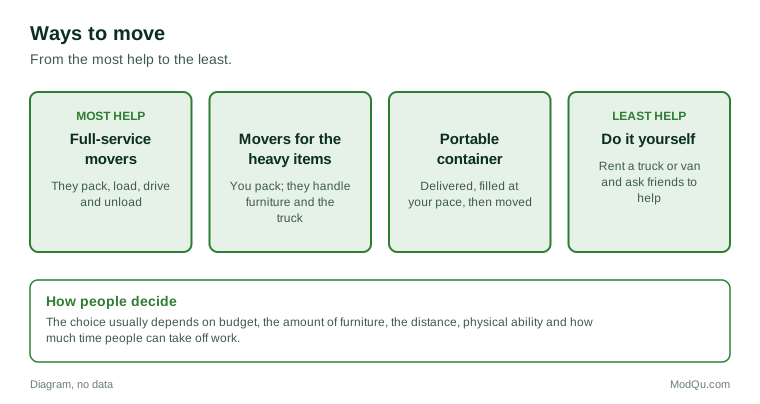
The main choice is who does the heavy lifting:
- Full-service movers pack, load, transport and unload. This costs the most but saves the most time and effort.
- Load-and-move services where the household packs and movers handle the furniture and truck.
- Portable storage containers delivered to the home, filled by the household and moved by the company.
- Renting a truck or van and moving with friends and family.
- Hiring labour only, people to load and unload a rented truck.
- Shipping by freight, sometimes used for long-distance moves.
People's choice usually depends on budget, the amount of furniture, distance, physical ability and time off work.
Example
A young couple moving from a one-bedroom apartment across town rents a cargo van for a day and asks three friends to help, paying them in pizza. For the large sofa and the stairs at the new place, they hire two movers for two hours. They say the mix saved money without anyone getting hurt.
What a move costs
Moving costs vary widely with distance, the amount of belongings, the time of year and the services used. Common costs include:
- movers or truck rental, plus fuel and kilometre charges;
- packing materials, such as boxes, tape and padding;
- storage, if the old and new homes do not line up;
- cleaning the old home, sometimes needed to get a deposit back;
- connection fees for utilities, internet and phone;
- travel, meals and hotels for long moves;
- time off work;
- new furniture and items for the new home.
Summer, month ends and weekends are the busiest times for movers, and prices are often higher. Booking early or moving midweek can lower the cost.
Example (hypothetical figures)
A family of four moves across a city. Movers charge $160 an hour for three workers and a truck, and the job takes seven hours, costing $1,120. Boxes and materials cost $180, cleaning the old home costs $250 and internet installation costs $60. The total is $1,610, more than the $1,200 they had set aside.
Choosing movers and avoiding scams
Moving scams are a known problem. Common warning signs include:
- a very low quote given over the phone without seeing the belongings;
- a large deposit demanded upfront;
- no written estimate or contract;
- no physical address or a changing company name;
- belongings held until the customer pays much more than quoted.
People are often advised to get several written estimates, check reviews, confirm insurance, and understand whether the estimate is binding. The Competition Bureau of Canada and provincial consumer protection offices have issued warnings about moving fraud.
Example
A man moving to another province gets three quotes. One is far lower than the others and asks for half the price as a cash deposit. He chooses a company that sends someone to see his belongings, gives a written estimate and explains its insurance, even though it costs more.
Setting up after the move
Once the boxes are inside, there is a long list of things to change. People often find these the hardest:
- internet and phone, especially when installation dates are weeks away;
- utilities such as electricity, gas and water;
- mail forwarding through Canada Post;
- address changes with banks, employers, the Canada Revenue Agency, insurance companies and subscriptions;
- driver's licence and vehicle registration, and health card if moving provinces;
- finding a new family doctor, dentist, school or child care;
- getting to know a new neighbourhood.
Moving to a new province adds steps such as a new health card, which in some provinces involves a waiting period before coverage begins.
Example
A nurse moves from one province to another for a new job. Her furniture arrives in four days, but internet takes two weeks and finding a family doctor takes much longer. She keeps a list on her phone of every account she has updated and adds to it whenever a letter arrives at the old address.
Emotional side of moving
Moving can be exciting and also stressful. Common feelings include worry about money, sadness at leaving neighbours and friends, and tiredness from packing and unpacking. Children may need to change schools. Older adults downsizing may have to sort through decades of belongings and memories. Some people hire professional organizers or senior move managers to help. Others find that settling in, meeting neighbours and finding new routines takes months, long after the last box is unpacked.
What people disagree about
Opinion is divided on whether hiring movers is worth the cost, whether moving companies should be more tightly regulated, how much notice landlords should give, and whether governments should help people who move for work or affordable housing. Survey questions help show how moving experiences differ by distance, age and household type.
Key terms
- Binding estimateA moving quote that sets the price, unless the job changes.
- Non-binding estimateA moving quote that can change based on the actual work.
- Full-service moveMovers pack, load, transport and unload.
- Portable storage containerA container delivered to your home, filled by you and moved by a company.
- Mail forwardingRedirecting mail from your old address to your new one.
- InventoryA list of the items being moved.
- DownsizingMoving to a smaller home.
- Valuation coverageProtection for belongings damaged or lost during a move.
Full glossary: moving services terms on EditingTests.com.
Moving house vocabulary test
How well do you know the language of this topic? Try 8 quick questions. Your score is shown straight away and is not saved.
What the moving house survey asks
This survey is part of ModQu's Home and Property survey. The moving house part takes about five minutes and covers:
- Whether you moved in the last two years, and how far.
- Whether you hired movers, rented a truck or moved yourself.
- What the move cost in total, and how that compared with your budget.
- How you chose a moving company, if you used one.
- What was hardest to set up after moving.
- Whether you plan to move again in the next two years.
After that you can choose to continue with other short parts of the Home and Property survey, such as buying a home or renting, or stop.
Ready to take part?
Your answers help show what people really think and do. Results are only ever reported as totals; no one can see your individual answers.
Start the surveyQuestions about this survey
Who can take part?
People who moved in the last two years.
Do I have to give my name?
No. You may be asked for your age group, region and similar details so results can be broken down, but not your name. ModQu never asks for passwords, card numbers or account numbers.
How are the results used?
Answers are combined into totals and percentages and published in ModQu reports. Individual answers are never shown.
Is the vocabulary test part of the survey?
No. It is optional and separate, and your score is not stored.
Do I need to have moved recently to take part?
The survey is mainly for people who moved in the last two years, but others can answer questions about plans to move.