
Share your views on housing costs
Tell us how affordable housing is where you live, how it has affected your plans and which policies you think would help. Your answers are combined with other people's and reported only as totals.
Start the housing affordability surveyAbout 5 minutes. No account needed. You can stop at any time.
What this topic covers
Housing affordability is about whether people can pay for a suitable home without giving up other necessities. It applies to both renters and owners, and to people who are trying to enter the housing market or stay in it. This topic covers:
- how affordability is measured;
- why housing costs rise or fall;
- who is most affected;
- how housing costs shape life decisions;
- public policies at the federal, provincial and municipal levels;
- what people think should be done.
Buying, renting and condo living each have their own pages. This page looks at the wider picture and public attitudes.
How affordability is measured
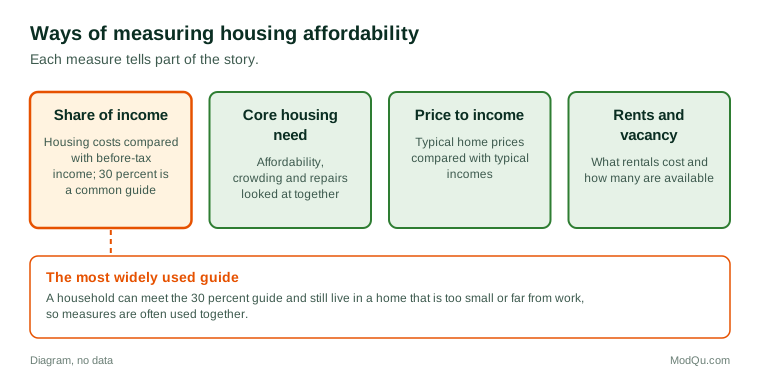
Several measures are commonly used:
- Share of income spent on housing. In Canada, housing is often considered affordable if it costs less than 30 percent of a household's before-tax income, a benchmark used by the Canada Mortgage and Housing Corporation (CMHC).
- Core housing need, a CMHC measure of households whose housing is unaffordable, too small or in need of major repairs, and who could not afford a suitable home nearby.
- Price-to-income ratios, comparing typical home prices with typical incomes.
- Rent and vacancy rates, showing how hard it is to find a rental and what it costs.
- Ownership costs, including mortgage payments, property taxes, insurance and maintenance.
Each measure tells part of the story. A household can meet the 30 percent benchmark and still live in a home that is too small, or far from work.
Example (hypothetical figures)
Two households each earn $80,000 a year, or about $6,667 a month. One pays $1,900 a month in rent, which is 28.5 percent of income. The other pays $2,600 a month in mortgage, property tax and insurance, which is 39 percent. By the 30 percent benchmark, the first is within the guide and the second is not, even though the second is building equity.
Why housing costs change
Housing costs are affected by many factors, and experts weigh them differently:
- supply: how many homes are built, and how fast;
- demand: population growth, immigration, household size and where jobs are;
- interest rates, which affect mortgage payments and how much buyers can borrow;
- zoning and approvals, which affect what can be built where and how long it takes;
- construction costs, including land, materials, labour and fees;
- investment demand, from people buying homes as investments;
- incomes, which may not rise as quickly as prices.
Housing markets also differ a lot across Canada. Costs in large cities and some smaller communities have risen far faster than in other areas, so affordability depends heavily on where a person lives and when they entered the market.
Who is most affected
Housing costs weigh more heavily on some groups:
- young adults trying to move out or buy a first home;
- renters with low incomes, especially single-income households;
- newcomers who have no credit history or local references;
- older adults on fixed incomes, especially renters;
- people with disabilities, who also need accessible housing;
- single parents;
- people living in high-cost cities who work in lower-paid jobs.
Homelessness is the most severe outcome of unaffordable housing, and has become more visible in many Canadian communities.
How housing costs shape life decisions
Housing costs affect choices well beyond the home itself. People report delaying or changing:
- moving out of a parent's home;
- having children, or having more children;
- living alone, choosing roommates or multigenerational living instead;
- where to live, moving farther from work or to another city or province;
- changing jobs, if a move would mean higher housing costs;
- retiring, if housing costs remain high;
- saving for retirement, when most income goes to housing.
Example
A couple in their early thirties both work full time in a large city. They want two children but live in a one-bedroom apartment. After comparing rents and prices, they move to a smaller city two hours away, where one of them can work remotely. They say the decision was about space for a family more than any other reason.
Example
A woman in her twenties moves back to her parents' home after her rent rises. She plans to stay a year to save for a deposit on a shared rental. Her parents are glad to help, though the family says the house now feels crowded.
Policies that are debated
Governments in Canada have tried many approaches, and people disagree about which work best:
- building more homes, including changes to zoning to allow more units on a lot, such as secondary suites and small apartment buildings;
- building and funding social, co-operative and non-profit housing;
- rent controls and stronger tenant protections;
- help for first-time buyers, such as tax-free savings accounts and changes to mortgage rules;
- taxes on vacant homes, foreign buyers or homes sold quickly after purchase;
- limits on short-term rentals;
- housing benefits paid to renters with low incomes.
Some policies aim to increase supply over the long term; others aim to help people now. Some people worry that help for buyers raises demand and prices, while others worry that new buildings will change their neighbourhoods.
Example
At a city council meeting about allowing fourplexes on residential streets, one resident says more homes are needed for their grown children. Another worries about parking and shade on their garden. A third, who rents, says they would welcome more choice. All three say housing is too expensive, but they disagree on what to do.
What people disagree about
Beyond specific policies, opinion is divided on whether housing should be treated mainly as a home or an investment, how much governments should intervene, whether immigration levels should be linked to housing supply, and how to balance the interests of owners, renters and future residents. These views tend to differ by age, region and whether people own or rent.
Key terms
- AffordabilityWhether people can pay for suitable housing without giving up other necessities.
- Core housing needA CMHC measure of households in unaffordable, crowded or poor housing.
- Price-to-income ratioHome prices compared with household incomes.
- ZoningMunicipal rules on what can be built where.
- Social housingHousing owned or funded by governments or non-profits for lower-income households.
- Housing supplyThe number of homes available or being built.
- Vacancy taxA tax on homes left empty.
- Secondary suiteA separate living unit within or beside a house.
Full glossary: affordable housing development terms on EditingTests.com.
Housing affordability vocabulary test
How well do you know the language of this topic? Try 8 quick questions. Your score is shown straight away and is not saved.
What the housing affordability survey asks
This survey is part of ModQu's Home and Property survey. The housing affordability part takes about five minutes and covers:
- How affordable you find housing where you live.
- What share of your income goes to housing, in ranges.
- Whether housing costs have delayed or changed a major life decision for you.
- Whether you have moved, or considered moving, because of housing costs.
- Which policies you think would help most.
- How you expect housing costs to change in the next five years.
After that you can choose to continue with other short parts of the Home and Property survey, such as buying a home or renting, or stop.
Ready to take part?
Your answers help show what people really think and do. Results are only ever reported as totals; no one can see your individual answers.
Start the surveyQuestions about this survey
Who can take part?
Adults.
Do I have to give my name?
No. You may be asked for your age group, region and similar details so results can be broken down, but not your name. ModQu never asks for passwords, card numbers or account numbers.
How are the results used?
Answers are combined into totals and percentages and published in ModQu reports. Individual answers are never shown.
Is the vocabulary test part of the survey?
No. It is optional and separate, and your score is not stored.
Is this survey only for people who struggle with housing costs?
No. Everyone's views are useful, including people who own outright and people who find housing affordable.