
Intelligence · Market and competitive intelligence
"Market Intelligence: Understanding Size, Trends and Dynamics"
Market intelligence tells an organisation how big its market is, how it is changing and why. This article explains how markets are sized, how trends are tracked and forecast, how markets evolve over time, and how organisations turn market information into decisions.
Every business decision about where to compete rests on beliefs about markets. How many potential customers are there? How fast is demand growing? Which segments are expanding and which are shrinking? What forces will change the market in the next five years? Market intelligence is the organised effort to answer these questions with evidence rather than assumption. It covers the size and structure of markets, the trends that move them, and the dynamics of how they grow, mature and change. This article explains how market intelligence is produced and used, and what research shows about its value.
Market intelligence and market orientation
Market intelligence is closely linked to the idea of market orientation. Kohli and Jaworski (1990) defined market orientation as the organisation-wide generation of market intelligence about current and future customer needs, its dissemination across departments, and the organisation's responsiveness to it. In their view, a market-oriented company is one that continually gathers intelligence about customers, competitors and the forces affecting them, shares it widely and acts on it.
Narver and Slater (1990) described market orientation in terms of customer orientation, competitor orientation and coordination across functions, and found that it was associated with higher profitability among the businesses they studied. Jaworski and Kohli (1993) found that market orientation was linked to better overall performance and to higher employee commitment, and that it depended on senior management emphasis, the connections between departments and reward systems that encourage attention to the market.
A meta-analysis by Kirca et al. (2005), combining results from many studies, confirmed a positive relationship between market orientation and performance, with the effect working partly through innovation, customer loyalty and quality. The implication is that market intelligence matters not as a report but as a capability: the ability to learn about the market faster and more accurately than competitors and to act on that learning.
Day (1994) described market sensing as a distinctive capability of market-driven organisations: a systematic process of acquiring, interpreting and using information about the market, combined with the ability to anticipate changes rather than simply react to them. Sinkula (1994) and Slater and Narver (1995) linked market intelligence to organisational learning, arguing that the value of market information depends on how organisations interpret it, share it and store it in memory for future use.
Sizing a market
The first question market intelligence usually faces is: how big is the market? The answer depends on careful definition. Kotler and Keller (2016) distinguish several levels: the potential market of all customers with some interest in a product, the available market of those with the interest, income and access to buy it, the served market that a company chooses to pursue, and the penetrated market of customers who have already bought. Confusing these levels produces some of the most common errors in business plans, such as treating everyone who might conceivably want a product as a realistic customer.
There are two broad approaches to estimating size.
Top-down estimation
A top-down estimate starts from a large known figure, such as total population, total industry sales or government statistics, and narrows it by applying percentages for the relevant segment. For example, a company selling software to dental practices might start with the number of practices in a country from official business statistics, estimate the share large enough to need the software, and multiply by the expected annual spend. Top-down estimates are quick, but each percentage is an assumption, and small errors compound.
Bottom-up estimation
A bottom-up estimate builds from the unit level: the number of customers in each segment, how often they buy and how much they spend each time, derived from surveys, sales data or interviews. Bottom-up estimates take more effort but expose assumptions more clearly and are usually more reliable for specific segments.
Good practice uses both and compares them. When top-down and bottom-up estimates differ greatly, the gap points to assumptions that need checking. Armstrong (2001), summarising principles of forecasting, recommends combining estimates from different methods, because errors in independent methods tend to offset each other.
Segmenting the market
A single figure for market size hides the differences that matter most for strategy. Markets are made up of segments: groups of customers with similar needs, behaviours or circumstances who respond to an offer in similar ways. Kotler and Keller (2016) describe segmentation by geography, demographics, psychographics such as lifestyle and values, and behaviour such as usage rate, loyalty and the benefits sought. In business markets, segments may be defined by industry, company size, buying process or application.
Segmentation turns market intelligence into choices. A market growing at 3% overall may contain one segment growing at 15% and another shrinking. A segment that is small today may be the one where new competitors are gaining a foothold. Good segment definitions are measurable, so that their size can be estimated; reachable, so that the company can serve them; and meaningfully different, so that they call for different products, prices or messages. Intelligence teams should track size, growth and profitability by segment, not only for the market as a whole.
Tracking trends
Markets change continuously, and much of market intelligence consists of monitoring that change. Aguilar (1967), in an early study of how managers gathered information about their environment, found that most relied on personal contacts and informal sources, and that systematic environmental scanning was rare. Aguilar proposed organised scanning across economic, technical, political and social factors, a precursor of later frameworks such as PESTLE analysis. Choo (1996) later described how organisations use information to make sense of changes in their environment, create knowledge and make decisions, emphasising that scanning is valuable only if it feeds into interpretation and action.
Montgomery and Weinberg (1979) proposed strategic intelligence systems that would gather information about the market environment systematically, rather than leaving it to chance. They argued that such systems should be designed around the strategic decisions they support, a principle that remains central to market intelligence today.
Typical sources of trend information include:
- Official statistics on population, incomes, household spending, industry output and trade.
- Industry data from trade associations, regulators and published reports.
- Company data, including sales, enquiries, website visits and search terms, which often reveal shifts earlier than external sources.
- Primary research, such as surveys and interviews with customers and non-customers, which can explain why behaviour is changing.
- Expert and frontline knowledge, from sales staff, distributors and suppliers who see changes before they appear in statistics.
The value of trend information lies less in collecting it than in distinguishing durable shifts from passing fluctuations. Gilad (2004) argues that the purpose of market and competitive intelligence is early warning: identifying signals of change while there is still time to respond, rather than documenting changes after they have happened.
Market dynamics: how markets grow and change
Diffusion of new products
New products do not reach their full market at once. Rogers (2003), synthesising decades of research on the diffusion of innovations, described how adoption spreads through a population from innovators and early adopters to the majority and finally to laggards, with the pace influenced by the product's relative advantage, compatibility with existing practices, complexity, trialability and observability.
Bass (1969) expressed this process mathematically. In the Bass diffusion model, adoption is driven by two forces: innovation, the tendency of some people to adopt independently, for example in response to advertising; and imitation, the tendency to adopt because others have. Early in a product's life, innovation dominates and sales grow slowly; as adopters accumulate, imitation accelerates growth; eventually, as the remaining potential shrinks, sales peak and decline. Figure 1 shows the characteristic S-shaped curve of cumulative adoption and the bell-shaped curve of new adoption.
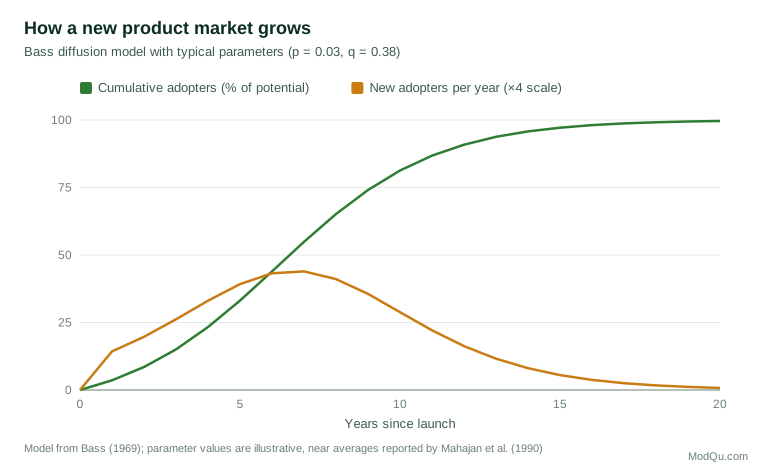
Mahajan et al. (1990) reviewed applications of diffusion models in marketing and reported that the imitation effect is usually much larger than the innovation effect, so word of mouth and visible adoption drive most growth. Diffusion models are useful for market intelligence because they can be estimated from a few years of early sales data, or by analogy with similar products, to forecast when a market will peak.
Market life cycles and disruption
Markets themselves pass through stages of introduction, growth, maturity and decline, each with different competitive conditions. Porter (1980) described how industry structure changes as markets evolve: growth attracts entrants, maturity brings consolidation and price competition, and decline forces exits or a search for profitable niches.
Christensen (1997) identified a pattern that market intelligence often misses. Disruptive innovations begin as inferior products serving small or low-value segments that established companies ignore. Because established companies listen closely to their best customers, who do not want the new product, they rationally underinvest in it. The disruptive product then improves until it meets the needs of mainstream customers, and the established companies lose their markets. The lesson for market intelligence is that the most important trends may first appear in segments that current sales data and customer feedback do not cover.
Understanding why customers buy
Christensen et al. (2016) argue that markets are better understood by the "jobs" customers are trying to get done than by product categories or demographic segments. A customer does not want a drill but a hole; a commuter buying a milkshake may want something to make a long drive less boring. Defining markets by jobs reveals competitors and opportunities that category-based market sizing misses.
Common errors
Several errors recur in market intelligence work:
- The top-down trap. Business plans often assume that capturing a small percentage of a very large market is easy. The large figure is usually the potential market, not the available or served market, and winning even a small share requires reasons for customers to switch.
- Extrapolating straight lines. Growth rates observed early in a product's life rarely continue indefinitely. Diffusion curves flatten as markets saturate, and forecasting by simple extrapolation overstates long-term demand.
- Listening only to current customers. Current customers are the easiest to study, but they reveal little about non-customers or emerging segments, which is where Christensen (1997) found the most dangerous changes begin.
- Confusing stated and actual behaviour. People's statements about what they would buy are useful but optimistic; survey results should be calibrated against actual purchase data where possible.
- Stale numbers. Market sizes quoted from old reports are repeated long after conditions have changed. Every estimate should carry its date and source.
- Precision without accuracy. A market estimate given to the nearest thousand dollars implies a certainty that does not exist. Ranges communicate the real state of knowledge better.
Turning market information into decisions
Research on market orientation shows that information has value only when it is shared and used. Moorman (1995) studied how organisations process market information and found that the cultural characteristics of firms affected how they acquired, transmitted and used it, and that the use of information, not merely its acquisition, was associated with better new product outcomes. Cohen and Levinthal (1990) described an organisation's absorptive capacity: its ability to recognise the value of new external information, assimilate it and apply it. Absorptive capacity depends on prior knowledge; organisations that already understand their markets are better at learning from new market intelligence.
Calof and Wright (2008) note that market and competitive intelligence practice has developed separately in different disciplines, from marketing to information science, and that organisations benefit from combining their perspectives.
Several practices help market intelligence influence decisions:
- Start from decisions. Identify the market questions behind upcoming decisions, such as entering a new region or launching a product, and focus collection on them.
- Define the market carefully. State which customers, needs and geographies are included, and keep definitions consistent over time.
- Triangulate. Compare estimates from different methods and sources; investigate large discrepancies.
- State uncertainty. Present market sizes and forecasts as ranges with the main assumptions, not single precise numbers.
- Watch the edges. Monitor segments, technologies and competitors outside the current core, where disruptive change often begins.
- Track forecasts against outcomes. Tetlock and Gardner (2015) found that forecasters improve when they keep score; organisations can do the same by recording market forecasts and comparing them with what happens.
An illustration
A Canadian manufacturer of home heating equipment wants to know whether to invest in heat pumps. A top-down estimate begins with the number of homes in its regions, the share heated by oil or electric baseboard, and the typical replacement cycle of heating systems. A bottom-up estimate uses a survey of homeowners about their plans, combined with sales data from the company's dealers. The two estimates differ by about 40%, and investigation shows that the top-down estimate assumed every replaced system was a candidate, while the survey revealed that many homeowners in older homes doubted heat pumps would work in very cold weather.
Trend monitoring adds context: government rebate programmes, rising fuel prices and improving cold-climate performance are all pushing adoption up. Early sales data, fitted to a diffusion model, suggest that adoption is still in its early, slow-growth phase, with rapid growth likely within a few years if word of mouth spreads. The intelligence team presents a range of market forecasts with the key uncertainties, cold-weather performance and the continuation of rebates, and recommends investing in demonstration installations to accelerate imitation effects. Over the following years it tracks actual adoption against the forecast range and updates its estimates. It also tracks the segments where adoption is fastest, which turn out to be newer suburban homes and rural homes previously heated by oil, and shifts its dealer training and marketing towards them.
Conclusion
Market intelligence answers fundamental questions about how big a market is, how it is changing and why. It combines careful definitions, multiple estimation methods, continuous monitoring of trends and an understanding of the dynamics by which markets grow, mature and are disrupted. Research on market orientation shows that organisations which generate, share and act on market intelligence tend to perform better. The key is to treat market intelligence not as a one-time report but as a continuing capability for learning about the market and acting on what is learned.
References
Aguilar, F. J. (1967). Scanning the business environment. Macmillan.
Armstrong, J. S. (Ed.). (2001). Principles of forecasting: A handbook for researchers and practitioners. Kluwer Academic.
Bass, F. M. (1969). A new product growth for model consumer durables. Management Science, 15(5), 215–227. https://doi.org/10.1287/mnsc.15.5.215
Calof, J. L., & Wright, S. (2008). Competitive intelligence: A practitioner, academic and inter-disciplinary perspective. European Journal of Marketing, 42(7/8), 717–730. https://doi.org/10.1108/03090560810877114
Choo, C. W. (1996). The knowing organization: How organizations use information to construct meaning, create knowledge and make decisions. International Journal of Information Management, 16(5), 329–340. https://doi.org/10.1016/0268-4012(96)00020-5
Christensen, C. M. (1997). The innovator's dilemma: When new technologies cause great firms to fail. Harvard Business School Press.
Christensen, C. M., Hall, T., Dillon, K., & Duncan, D. S. (2016). Know your customers' "jobs to be done." Harvard Business Review, 94(9), 54–62.
Cohen, W. M., & Levinthal, D. A. (1990). Absorptive capacity: A new perspective on learning and innovation. Administrative Science Quarterly, 35(1), 128–152. https://doi.org/10.2307/2393553
Day, G. S. (1994). The capabilities of market-driven organizations. Journal of Marketing, 58(4), 37–52. https://doi.org/10.1177/002224299405800404
Gilad, B. (2004). Early warning: Using competitive intelligence to anticipate market shifts, control risk, and create powerful strategies. AMACOM.
Jaworski, B. J., & Kohli, A. K. (1993). Market orientation: Antecedents and consequences. Journal of Marketing, 57(3), 53–70. https://doi.org/10.1177/002224299305700304
Kirca, A. H., Jayachandran, S., & Bearden, W. O. (2005). Market orientation: A meta-analytic review and assessment of its antecedents and impact on performance. Journal of Marketing, 69(2), 24–41. https://doi.org/10.1509/jmkg.69.2.24.60761
Kohli, A. K., & Jaworski, B. J. (1990). Market orientation: The construct, research propositions, and managerial implications. Journal of Marketing, 54(2), 1–18. https://doi.org/10.1177/002224299005400201
Kotler, P., & Keller, K. L. (2016). Marketing management (15th ed.). Pearson.
Mahajan, V., Muller, E., & Bass, F. M. (1990). New product diffusion models in marketing: A review and directions for research. Journal of Marketing, 54(1), 1–26. https://doi.org/10.1177/002224299005400101
Montgomery, D. B., & Weinberg, C. B. (1979). Toward strategic intelligence systems. Journal of Marketing, 43(4), 41–52. https://doi.org/10.1177/002224297904300405
Moorman, C. (1995). Organizational market information processes: Cultural antecedents and new product outcomes. Journal of Marketing Research, 32(3), 318–335. https://doi.org/10.1177/002224379503200307
Narver, J. C., & Slater, S. F. (1990). The effect of a market orientation on business profitability. Journal of Marketing, 54(4), 20–35. https://doi.org/10.1177/002224299005400403
Porter, M. E. (1980). Competitive strategy: Techniques for analyzing industries and competitors. Free Press.
Rogers, E. M. (2003). Diffusion of innovations (5th ed.). Free Press.
Sinkula, J. M. (1994). Market information processing and organizational learning. Journal of Marketing, 58(1), 35–45. https://doi.org/10.1177/002224299405800103
Slater, S. F., & Narver, J. C. (1995). Market orientation and the learning organization. Journal of Marketing, 59(3), 63–74. https://doi.org/10.1177/002224299505900306
Tetlock, P. E., & Gardner, D. (2015). Superforecasting: The art and science of prediction. Crown.