
Intelligence · Market and competitive intelligence
"Porter's Five Forces as an Intelligence Framework"
Porter's five forces model explains why some industries are more profitable than others. This article explains the model, the evidence for and against it, its main criticisms, and how intelligence teams can turn it from a one-off strategy exercise into a continuing monitoring framework.
Why do airlines struggle to earn their cost of capital while software companies and soft drink makers earn high returns year after year? Michael Porter's answer, first published in 1979, was that profitability depends heavily on the structure of an industry: on five competitive forces that determine how much of the value created in an industry its firms can keep. The five forces model became one of the most widely taught frameworks in business strategy. It is also, used properly, a powerful framework for intelligence: it tells analysts which features of an industry to watch and why changes in them matter.
This article explains the model, reviews the evidence about how much industry structure matters, considers its criticisms and shows how intelligence teams can use it as a continuing monitoring tool rather than a one-off exercise.
The five forces
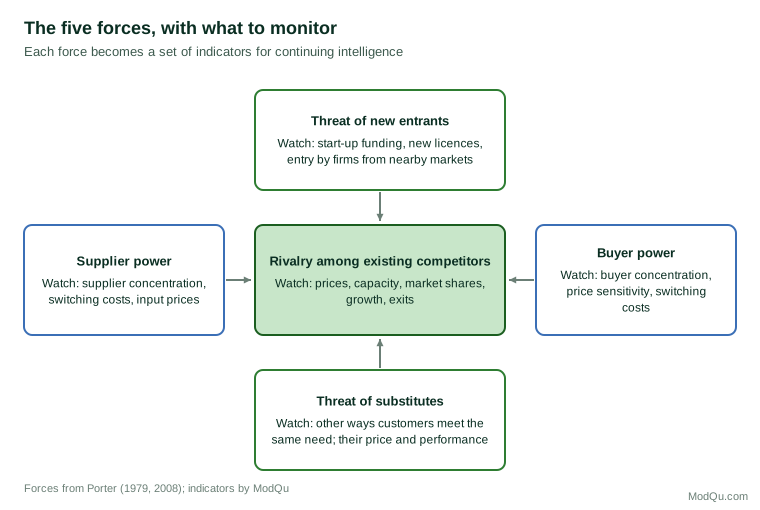
Porter (1979, 1980) argued that competition in an industry extends beyond existing rivals. Five forces together determine the intensity of competition and therefore the industry's profit potential, as shown in Figure 1.
Rivalry among existing competitors
Rivalry is intense when competitors are numerous or of similar size, when industry growth is slow, when products are hard to differentiate, when fixed costs are high and when exit is difficult. Intense rivalry, especially on price, transfers value from firms to customers.
Threat of new entrants
New entrants add capacity and compete for share. Their threat depends on barriers to entry, a concept developed by Bain (1956): economies of scale, the capital required, access to distribution, brand loyalty, proprietary technology and government regulation. High barriers protect incumbents' profits; low barriers mean that high profits attract entry until they are competed away.
Threat of substitutes
Substitutes are products from outside the industry that meet the same need: video calls for business travel, plastic for glass, streaming for cinema. Their threat depends on their relative price and performance and on customers' costs of switching. Substitutes place a ceiling on the prices an industry can charge.
Bargaining power of buyers
Buyers are powerful when they are concentrated, purchase in large volumes, face low switching costs, can credibly produce the product themselves or are highly price-sensitive. Powerful buyers push down prices and demand more quality or service.
Bargaining power of suppliers
Suppliers are powerful when they are more concentrated than the industry they sell to, when their inputs are differentiated or critical, when switching suppliers is costly, or when they could credibly enter the industry themselves. Powerful suppliers capture value by raising prices or reducing quality.
Porter (2008), revisiting the model, emphasised several points that are often misunderstood. Industry growth rate, technology, government and complementary products are not forces in themselves but factors that affect the five forces. The model should be applied to a clearly defined industry. And the strongest forces, not all five equally, usually determine profitability.
How much does industry matter?
The five forces model assumes that industry structure has a large effect on profitability. Empirical research has tested this claim by decomposing the variation in firm profits into industry effects, firm-specific effects and other factors.
Rumelt (1991), analysing American manufacturing firms, found that firm-specific effects, the differences between businesses within the same industry, explained far more of the variation in profitability than industry effects. Rumelt's results suggested that what a firm does matters more than which industry it is in. McGahan and Porter (1997), using a broader dataset including service industries, found larger industry effects, accounting for a substantial share of explained variation, with the importance of industry differing across sectors. Hawawini et al. (2003) found that for most firms industry effects mattered, but that for a small number of exceptional leaders and laggards, firm-specific factors dominated.
The broad conclusion is that both industry and firm matter. Industry structure sets the conditions within which firms compete, but firm-specific resources and strategy explain much of the difference in performance within an industry. Barney (1991) emphasised this second point in the resource-based view: sustained advantage comes from resources that are valuable, rare, hard to imitate and well organised. For intelligence purposes, this means analysing both the forces shaping the industry and the resources and strategies of particular competitors.
Criticisms and extensions
The five forces model has attracted several criticisms.
It is static. The model describes industry structure at a point in time, while industries change constantly. Christensen (1997) showed how disruptive technologies can transform industries from below, in ways that analysis of current structure may not reveal. Grundy (2006) argued that the model needs to be applied dynamically, considering how forces are likely to change and what drives the changes.
It emphasises competition over cooperation. Brandenburger and Nalebuff (1996) proposed adding complementors, firms whose products make one's own more valuable, such as software for computers or charging networks for electric vehicles. Their "value net" recognises that firms may compete and cooperate at the same time.
It underplays network effects and platforms. Shapiro and Varian (1999) explained how network effects, where a product becomes more valuable as more people use it, create winner-take-most dynamics in information industries. Platform businesses blur the boundaries between buyers, suppliers and competitors.
Industry boundaries are unclear. Defining "the industry" is itself a judgement. Porac and Thomas (1990) showed that managers' mental models of their competitive set can be narrow, excluding firms that later prove important.
It can become a box-ticking exercise. Mintzberg (1994) criticised formal strategic planning for substituting analysis for strategic thinking. A five forces analysis completed once for a strategy document, then filed, has little value.
Grant (2016) summarises the practical view that remains widely accepted: the five forces model is a useful starting point for analysing industry attractiveness and the sources of competitive pressure, provided it is applied dynamically and combined with analysis of firms' resources and of cooperative as well as competitive relationships.
From industry to position
Industry analysis answers the question of how attractive an industry is. A second question is how a firm should position itself within it. Porter (1985) addressed this with the idea of competitive advantage, achieved either through lower cost or through differentiation that allows a premium price, and with the value chain, which breaks a firm's activities into primary activities such as operations, logistics, marketing and service, and support activities such as technology and procurement. Advantage arises from performing these activities more cheaply or in ways that create more value for buyers.
For intelligence, the value chain links industry forces to individual firms. A rise in supplier power affects firms differently depending on how their procurement and operations are organised. A substitute threatens some firms' products more than others. Mapping competitors' value chains, using public information about their facilities, suppliers, channels and service models, shows which rivals are most exposed to changes in each force and which are best placed to exploit them. The same mapping helps a firm see where its own position is strong or weak as the industry changes.
Applying the model in services and digital markets
The five forces model was developed mainly from studies of manufacturing industries, but its logic applies elsewhere with some adjustments.
In professional services, such as accounting or consulting, the key assets are people. Supplier power then includes the bargaining power of skilled staff, who can leave and take clients with them. Entry barriers depend more on reputation and relationships than on capital.
In digital markets, network effects can make entry barriers very high once a platform is established, yet very low before any platform has won. Shapiro and Varian (1999) describe how competition in such markets is often a contest to build an installed base quickly, after which switching costs and network effects protect the leader. Buyers and suppliers may be the same people, as in marketplaces where users both sell and buy.
In regulated industries, such as utilities, telecommunications or health care, government decisions on prices, licences and standards can outweigh all five forces. Porter (2008) treats government as a factor acting through the forces rather than a sixth force, but in practice intelligence teams in these industries devote much of their monitoring to regulators.
In each case, the core questions remain the same: who captures the value the industry creates, and what could change that?
From strategy exercise to intelligence framework
The main limitation of the five forces model in practice is not conceptual but procedural: it is usually applied once, at a moment of strategic planning. Its greatest value for intelligence comes from turning each force into a set of indicators that are monitored continuously.
Indicators for each force
For each force, the intelligence team identifies observable indicators that would signal change:
- New entrants: venture capital funding in the sector, new business registrations, regulatory approvals and licences, announcements by firms in adjacent markets, falling costs of key technologies.
- Substitutes: price and performance trends of alternative solutions, adoption rates, customer survey data on alternatives considered.
- Buyer power: consolidation among customers, growth of purchasing groups or online comparison tools, changes in customers' switching costs.
- Supplier power: consolidation among suppliers, shortages or price increases in key inputs, suppliers' moves into the industry.
- Rivalry: price movements, capacity additions, market share changes, new product launches, exits, mergers.
Ansoff (1975) argued that strategic surprises are usually preceded by weak signals: early, ambiguous indications of change. Monitoring indicators for each force is a structured way of catching weak signals before they become obvious. Aguilar (1967) found that most managers scanned their environment informally and unevenly; a five forces indicator set makes scanning systematic.
Linking forces to competitor behaviour
Changes in forces affect competitors differently. A rise in supplier power hurts firms with weak purchasing positions more than those with long-term contracts. Chen (1996) showed that rivalry is most intense between firms with overlapping markets and similar resources, so changes in industry structure often trigger competitive responses among such firms. Zajac and Bazerman (1991) warned that managers often neglect how rivals will react to industry changes and to their own moves, leading to collective outcomes, such as overcapacity, that no firm intended. Intelligence should therefore connect industry-level indicators to competitor-level profiles.
Early warning
Gilad (2004) describes early warning as the central purpose of competitive intelligence: identifying risks and opportunities early enough to act. A five forces indicator set supports early warning by defining in advance which changes matter and what thresholds should trigger an alert. For example, a fall of more than a certain percentage in the price of a substitute technology, or the entry of a major firm from an adjacent market, might trigger a review of strategy.
Fleisher and Bensoussan (2015) recommend combining industry analysis with other techniques, such as scenario analysis, to explore how combinations of changes in forces might reshape an industry.
An illustration: grocery delivery
Consider a regional grocery chain analysing its industry. A traditional five forces analysis might conclude that rivalry is intense but stable among a few large chains, that buyer power is moderate because individual shoppers are price-sensitive but not concentrated, that supplier power varies by product, that entry barriers are high because of the scale needed for stores and distribution, and that substitutes are limited.
Used as an intelligence framework, the same analysis becomes a set of indicators. The team monitors funding for grocery delivery start-ups, entry by online retailers and delivery platforms into groceries, adoption of online ordering among its customers, consolidation among food manufacturers, and price movements among competitors. Over two years, the indicators show that online platforms are lowering entry barriers by using partnerships rather than building stores, that delivery is becoming a substitute for store visits among younger households, and that a large manufacturer is beginning to sell directly to consumers. None of these changes would have appeared in a one-off analysis. Tracked continuously, they give the chain time to develop its own delivery service and renegotiate supplier terms before its position weakens. The team also reviews each indicator once a year, dropping those that have proved uninformative and adding new ones, such as the market share of discount chains that had begun offering delivery through the same platforms. The indicator set, and the reasoning behind each item, are written down so that new analysts and managers can see why each signal is being watched.
Using the framework well
- Define the industry carefully. State which products, customers and geographies are included, and revisit the definition as boundaries shift.
- Focus on the strongest forces. Not all forces matter equally; identify the few that most determine profitability.
- Look for change, not just levels. The most valuable intelligence concerns how forces are shifting and why.
- Add complementors and platforms. Consider cooperative relationships and network effects alongside competitive pressures.
- Combine with firm analysis. Industry structure explains part of performance; competitor resources and strategies explain the rest.
- Monitor continuously. Turn each force into indicators with owners, sources and alert thresholds.
- Revisit assumptions. Record the judgements behind each assessment of a force, and check them when indicators move, so that the analysis improves over time rather than being repeated from scratch.
Conclusion
Porter's five forces model explains how industry structure shapes profitability through rivalry, entry, substitutes, buyer power and supplier power. Research shows that industry matters, though less than firm-specific factors for many companies, and critics have rightly pointed to the model's static nature and its neglect of cooperation and network effects. Its greatest value for intelligence lies in converting each force into indicators that are monitored over time. Used this way, the model becomes a framework for early warning: a disciplined way of noticing when the structure of an industry is changing, while there is still time to respond.
References
Aguilar, F. J. (1967). Scanning the business environment. Macmillan.
Ansoff, H. I. (1975). Managing strategic surprise by response to weak signals. California Management Review, 18(2), 21–33. https://doi.org/10.2307/41164635
Bain, J. S. (1956). Barriers to new competition: Their character and consequences in manufacturing industries. Harvard University Press.
Barney, J. (1991). Firm resources and sustained competitive advantage. Journal of Management, 17(1), 99–120. https://doi.org/10.1177/014920639101700108
Brandenburger, A. M., & Nalebuff, B. J. (1996). Co-opetition. Currency Doubleday.
Chen, M.-J. (1996). Competitor analysis and interfirm rivalry: Toward a theoretical integration. Academy of Management Review, 21(1), 100–134. https://doi.org/10.5465/amr.1996.9602161567
Christensen, C. M. (1997). The innovator's dilemma: When new technologies cause great firms to fail. Harvard Business School Press.
Fleisher, C. S., & Bensoussan, B. E. (2015). Business and competitive analysis: Effective application of new and classic methods (2nd ed.). Pearson Education.
Gilad, B. (2004). Early warning: Using competitive intelligence to anticipate market shifts, control risk, and create powerful strategies. AMACOM.
Grant, R. M. (2016). Contemporary strategy analysis: Text and cases (9th ed.). Wiley.
Grundy, T. (2006). Rethinking and reinventing Michael Porter's five forces model. Strategic Change, 15(5), 213–229. https://doi.org/10.1002/jsc.764
Hawawini, G., Subramanian, V., & Verdin, P. (2003). Is performance driven by industry- or firm-specific factors? A new look at the evidence. Strategic Management Journal, 24(1), 1–16. https://doi.org/10.1002/smj.278
McGahan, A. M., & Porter, M. E. (1997). How much does industry matter, really? Strategic Management Journal, 18(S1), 15–30.
Mintzberg, H. (1994). The rise and fall of strategic planning. Free Press.
Porac, J. F., & Thomas, H. (1990). Taxonomic mental models in competitor definition. Academy of Management Review, 15(2), 224–240. https://doi.org/10.5465/amr.1990.4308155
Porter, M. E. (1979). How competitive forces shape strategy. Harvard Business Review, 57(2), 137–145.
Porter, M. E. (1980). Competitive strategy: Techniques for analyzing industries and competitors. Free Press.
Porter, M. E. (1985). Competitive advantage: Creating and sustaining superior performance. Free Press.
Porter, M. E. (2008). The five competitive forces that shape strategy. Harvard Business Review, 86(1), 78–93.
Rumelt, R. P. (1991). How much does industry matter? Strategic Management Journal, 12(3), 167–185. https://doi.org/10.1002/smj.4250120302
Shapiro, C., & Varian, H. R. (1999). Information rules: A strategic guide to the network economy. Harvard Business School Press.
Zajac, E. J., & Bazerman, M. H. (1991). Blind spots in industry and competitor analysis: Implications of interfirm (mis)perceptions for strategic decisions. Academy of Management Review, 16(1), 37–56. https://doi.org/10.5465/amr.1991.4278990