
Intelligence · Market and competitive intelligence
Win-Loss Analysis as a Source of Commercial Intelligence
Every won or lost sale contains evidence about customers, competitors and the seller's own performance. This article explains how win-loss analysis collects that evidence, why sales records alone mislead, how to interview buyers and analyse the results, and how to turn findings into action.
Every competitive sale ends with a decision. A buyer has compared alternatives, weighed price, product, service and risk, and chosen one supplier over others. That decision contains some of the most valuable commercial intelligence available to any business: direct evidence of how customers judge it against its competitors, at the moment when the judgement mattered. Yet most organisations learn little from it. Lost deals are attributed to price, won deals to the salesperson's skill, and both are quickly forgotten.
Win-loss analysis is the systematic study of why competitive deals are won and lost. It collects evidence from buyers and from internal records, analyses patterns across many decisions and feeds the findings to sales, marketing, product and leadership teams. This article explains how to do it well.
Why win-loss analysis matters
Win-loss analysis sits at the intersection of customer research and competitive intelligence. It reveals what buyers value, how they perceive competitors, where the seller's offer or process falls short, and how competitors are positioning themselves. Gilad (2004) and Fleisher and Bensoussan (2015) both treat it as one of the most direct sources of competitive intelligence, because it draws on people who have just evaluated the competitors in detail.
It is also a source of organisational learning. Argyris and Schön (1978) distinguished single-loop learning, correcting errors within existing assumptions, from double-loop learning, questioning the assumptions themselves. A sales team that responds to every lost deal by cutting prices is engaged in single-loop learning. Win-loss analysis can prompt double-loop learning by showing that the assumption that "we lose on price" is often wrong.
Why internal records mislead
Most organisations already record a reason for each lost deal in their customer relationship management system, usually chosen by the salesperson from a short list. These records are a poor guide to why deals were actually lost.
Self-serving attribution. Miller and Ross (1975) reviewed evidence that people tend to attribute successes to their own efforts and failures to external factors. Salespeople are no exception. Losses are attributed to price, product gaps or a competitor's unfair tactics, factors outside the salesperson's control, more often than to the quality of the sales process. Figure 1 shows a hypothetical but typical pattern.
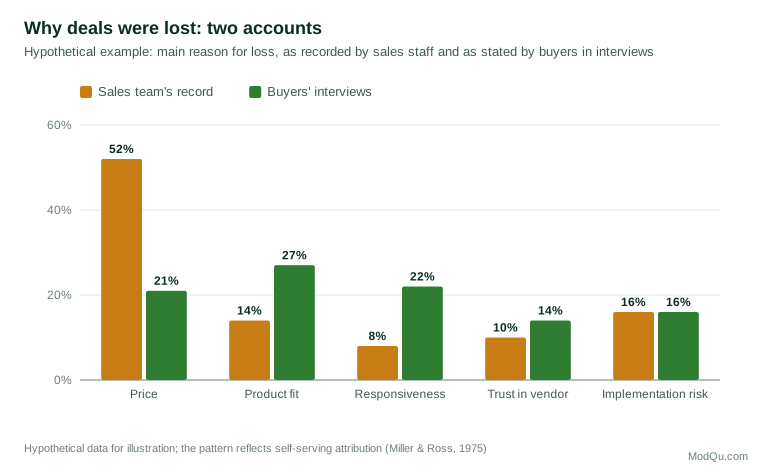
Hindsight. Fischhoff (1975) showed that once people know an outcome, they believe it was more predictable than it was and reconstruct their memories to fit it. A salesperson who lost a deal may genuinely remember the warning signs as clearer than they were, or forget signals that pointed the other way.
Limited access. Even an honest salesperson may not know why a deal was lost. Buyers rarely give their full reasons to the losing vendor, and the salesperson sees only part of the buying process.
Price as a polite answer. Buyers often cite price when declining a vendor because it is easy to say and avoids criticism. "Your price was higher" is less awkward than "we did not trust your team to deliver".
For these reasons, win-loss analysis relies mainly on evidence gathered directly from buyers, by someone other than the salesperson involved.
Collecting evidence from buyers
Interviews
The richest source is a structured interview with the people who made or influenced the buying decision, conducted soon after the decision, typically within a few weeks. Interviews are best conducted by a neutral party: an internal team independent of sales, or an external research firm. Buyers speak more candidly to someone who was not part of the sales effort and who promises that individual comments will be reported anonymously.
A good interview guide covers the buyer's original need and how it was defined, the vendors considered and why, the evaluation criteria and their relative importance, how each vendor performed against those criteria, the decisive factors, and what the losing vendors could have done differently. Open questions such as "walk me through how the decision was made" yield more than direct questions such as "was price important?", which invite agreement.
Griffin and Hauser (1993), studying how to capture customer needs, found that a relatively small number of in-depth interviews revealed most of the needs that a much larger number would have identified. Guest et al. (2006) similarly found that in interview studies with a fairly homogeneous group, most themes emerged within the first dozen interviews. For win-loss analysis, this suggests that fifteen to thirty interviews per segment per period are often enough to identify the main patterns, though more are needed to track changes over time.
Surveys
Short surveys can extend coverage to more deals at lower cost. They are useful for tracking the frequency of known reasons and comparing ratings of vendors on standard criteria. Tourangeau et al. (2000) describe the cognitive steps respondents go through in answering survey questions, and how wording, order and response options shape answers. Krosnick (1991) showed that respondents often take shortcuts, choosing the first acceptable answer or agreeing with statements, when questions are demanding. Win-loss surveys should be short, clearly worded and combined with open questions.
Limits of what buyers can report
Buyers' accounts are valuable but not infallible. Nisbett and Wilson (1977) showed that people often cannot accurately report the reasons for their own decisions and instead offer plausible explanations. A buyer may cite product features when the real driver was a relationship with a competitor's salesperson. Good interviewers probe for specific events and examples rather than general reasons, and analysts look for patterns across many interviews rather than relying on any single account.
Who responds
Not every buyer agrees to an interview. Groves (2006) showed that nonresponse leads to bias when the reasons for not responding are related to the topic. In win-loss analysis, buyers who were most dissatisfied with a vendor may be least willing to speak to it, and won customers may be more willing than lost ones. Tracking response rates by outcome and segment, and offering a neutral interviewer, helps reduce this bias.
Analysing the evidence
Coding
Interview transcripts and open survey answers need to be coded into themes. Braun and Clarke (2006) describe thematic analysis: reading the material closely, assigning codes to meaningful segments, grouping codes into themes and checking the themes against the data. Krippendorff (2019) describes content analysis methods for doing this systematically and reliably, including having two people code the same material and checking their agreement.
Patterns across deals
The value of win-loss analysis comes from patterns, not individual stories. Useful analyses compare:
- Reasons for wins and losses by competitor, segment, deal size and region.
- How buyers rate the seller and competitors on each evaluation criterion.
- Differences between the seller's view and the buyer's view of the same deals.
- Changes over time, which may reveal a competitor's new strategy or the effect of a product change.
Linking to sales process
Win-loss findings often reveal issues in how selling is done. Rackham (1988), based on research observing thousands of sales calls, found that successful salespeople in large sales asked more questions about the customer's situation, problems and the implications of those problems, rather than presenting product features early. Verbeke et al. (2011), in a meta-analysis of drivers of sales performance, found that selling-related knowledge and the ability to adapt to customers were among the strongest predictors of performance. Win-loss analysis can show whether buyers experienced the seller's team as understanding their needs or as pushing a product.
Running a programme
A sustainable win-loss programme needs a few practical elements:
- Selection rules. Decide which deals qualify, for example competitive deals above a certain value, and sample from them consistently, rather than interviewing only buyers who are easy to reach or deals that sales staff nominate.
- Timing. Contact buyers within a few weeks of the decision, while memories are fresh but after the outcome is final.
- Consent and confidentiality. Explain the purpose, how long the interview will take and how comments will be reported. Do not pass identifiable criticism of individuals back to the sales team.
- A standard guide. Use a consistent core set of questions so that results can be compared over time, with room for follow-up questions.
- Regular reporting. Summarise findings quarterly for leadership, with themes, supporting quotations and recommended actions, and share relevant findings with each function.
- Follow-through. Track which recommendations were adopted and whether later interviews show improvement.
Turning findings into action
Win-loss analysis is only useful if it changes what the organisation does. Common uses include:
- Sales: coaching on discovery and qualification, improved competitive positioning, and earlier identification of deals unlikely to be won.
- Marketing: messages that address what buyers actually value and the concerns they actually have about the seller.
- Product: priorities for features, integration or usability based on gaps buyers cite.
- Pricing: evidence on when price is genuinely decisive and when it is a polite cover for other reasons.
- Strategy: early warning of competitors' changing strategies and of segments where the seller is losing ground.
Zoltners et al. (2008) describe sales force effectiveness as depending on many decisions, from sales force size and structure to training, compensation and support. Win-loss findings can inform each of them. Kumar et al. (2008) showed that redesigning sales campaigns around customer-level insight improved performance; win-loss evidence is one source of such insight.
Organisational conditions
Win-loss programmes fail when findings threaten people. If losses are used to blame individual salespeople, staff will resist interviews and dispute findings. Edmondson (1999) found that teams learn more when members feel psychologically safe to admit mistakes and discuss problems. Win-loss findings should be presented as evidence about patterns and processes, not judgements on individuals.
Clark and Montgomery (1999) found that managers often identify competitors narrowly. Win-loss interviews regularly reveal competitors the seller had not considered, including buyers' decisions to do nothing or to build a solution themselves. Treating "no decision" as a competitor in its own right is often one of the most useful findings.
Reichheld (2003) argued that customers' willingness to recommend a company reflects their overall experience. Win-loss programmes that also interview won customers can track whether new customers' expectations, formed during the sale, are met after it.
An illustration
A software company selling to mid-sized manufacturers believed it lost most deals on price; its sales records said so. It commissioned an independent firm to interview buyers from forty recent decisions, half won and half lost. The interviews told a different story. Price was decisive in only a minority of losses. More often, buyers described the company's demonstrations as generic, its answers on integration with their existing systems as vague, and its response times during evaluation as slow compared with a smaller competitor that assigned a technical specialist to each prospect.
The company changed its process: it introduced industry-specific demonstrations, assigned technical specialists earlier, and created clear integration documentation. It did not cut prices. Win rates against the smaller competitor rose over the following year, and continued interviews tracked whether the changes were noticed by buyers.
Conclusion
Win-loss analysis turns the outcome of competitive deals into intelligence about customers, competitors and the seller's own performance. Its central lesson is that internal records, shaped by self-serving attribution and hindsight, often misstate why deals are lost. Interviews with buyers, conducted neutrally and analysed systematically across many deals, provide a more accurate picture. Used in an environment where findings lead to learning rather than blame, win-loss analysis is one of the most direct and practical forms of commercial intelligence.
References
Argyris, C., & Schön, D. A. (1978). Organizational learning: A theory of action perspective. Addison-Wesley.
Braun, V., & Clarke, V. (2006). Using thematic analysis in psychology. Qualitative Research in Psychology, 3(2), 77–101. https://doi.org/10.1191/1478088706qp063oa
Clark, B. H., & Montgomery, D. B. (1999). Managerial identification of competitors. Journal of Marketing, 63(3), 67–83. https://doi.org/10.1177/002224299906300305
Edmondson, A. (1999). Psychological safety and learning behavior in work teams. Administrative Science Quarterly, 44(2), 350–383. https://doi.org/10.2307/2666999
Fischhoff, B. (1975). Hindsight ≠ foresight: The effect of outcome knowledge on judgment under uncertainty. Journal of Experimental Psychology: Human Perception and Performance, 1(3), 288–299. https://doi.org/10.1037/0096-1523.1.3.288
Fleisher, C. S., & Bensoussan, B. E. (2015). Business and competitive analysis: Effective application of new and classic methods (2nd ed.). Pearson Education.
Gilad, B. (2004). Early warning: Using competitive intelligence to anticipate market shifts, control risk, and create powerful strategies. AMACOM.
Griffin, A., & Hauser, J. R. (1993). The voice of the customer. Marketing Science, 12(1), 1–27. https://doi.org/10.1287/mksc.12.1.1
Groves, R. M. (2006). Nonresponse rates and nonresponse bias in household surveys. Public Opinion Quarterly, 70(5), 646–675. https://doi.org/10.1093/poq/nfl033
Guest, G., Bunce, A., & Johnson, L. (2006). How many interviews are enough? An experiment with data saturation and variability. Field Methods, 18(1), 59–82. https://doi.org/10.1177/1525822X05279903
Krippendorff, K. (2019). Content analysis: An introduction to its methodology (4th ed.). SAGE.
Krosnick, J. A. (1991). Response strategies for coping with the cognitive demands of attitude measures in surveys. Applied Cognitive Psychology, 5(3), 213–236. https://doi.org/10.1002/acp.2350050305
Kumar, V., Venkatesan, R., & Reinartz, W. (2008). Performance implications of adopting a customer-focused sales campaign. Journal of Marketing, 72(5), 50–68. https://doi.org/10.1509/jmkg.72.5.050
Miller, D. T., & Ross, M. (1975). Self-serving biases in the attribution of causality: Fact or fiction? Psychological Bulletin, 82(2), 213–225. https://doi.org/10.1037/h0076486
Nisbett, R. E., & Wilson, T. D. (1977). Telling more than we can know: Verbal reports on mental processes. Psychological Review, 84(3), 231–259. https://doi.org/10.1037/0033-295X.84.3.231
Rackham, N. (1988). SPIN selling. McGraw-Hill.
Reichheld, F. F. (2003). The one number you need to grow. Harvard Business Review, 81(12), 46–54.
Tourangeau, R., Rips, L. J., & Rasinski, K. (2000). The psychology of survey response. Cambridge University Press. https://doi.org/10.1017/CBO9780511819322
Verbeke, W., Dietz, B., & Verwaal, E. (2011). Drivers of sales performance: A contemporary meta-analysis. Have salespeople become knowledge brokers? Journal of the Academy of Marketing Science, 39(3), 407–428. https://doi.org/10.1007/s11747-010-0211-8
Zoltners, A. A., Sinha, P., & Lorimer, S. E. (2008). Sales force effectiveness: A framework for researchers and practitioners. Journal of Personal Selling & Sales Management, 28(2), 115–131. https://doi.org/10.2753/PSS0885-3134280201