
Intelligence · Market and competitive intelligence
Competitor Profiling and Benchmarking
A competitor profile explains what a rival wants, believes, does and can do; benchmarking compares performance and practices against others. This article explains how to build both, how to avoid common errors, and how to keep benchmarking lawful.
Two of the most common outputs of competitive intelligence are the competitor profile and the benchmark. A profile describes a particular rival in enough depth to anticipate its behaviour. A benchmark compares an organisation's performance or practices with those of others, to show where it is ahead, where it lags and what it might learn. Both are simple in principle and easy to do badly. This article explains how to build them well.
Choosing which competitors to profile
The first decision is which competitors deserve attention. Clark and Montgomery (1999) found that managers tend to identify competitors that resemble themselves in size and products, and to overlook firms that serve the same customer needs in different ways. Porac and Thomas (1990) showed that managers hold mental categories of "who we compete with" that can exclude new or unconventional rivals.
Chen (1996) offered a more systematic approach. Two firms are likely to be intense rivals when they overlap in many of the same markets (market commonality) and when they have similar resources (resource similarity). Firms with high market commonality are likely to notice and respond to each other's moves. Firms with similar markets but different resources may compete in unexpected ways, for example a digital entrant with a very different cost structure. A useful profile set includes the closest direct rivals, the most likely disruptors and at least one firm that serves the same customers through a different approach.
Building a competitor profile
Porter (1980) proposed a framework for competitor analysis with four components, shown in Figure 1.
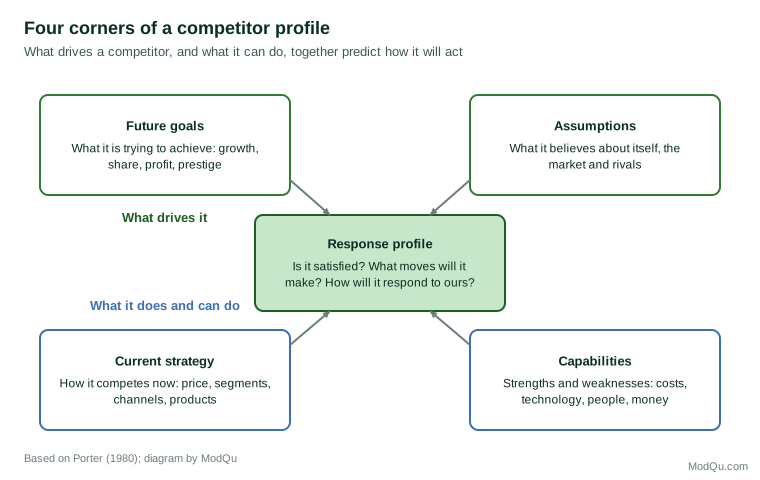
- Future goals. What is the competitor trying to achieve? Growth, market share, profitability or technological leadership? Goals can often be inferred from statements to investors, executive pay structures and past decisions.
- Assumptions. What does the competitor believe about itself, its customers and its rivals? A firm that believes it is the quality leader may not respond to price cuts; one that believes a market is declining may not defend it.
- Current strategy. How does it compete now: which segments, products, prices and channels? This is the most visible corner and the one most profiles over-emphasise.
- Capabilities. What can it do? Its cost position, technology, people, finances, brand and distribution determine which moves are realistic.
Combining the four corners produces a response profile: is the competitor satisfied with its position, what moves is it likely to make, where is it vulnerable, and how will it respond to our moves? Zajac and Bazerman (1991) showed that managers often fail to ask the last question, assuming that their own price cuts or capacity expansions will not provoke a response. A good profile makes the likely response explicit.
Sources for profiles
Fleisher and Bensoussan (2015) and Kahaner (1996) list the main legitimate sources: annual reports and regulatory filings; investor presentations and earnings calls; patents; job postings; press releases and interviews; product literature and the products themselves; trade shows; and conversations with customers, distributors and suppliers. Calof and Wright (2008) emphasise that the analytic value comes from combining fragments from different sources into a coherent picture.
Keeping profiles honest
Profiles go stale and harden into stereotypes. Gilad (2004) warns that organisations often hold fixed views of competitors that blind them to changes in strategy. Three habits help:
- Date every fact and update on a schedule. A profile more than a year old is a history, not intelligence.
- Separate fact from inference. Mark which statements are observed and which are judgements, with a level of confidence.
- Test alternatives. For important judgements about a competitor's intentions, list competing explanations and check which evidence fits each, as Heuer (1999) recommended for intelligence analysis generally.
Benchmarking
Benchmarking compares performance or practices with others. Camp (1989), describing the approach developed at Xerox in the late 1970s and 1980s, defined it as the search for industry best practices that lead to superior performance. Xerox compared its costs, quality and processes with those of competitors and with leading firms in other industries, and used the gaps to set targets and redesign its processes.
There are several kinds of benchmarking:
- Competitive benchmarking compares performance with direct rivals, for example on price, quality or delivery time.
- Functional benchmarking compares a specific process, such as warehousing or billing, with the best performers in any industry.
- Internal benchmarking compares units within the same organisation, such as stores, plants or regions.
Camp emphasised that the value of benchmarking lies less in the numbers than in understanding the practices that produce them. Knowing that a rival delivers in two days rather than five matters less than learning how.
Comparable measures
Benchmarks mislead when measures are not comparable. Differences in accounting, product mix, customer base or definitions can make one firm look better or worse than it is. Good benchmarks define measures precisely, adjust for major differences and present ranges rather than single figures where data are uncertain.
Lawful benchmarking
Benchmarking with competitors requires care. Exchanging current or future prices, costs, capacity or other competitively sensitive information directly between competitors can raise concerns under competition law, such as Canada's Competition Act (1985), because it can facilitate coordination. Lawful benchmarking typically uses an independent third party, aggregates data from several firms so that no individual firm's figures can be identified, uses historical rather than current data and is reviewed by legal counsel.
An example
A regional grocery chain profiles a discount rival that has opened three stores in its area. Annual reports and investor presentations show the rival's goal of rapid expansion and a belief that shoppers will trade convenience for lower prices. Store visits and price checks reveal a narrow range, mostly private-label products and prices about 15% lower. Job postings suggest further openings. The response profile concludes that the rival is unlikely to match the chain's fresh-food range or service but will keep expanding on price. The chain responds not by matching prices across the board but by reducing prices on the most comparable basic items, strengthening its fresh-food offer and benchmarking its own store operating costs against industry data to find savings.
Conclusion
Competitor profiles and benchmarks turn scattered information into usable comparisons. A good profile explains what a competitor wants, believes, does and can do, and predicts how it will act and respond. A good benchmark compares like with like and focuses on the practices behind performance. Both must be kept current, separate fact from judgement and, in the case of benchmarking with rivals, respect the limits of competition law.
References
Calof, J. L., & Wright, S. (2008). Competitive intelligence: A practitioner, academic and inter-disciplinary perspective. European Journal of Marketing, 42(7/8), 717–730. https://doi.org/10.1108/03090560810877114
Camp, R. C. (1989). Benchmarking: The search for industry best practices that lead to superior performance. ASQC Quality Press.
Chen, M.-J. (1996). Competitor analysis and interfirm rivalry: Toward a theoretical integration. Academy of Management Review, 21(1), 100–134. https://doi.org/10.5465/amr.1996.9602161567
Clark, B. H., & Montgomery, D. B. (1999). Managerial identification of competitors. Journal of Marketing, 63(3), 67–83. https://doi.org/10.1177/002224299906300305
Competition Act, R.S.C. 1985, c. C-34 (Canada).
Fleisher, C. S., & Bensoussan, B. E. (2015). Business and competitive analysis: Effective application of new and classic methods (2nd ed.). Pearson Education.
Gilad, B. (2004). Early warning: Using competitive intelligence to anticipate market shifts, control risk, and create powerful strategies. AMACOM.
Heuer, R. J., Jr. (1999). Psychology of intelligence analysis. Center for the Study of Intelligence, Central Intelligence Agency.
Kahaner, L. (1996). Competitive intelligence: How to gather, analyze, and use information to move your business to the top. Simon & Schuster.
Porac, J. F., & Thomas, H. (1990). Taxonomic mental models in competitor definition. Academy of Management Review, 15(2), 224–240. https://doi.org/10.5465/amr.1990.4308155
Porter, M. E. (1980). Competitive strategy: Techniques for analyzing industries and competitors. Free Press.
Zajac, E. J., & Bazerman, M. H. (1991). Blind spots in industry and competitor analysis: Implications of interfirm (mis)perceptions for strategic decisions. Academy of Management Review, 16(1), 37–56. https://doi.org/10.5465/amr.1991.4278990