
Intelligence · Market and competitive intelligence
"Competitive Intelligence: Ethical Collection and Analysis"
Competitive intelligence helps an organisation understand its rivals and anticipate their moves. This article explains how competitive intelligence is planned, collected ethically from legitimate sources and analysed to avoid common blind spots.
No business competes in isolation. Its prices, products, hiring and investment decisions are made in the shadow of what competitors are doing and might do next. Competitive intelligence is the systematic collection and analysis of information about competitors and the competitive environment, used to support decisions. Kahaner (1996) describes it as a process of monitoring the competitive environment and turning the resulting information into actionable knowledge. Done well, it gives decision-makers early warning of competitors' moves and a realistic picture of their strengths and weaknesses. Done badly, it collects gossip, confirms prejudices or crosses ethical and legal lines. This article explains how to plan, collect and analyse competitive intelligence well.
Planning: start with the questions
Competitive intelligence should begin with decisions, not with data. Herring (1999) proposed identifying key intelligence topics: the small number of issues on which senior managers most need intelligence. These typically fall into three groups: strategic decisions, such as whether to enter a market or invest in a technology; early-warning topics, such as possible new entrants or regulatory changes; and descriptions of key players, such as major competitors, customers and suppliers. Defining these topics with decision-makers keeps collection focused and makes the results more likely to be used.
Montgomery and Weinberg (1979) made a similar argument for strategic intelligence systems: they should be designed around the strategic decisions they support. Gilad (2004) stresses early warning as the central purpose: identifying the signals of competitive change in time to respond.
Collection: legitimate sources are rich
A common misconception is that useful competitive intelligence requires secret or improper methods. In practice, most of what an organisation needs to know about its competitors is available legitimately. Fleisher and Bensoussan (2015) and Calof and Wright (2008) describe the wide range of open sources available to analysts:
- Company publications: annual reports, investor presentations, regulatory filings, press releases and websites.
- Job postings: a competitor hiring dozens of engineers in a particular technology reveals investment priorities.
- Patents and trademarks: filings show research directions and planned products.
- Products: buying and examining competitors' products reveals design, cost and quality.
- Trade shows and conferences: presentations and stands show new products and messages.
- Customers, suppliers and distributors: conversations conducted openly often reveal how competitors sell, price and perform.
- The sales force: salespeople hear about competitors' offers and tactics every day, but their knowledge is rarely collected systematically.
- News, industry media and analysts' reports.
Combining many such fragments, each harmless on its own, often produces a detailed picture of a competitor's strategy.
Collection: the ethical line
Some methods are clearly wrong. Paine (1991) identified the main categories of questionable intelligence-gathering: misrepresentation, such as posing as a customer or student to obtain information; improper influence, such as bribing or pressuring employees to disclose confidential information; and covert surveillance, such as hidden recording or intercepting communications. Crane (2005) argues that competitive intelligence becomes industrial espionage when it involves trespass, breach of confidentiality, misrepresentation or the collection of information whose disclosure would harm the public interest. Figure 1 summarises how common methods are usually judged.
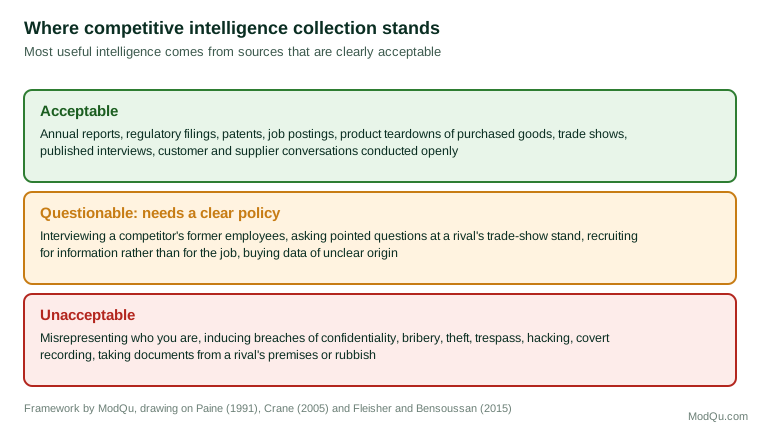
The middle band deserves particular attention. Interviewing a competitor's former employee is lawful, but asking them to reveal trade secrets they are bound to protect is not. A written policy, training and a simple test, such as "would we be comfortable if this method were reported in the newspaper?", help analysts stay on the right side of the line. The legal and ethical issues are discussed in more depth in a companion article.
Analysis: understanding the competitor
Collected information becomes intelligence only through analysis. Porter (1980) proposed a framework for competitor analysis based on four components: a competitor's future goals, its assumptions about itself and the industry, its current strategy, and its capabilities. Together they help predict how a competitor is likely to act and how it will respond to moves by others. A competitor whose goals stress market share and whose assumptions include a belief in its own cost advantage is likely to respond aggressively to a price cut.
Chen (1996) offered a way to judge which competitors matter most. Rivalry is likely to be most intense between firms that overlap in the markets they serve (market commonality) and that have similar resources (resource similarity). Firms that share many markets are likely to respond to each other's attacks; firms with different resources may compete in unexpected ways.
Analysis: avoiding blind spots
The greatest weaknesses in competitive intelligence are often in the analyst's own thinking.
Narrow competitor definition. Clark and Montgomery (1999) found that managers tend to identify competitors that look like themselves, based on similar products and size, and overlook firms that meet the same customer needs differently. Porac and Thomas (1990) showed that managers carry mental categories of "who we compete with" that can exclude new or unconventional rivals.
Misjudging rivals' reactions. Zajac and Bazerman (1991) argued that managers systematically fail to consider how competitors will respond to their decisions, for example by assuming that capacity expansions or price cuts will not be matched, which leads to overcapacity and price wars across an industry.
Confirmation bias. Analysts and managers tend to accept information that fits existing beliefs about a competitor and discount information that contradicts them. Heuer (1999) recommended structured methods, such as listing alternative hypotheses about a competitor's intentions and testing each against the evidence, to counter this tendency.
An illustration
A mid-sized maker of industrial pumps hears from two distributors that a larger rival is offering unusually long warranties. The intelligence team treats this as an early-warning signal and checks other open sources. The rival's recent job postings seek reliability engineers and field service technicians in three new regions. Its latest investor presentation mentions "service-led growth". A teardown of its newest pump, bought through a distributor, shows more durable seals and a sensor port for remote monitoring. Patent filings describe a system for predicting pump failures from vibration data.
Taken together, these fragments suggest that the rival is preparing to compete on reliability and service contracts rather than price. The team states this as a probable interpretation, with moderate confidence, and lists an alternative: that the warranties are a short-term response to a quality problem. Over the next two months, further signals, including new service-contract pricing reported by customers, support the first interpretation. Management decides to accelerate its own remote-monitoring product rather than cut prices, a response it would not have considered had it assumed the rival was preparing a price war. Every piece of information used was obtained lawfully and openly.
Organising the function
Competitive intelligence does not require a large department. Many organisations run it with one or two analysts who coordinate a network of contributors: salespeople who report competitor activity through a simple form, product managers who track rivals' products, and purchasing staff who hear from suppliers. What matters is that someone owns the key intelligence topics, collects contributions regularly, analyses them and reports to decision-makers, and that contributors see their information being used.
Delivering intelligence
Competitive intelligence must reach decision-makers in a form they can use: short, focused on implications, and clear about confidence. A useful format answers three questions for each finding: what we know, what it means for us, and what we recommend. Regular competitor briefings, early-warning alerts on key intelligence topics and war-gaming exercises, in which managers role-play competitors' responses to a planned move, are common ways to bring intelligence into decisions.
Conclusion
Competitive intelligence helps organisations see their competitive environment clearly and anticipate change. It works best when it starts from key decisions, draws on the wealth of legitimate open sources, stays within clear ethical boundaries and uses structured analysis to avoid the blind spots that lead managers to misjudge their rivals. The most valuable intelligence is rarely secret; it comes from careful collection and disciplined thinking about information that is available to anyone willing to look.
References
Calof, J. L., & Wright, S. (2008). Competitive intelligence: A practitioner, academic and inter-disciplinary perspective. European Journal of Marketing, 42(7/8), 717–730. https://doi.org/10.1108/03090560810877114
Chen, M.-J. (1996). Competitor analysis and interfirm rivalry: Toward a theoretical integration. Academy of Management Review, 21(1), 100–134. https://doi.org/10.5465/amr.1996.9602161567
Clark, B. H., & Montgomery, D. B. (1999). Managerial identification of competitors. Journal of Marketing, 63(3), 67–83. https://doi.org/10.1177/002224299906300305
Crane, A. (2005). In the company of spies: When competitive intelligence gathering becomes industrial espionage. Business Horizons, 48(3), 233–240. https://doi.org/10.1016/j.bushor.2004.11.005
Fleisher, C. S., & Bensoussan, B. E. (2015). Business and competitive analysis: Effective application of new and classic methods (2nd ed.). Pearson Education.
Gilad, B. (2004). Early warning: Using competitive intelligence to anticipate market shifts, control risk, and create powerful strategies. AMACOM.
Herring, J. P. (1999). Key intelligence topics: A process to identify and define intelligence needs. Competitive Intelligence Review, 10(2), 4–14.
Heuer, R. J., Jr. (1999). Psychology of intelligence analysis. Center for the Study of Intelligence, Central Intelligence Agency.
Kahaner, L. (1996). Competitive intelligence: How to gather, analyze, and use information to move your business to the top. Simon & Schuster.
Montgomery, D. B., & Weinberg, C. B. (1979). Toward strategic intelligence systems. Journal of Marketing, 43(4), 41–52. https://doi.org/10.1177/002224297904300405
Paine, L. S. (1991). Corporate policy and the ethics of competitor intelligence gathering. Journal of Business Ethics, 10(6), 423–436. https://doi.org/10.1007/BF00382825
Porac, J. F., & Thomas, H. (1990). Taxonomic mental models in competitor definition. Academy of Management Review, 15(2), 224–240. https://doi.org/10.5465/amr.1990.4308155
Porter, M. E. (1980). Competitive strategy: Techniques for analyzing industries and competitors. Free Press.
Zajac, E. J., & Bazerman, M. H. (1991). Blind spots in industry and competitor analysis: Implications of interfirm (mis)perceptions for strategic decisions. Academy of Management Review, 16(1), 37–56. https://doi.org/10.5465/amr.1991.4278990