
Share your experience of buying a home
Tell us whether you plan to buy, where you search and how you are going about it. Your answers are combined with other people's and reported only as totals.
Start the buying a home surveyAbout 5 minutes. No account needed. You can stop at any time.
What this topic covers
This topic covers buying a home to live in:
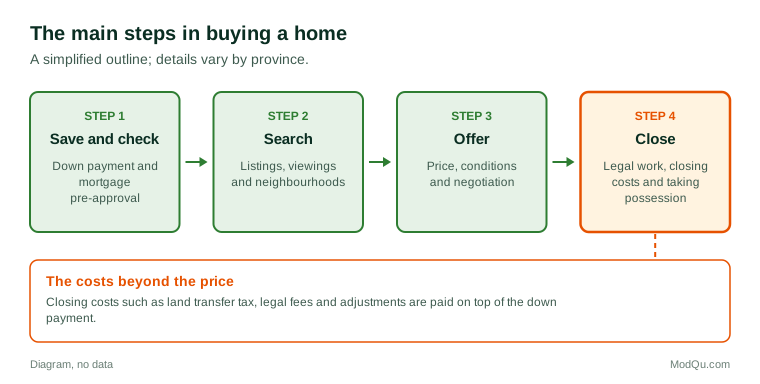
- Planning: deciding to buy, saving a down payment and checking what is affordable.
- Searching: listings, open houses, neighbourhoods and types of homes.
- Agents and professionals: real estate agents, mortgage brokers, lawyers or notaries, and home inspectors.
- Making an offer, negotiating and handling competing offers.
- Closing: the costs and steps to take ownership.
- First-time buyers and the programs aimed at them.
Mortgages themselves are covered on the mortgages and home loans page, and wider questions about housing costs on the housing affordability page. This page describes the process; it does not give financial or legal advice.
Deciding to buy
People decide to buy for many reasons:
- wanting stability and control over their home;
- building equity instead of paying rent;
- more space for a growing family;
- moving to a new city for work;
- downsizing in later life;
- a sense that owning is a milestone.
Others decide to keep renting because of cost, the flexibility to move, or the work and risk involved in owning. Many people say the decision depends mostly on what they can afford in the area where they want to live.
Saving and checking what you can afford
The down payment is the part of the price paid upfront. In Canada, the minimum down payment depends on the price, and buyers with less than 20 percent down usually need mortgage default insurance. Many buyers save for years, and some get help from family.
Programs that help first-time buyers in Canada include the First Home Savings Account (FHSA), which lets eligible people save for a first home with tax advantages, and the Home Buyers' Plan, which allows withdrawals from an RRSP under set rules. Some provinces and cities offer land transfer tax rebates for first-time buyers.
Before searching, many buyers get a mortgage pre-approval, which shows how much a lender may be willing to lend at a given rate, subject to conditions.
Example
A couple saves for four years for a down payment. They use first-home savings accounts and a gift from one set of parents. When they get pre-approved, the amount is lower than they hoped, so they widen their search to a nearby town where homes cost less.
Searching for a home
Buyers search in several ways:
- listing websites and apps, which show homes for sale with photos, prices and details;
- real estate agents, who send listings and arrange viewings;
- open houses on weekends;
- driving or walking through neighbourhoods;
- word of mouth, including homes sold privately.
Common trade-offs include:
- location versus size: a smaller home closer to work or family, or a larger one farther away;
- house versus condo or townhouse;
- new build versus resale;
- move-in ready versus a home that needs work;
- schools, transit, parks and shops nearby.
Example
A single parent wants three bedrooms near their children's school. Listings in that area are above their budget. After three months of searching, they choose a two-bedroom condo with a den in the same school catchment, deciding that staying near the school matters more than the extra bedroom.
Real estate agents
Many buyers use a real estate agent, sometimes called a realtor. A buyer's agent can find listings, arrange viewings, advise on pricing, prepare offers and negotiate. In most of Canada, the seller has traditionally paid the commission, which is then shared between the agents, but practices and rules are changing in some places. Some buyers search alone and hire a lawyer for the paperwork.
Agents are regulated by provincial bodies, which set rules on licensing, conduct and how agents must disclose who they represent. Questions businesses want answered include how buyers choose an agent, how satisfied they are, and whether they would use one again.
Making an offer
An offer sets the price and terms the buyer proposes. It often includes conditions, such as:
- financing, so the buyer can withdraw if the mortgage is not approved;
- home inspection, so the buyer can withdraw or renegotiate if problems are found;
- sale of the buyer's current home;
- review of condo documents, for condo purchases.
In a busy market, sellers may receive several offers at once, sometimes called a bidding war. Some buyers make offers without conditions to compete, which can be risky. Several provinces have introduced a cooling-off period for some home purchases, during which a buyer can cancel, sometimes with a fee.
Example
A first-time buyer makes an offer on a house with financing and inspection conditions. The inspector finds that the roof needs replacing within two years. The buyer asks the seller to lower the price to cover part of the cost, the seller agrees to a smaller reduction, and the sale goes ahead.
Closing costs
The price is not the only cost. Buyers also pay closing costs, which may include:
- land transfer tax, charged by most provinces and some cities, such as Toronto;
- legal or notary fees;
- title insurance;
- home inspection fees;
- adjustments for property taxes or utilities the seller has already paid;
- mortgage default insurance tax in some provinces;
- moving costs and immediate repairs.
Example (hypothetical figures)
A buyer purchases a home for $500,000. They estimate closing costs of 1.5 to 4 percent of the price. At 2 percent, that is $10,000, covering land transfer tax, legal fees, title insurance and adjustments. They also set aside $3,000 for moving and $2,000 for small repairs, so they need $15,000 on top of the down payment.
What people disagree about
Opinion is divided on whether buying is better than renting, whether it is wise to stretch the budget, whether bidding wars should be limited, how agents should be paid, and whether governments should do more for first-time buyers. These views often depend on age, region and whether people already own.
Key terms
- Down paymentThe part of a home's price paid upfront.
- Pre-approvalA lender's statement of how much it may lend, subject to conditions.
- ConditionA term in an offer that must be met for the sale to go ahead.
- Home inspectionA check of a home's condition by a trained inspector.
- Closing costsFees and taxes paid when a purchase is completed.
- Land transfer taxA tax paid by the buyer when property changes hands.
- EquityThe share of a home's value that the owner owns outright.
- Bidding warSeveral buyers competing with offers on the same home.
Full glossary: residential property management terms on EditingTests.com.
Buying a home vocabulary test
How well do you know the language of this topic? Try 8 quick questions. Your score is shown straight away and is not saved.
What the buying a home survey asks
This survey is part of ModQu's Home and Property survey. The buying a home part takes about five minutes and covers:
- Whether you have bought a home recently, or plan to in the next two years.
- Where you search for listings, and which tools you use.
- Whether you used, or will use, a real estate agent, and how you chose one.
- What matters most to you: location, size, price, type of home or schools.
- How you are saving for or paid the down payment.
- What worries you most about buying.
After that you can choose to continue with other short parts of the Home and Property survey, such as renting or home renovation and repairs, or stop.
Ready to take part?
Your answers help show what people really think and do. Results are only ever reported as totals; no one can see your individual answers.
Start the surveyQuestions about this survey
Who can take part?
People who bought a home recently or plan to.
Do I have to give my name?
No. You may be asked for your age group, region and similar details so results can be broken down, but not your name. ModQu never asks for passwords, card numbers or account numbers.
How are the results used?
Answers are combined into totals and percentages and published in ModQu reports. Individual answers are never shown.
Is the vocabulary test part of the survey?
No. It is optional and separate, and your score is not stored.
Can renters take part?
Yes. Renters who are thinking about buying, or who have decided not to, are asked about their plans and reasons.