
Share your experience of renting
Tell us what you pay, how you found your place and how satisfied you are with your landlord. Your answers are combined with other people's and reported only as totals.
Start the renting surveyAbout 5 minutes. No account needed. You can stop at any time.
What this topic covers
This topic covers renting a home to live in:
- Apartments in purpose-built rental buildings, owned by companies or individuals.
- Rented houses, townhouses and condos, often owned by individual landlords.
- Basement and secondary suites in someone else's home.
- Rooms in shared housing, common among students and young adults.
- Social and co-operative housing, including non-profit and subsidized units.
- Seniors' rentals and other housing for specific groups.
It covers searching, costs, leases, the landlord relationship, repairs and moving. Formal disputes are covered on the tenant and landlord disputes page. Rules differ by province and territory, and this page describes them in general terms rather than giving legal advice.
Why people rent
People rent for many reasons, and not always by choice:
- flexibility to move for work, study or family;
- not having a down payment or not qualifying for a mortgage;
- cost, where renting is cheaper than owning in the same area;
- less responsibility for repairs and maintenance;
- a stage of life, such as studying, starting a career or after separation;
- later life, when some older adults sell a home and rent.
Some renters plan to buy one day; others expect to rent for life and would like more security as tenants.
Finding a place
Common ways of searching include:
- rental listing websites and apps;
- online classified and community groups;
- property management company websites;
- signs on buildings and word of mouth;
- agents, used more for higher-priced rentals in some cities.
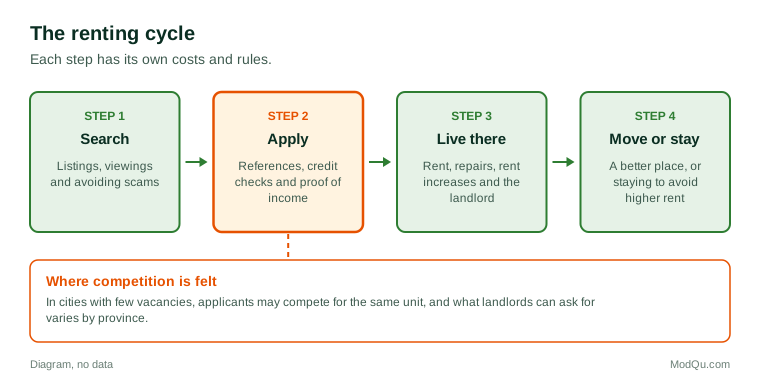
In cities with few vacancies, renters may view many units, compete with other applicants and face requests for references, credit checks, proof of income and sometimes several months' rent upfront, though what landlords can ask for varies by province. Rental scams are common: fake listings that ask for a deposit before a viewing, or for units the person does not own.
Example
A student moving to a new city for university finds an apartment listing with a low rent and photos of a bright unit. The "landlord" says they are abroad and asks for a deposit by e-transfer before a viewing. The student's parent checks the address and finds the same photos on an older listing for a different city. They do not send money and report the listing.
What renters pay
Rent is the largest monthly cost for most renting households. A common measure of affordability is the share of income spent on housing. In Canada, housing is often considered affordable if it costs less than 30 percent of a household's before-tax income, a benchmark used by the Canada Mortgage and Housing Corporation (CMHC).
Other costs may include:
- utilities such as heat, electricity, water and internet, depending on what the rent includes;
- parking and storage;
- tenant insurance, which many landlords require;
- a deposit, where the province allows one;
- moving costs.
Example (hypothetical figures)
A renter earns $4,500 a month before tax and pays $1,650 in rent, plus $90 for electricity and $70 for internet. Housing costs of $1,810 are about 40 percent of income, above the 30 percent benchmark. A one-bedroom unit in a building where utilities are included costs $1,700, which would bring the total, with internet, to $1,770, still about 39 percent.
Leases and rent increases
A lease, also called a tenancy agreement, sets out the rent, the length of the tenancy and the rules. It may be for a fixed term, such as one year, or month to month. Provinces set the rules for:
- how often rent can rise and how much notice is needed;
- rent increase limits in some provinces, which may not apply to all units;
- deposits and what they can be used for;
- ending a tenancy, by the tenant or the landlord;
- entry, meaning when a landlord can come into the unit.
Many renters are not sure what rules apply to them. In some provinces newer buildings are exempt from rent increase limits, and rents can reset to market levels when a tenant moves out.
Landlords, repairs and living conditions
The relationship with the landlord often shapes how renters feel about their home. Renters value landlords who:
- make repairs quickly;
- respond to messages;
- respect privacy and give notice before entering;
- keep common areas clean and safe;
- treat tenants fairly at the end of a tenancy.
Common problems include slow repairs, pests, heating that does not work well, mould, noise and disagreements over deposits. Some renters hesitate to complain because they worry about losing their home in a tight market. Each province has a body that handles tenancy disputes, such as a landlord and tenant board or a residential tenancy office.
Example
A family renting a townhouse reports a leaking bathroom fan to the property manager. After three weeks with no answer, they write again, keep copies of their messages and photos, and look up their province's rules on repairs. The manager sends a contractor the following week.
Moving and staying
Renters move more often than owners. Reasons include a rent increase, a better place, a change of job or household, conflict with the landlord or neighbours, and a landlord selling or moving into the unit. In low-vacancy cities, many renters stay in a unit that no longer suits them because moving would mean paying much more.
Example
A couple with a new baby wants a two-bedroom apartment. Their current one-bedroom has had small yearly increases, and similar two-bedroom units nearby cost far more. They decide to stay for another year, putting the baby's crib in the bedroom, while they save for higher rent.
What people disagree about
Opinion is divided on whether rent increases should be limited for all units, how much landlords should be able to ask applicants for, whether governments should build more rental and social housing, how to balance landlords' and tenants' rights, and whether renting for life is a reasonable choice. These views often depend on whether people rent, own or are landlords.
Key terms
- LeaseAn agreement setting out rent, length and rules of a tenancy.
- Fixed-term tenancyA tenancy for a set period, such as one year.
- Month-to-monthA tenancy that continues each month until ended with notice.
- Security depositMoney held by a landlord against damage or unpaid rent, where allowed.
- Rent controlLimits on how much and how often rent can rise.
- Vacancy rateThe share of rental units empty and available.
- Tenant insuranceInsurance covering a renter's belongings and liability.
- SubletRenting your unit to someone else while you keep the lease.
Full glossary: rent collection services terms on EditingTests.com.
Renting vocabulary test
How well do you know the language of this topic? Try 8 quick questions. Your score is shown straight away and is not saved.
What the renting survey asks
This survey is part of ModQu's Home and Property survey. The renting part takes about five minutes and covers:
- What kind of home you rent, and how long you have lived there.
- What share of your income goes to rent and utilities.
- How you found your current home, and how hard the search was.
- How satisfied you are with your landlord, repairs and building.
- Whether your rent has gone up, and by how much.
- Whether you plan to move in the next year, and why.
After that you can choose to continue with other short parts of the Home and Property survey, such as buying a home or home renovation and repairs, or stop.
Ready to take part?
Your answers help show what people really think and do. Results are only ever reported as totals; no one can see your individual answers.
Start the surveyQuestions about this survey
Who can take part?
Renters.
Do I have to give my name?
No. You may be asked for your age group, region and similar details so results can be broken down, but not your name. ModQu never asks for passwords, card numbers or account numbers.
How are the results used?
Answers are combined into totals and percentages and published in ModQu reports. Individual answers are never shown.
Is the vocabulary test part of the survey?
No. It is optional and separate, and your score is not stored.
Do I need to share my exact income?
No. Income questions use ranges, and you can skip any question you prefer not to answer.