
Share your experience of home maintenance
Tell us how much you spent on home maintenance last year, your biggest unexpected repair and whether you save for repairs. Your answers are combined with other people's and reported only as totals.
Start the home maintenance costs surveyAbout 5 minutes. No account needed. You can stop at any time.
What this topic covers
Home maintenance means the work needed to keep a home safe, working and in good condition. It is different from renovation, which changes or improves a home, although the two often overlap. This topic covers:
- routine upkeep, such as cleaning, servicing and small repairs;
- larger planned replacements, such as roofs, windows and heating systems;
- unexpected repairs, such as leaks, breakdowns and storm damage;
- how much homeowners spend and how they budget;
- whether they do the work themselves or hire professionals;
- shared costs in apartment buildings.
Routine upkeep
Routine tasks are often seasonal and fairly cheap, but skipping them can lead to larger problems. Common examples include:
- cleaning gutters and drains;
- servicing boilers, furnaces, air conditioners and water heaters;
- checking smoke and carbon monoxide alarms;
- sealing gaps around windows, doors, baths and showers;
- painting and treating wood;
- trimming trees and clearing vegetation away from walls;
- pest control;
- checking roofs after storms.
In climates with cold winters, protecting pipes from freezing matters. In hot, humid climates, mould, termites and air conditioning upkeep are bigger concerns. In places with heavy rain, drainage and roofs need more attention.
Major replacements
Some parts of a home wear out and must be replaced every so many years. How long they last depends on materials, climate and care. Common major items include:
- roof coverings;
- heating and cooling systems;
- water heaters;
- windows and doors;
- kitchen and bathroom fittings;
- flooring;
- exterior paint or render;
- plumbing and electrical wiring in older homes.
Homeowners who know the age of these items can plan ahead. Many do not, especially after buying an older home.
Unexpected repairs
Unexpected repairs cause the most stress. Common examples include:
- burst pipes and leaks;
- a broken boiler or furnace in winter;
- roof damage after a storm;
- blocked or collapsed drains;
- electrical faults;
- subsidence or foundation movement;
- pest damage, such as termites.
Some of these may be covered by home insurance, especially sudden events like storms and burst pipes. Wear and tear and gradual damage are usually not covered.
Example
A family's water heater fails during a cold week. A replacement costs more than they expected, and they have to pay for an emergency call-out because it is the weekend. They pay with a credit card and spend several months paying it off. Afterwards they start putting a small amount aside each month for repairs.
How much people spend and budget
Spending varies widely with the home's age, size, type and location, and with local labour costs. Some homeowners use rules of thumb, such as setting aside 1% to 2% of the home's value each year, or a set amount per square metre. These are only rough guides, and real costs come in uneven amounts: little in some years and a lot in others.
Example (hypothetical figures)
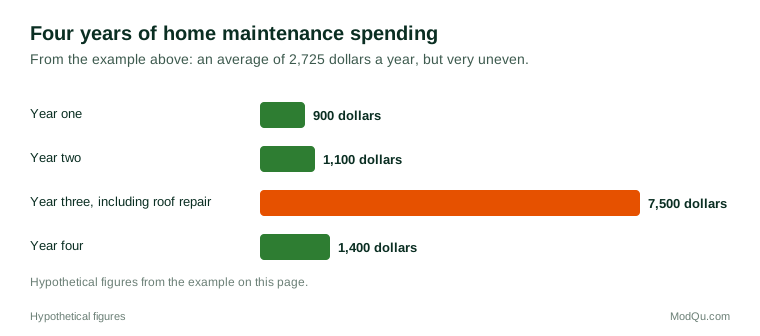
A homeowner tracks spending over four years. Year one: 900 dollars on routine upkeep. Year two: 1,100 dollars. Year three: 1,000 dollars plus a 6,500-dollar roof repair, 7,500 dollars in total. Year four: 1,400 dollars. The four-year total is 10,900 dollars, an average of 2,725 dollars a year, even though three of the four years cost less than 1,500 dollars.
Figure 1 shows how uneven the spending in that example is. Because large costs arrive unevenly, many people find it helpful to save a fixed amount each month into a separate repair fund.
Doing it yourself or hiring help
Homeowners choose between doing work themselves, hiring a handyperson, or hiring a licensed tradesperson. Their choice depends on:
- Skill and confidence;
- Time;
- Cost: labour can be a large part of a repair bill;
- Safety and rules: in many countries, electrical, gas and some plumbing work must be done by licensed professionals;
- Tools and equipment;
- Finding a reliable tradesperson, which many people say is hard, especially for small jobs.
Example
A young couple paint their own rooms, replace a dripping tap after watching an online video and clean their gutters. When they notice a burning smell from a light switch, they call a licensed electrician, who finds a loose connection. They say knowing which jobs not to do themselves is as important as the ones they can.
Shared buildings and service charges
In apartment buildings, condominiums and strata buildings, owners share the cost of maintaining common areas, roofs, lifts and building systems. They usually pay regular fees into a fund, and sometimes a special one-off charge, called a special assessment or levy, for large repairs. How well these funds are managed varies, and large unexpected charges are a common source of stress and dispute.
Trends and debates
Trends include rising costs of materials and labour, more homes built with smart sensors that warn of leaks, home warranty or service plans that cover appliance and system repairs for a fee, and climate-related damage from storms, floods and heat. Debates include whether service plans are good value, how to find trustworthy tradespeople, and whether governments should help older or low-income homeowners with essential repairs.
Questions that businesses want answered here include how much homeowners spend on maintenance, what their biggest unexpected repair was, whether they save for repairs and how they choose tradespeople.
Key terms
- MaintenanceWork to keep a home safe, working and in good condition.
- RenovationChanging or improving a home, such as a new kitchen or extension.
- Wear and tearGradual deterioration from normal use and age.
- Repair fundMoney set aside regularly to pay for future repairs.
- TradespersonA skilled worker such as a plumber, electrician or roofer.
- Call-out feeA charge for a tradesperson to visit, often higher at night or weekends.
- Special assessmentA one-off charge to owners in a shared building for large repairs.
- SubsidenceSinking of the ground under a building, which can damage foundations.
Full glossary: homebuilding operations terms on EditingTests.com.
Home maintenance costs vocabulary test
How well do you know the language of this topic? Try 8 quick questions. Your score is shown straight away and is not saved.
What the home maintenance costs survey asks
This survey is part of ModQu's Home and Property survey. The home maintenance costs part takes about five minutes and covers:
- How much you spent on home maintenance and repairs last year.
- Which routine upkeep tasks you do, and how often.
- Your biggest unexpected repair, what it cost and how you paid for it.
- Whether you save for repairs, and how.
- Which jobs you do yourself and which you pay professionals for.
- How easy it is to find a reliable tradesperson where you live.
After that you can choose to continue with other short parts of the Home and Property survey, such as buying a home or renting, or stop.
Ready to take part?
Your answers help show what people really think and do. Results are only ever reported as totals; no one can see your individual answers.
Start the surveyQuestions about this survey
Who can take part?
Homeowners.
Do I have to give my name?
No. You may be asked for your age group, region and similar details so results can be broken down, but not your name. ModQu never asks for passwords, card numbers or account numbers.
How are the results used?
Answers are combined into totals and percentages and published in ModQu reports. Individual answers are never shown.
Is the vocabulary test part of the survey?
No. It is optional and separate, and your score is not stored.
How much should I set aside for home maintenance?
There is no single answer. Some people use rules of thumb such as 1% to 2% of the home's value each year, but real costs depend on the home's age, size, condition, climate and local labour costs.
Does home insurance pay for repairs?
Usually only for sudden events covered by the policy, such as storm damage or a burst pipe. Gradual damage and wear and tear are usually excluded.
Which maintenance tasks prevent the most expensive problems?
Homeowners and inspectors often point to keeping water out: clearing gutters and drains, fixing small roof and plumbing leaks quickly, and sealing around baths, showers and windows. Water damage is one of the most common causes of costly repairs.
Should I buy a home warranty or service plan?
Some homeowners find these plans useful for budgeting, while others find the cover limited by exclusions, call-out charges and claim limits. Reading what is covered and excluded helps people compare a plan with saving the money themselves.