
Share your experience of energy-efficient homes
Tell us whether you have made your home more energy efficient, which upgrades you made and what stops you doing more. Your answers are combined with other people's and reported only as totals.
Start the smart and energy-efficient homes surveyAbout 5 minutes. No account needed. You can stop at any time.
What this topic covers
An energy-efficient home uses less energy to stay comfortable and run its appliances. A smart home uses connected devices that can be controlled remotely or automatically, some of which help save energy. This topic covers both, and looks at:
- which efficiency upgrades people have made, from small changes to major works;
- smart controls such as thermostats, plugs and lighting;
- costs, savings and payback;
- reasons for making changes, and barriers that stop people;
- differences between homeowners and renters;
- government programs, labels and rules.
Where homes use energy
The main uses of energy in a home differ with climate and building type:
- Space heating in cold and temperate climates is often the largest use.
- Cooling is the largest use in hot climates and is growing as temperatures rise.
- Water heating for showers, washing and cleaning.
- Cooking.
- Lighting.
- Appliances and electronics, including refrigerators, washing machines and devices on standby.
Knowing where energy goes helps people decide which changes will save the most.
Low-cost and no-cost changes
Many changes cost little or nothing:
- switching to LED light bulbs;
- sealing draughts around windows and doors;
- lowering the heating thermostat slightly or raising the cooling setting;
- using curtains and blinds to keep heat in or out;
- washing clothes at lower temperatures and air-drying them;
- turning off devices instead of leaving them on standby;
- using fans instead of air conditioning where possible.
Example
A renter in a draughty flat cannot make major changes, so they fit draught-excluder strips around the windows, hang thick curtains, switch to LED bulbs and use a plug-in timer for the water heater. They say the flat feels warmer and the winter bills are a little lower.
Major upgrades
Larger upgrades usually save more but cost more. Common examples include:
- Insulation in lofts, roofs, walls and floors;
- Double or triple glazing, or secondary glazing;
- Efficient heating, such as heat pumps or modern boilers;
- Efficient cooling, such as inverter air conditioners;
- Solar panels for electricity and solar thermal panels for hot water;
- Home batteries to store solar power;
- Efficient appliances, chosen using energy labels;
- Ventilation with heat recovery in well-sealed homes.
Many energy labelling schemes, such as the EU energy label, ENERGY STAR and star-rating labels in Australia and elsewhere, help people compare appliances.
Smart controls
Smart devices can help people control energy use:
- Smart thermostats that learn routines, adjust temperatures and can be controlled by phone;
- Smart plugs that switch devices on and off on schedules;
- Smart lighting that turns off automatically;
- Smart meters that show energy use in near real time;
- Apps that show solar generation, battery levels or the cheapest times to use electricity on time-of-use tariffs.
People's experiences vary. Some find smart controls help them save; others find them confusing, or feel the savings are small compared with the cost. Privacy and data concerns also come up.
Costs, savings and payback
People often ask how long an upgrade will take to pay for itself. This is called the payback period. It depends on the cost, the energy saved, energy prices, any grants and how long the person will stay in the home.
Example (hypothetical figures)
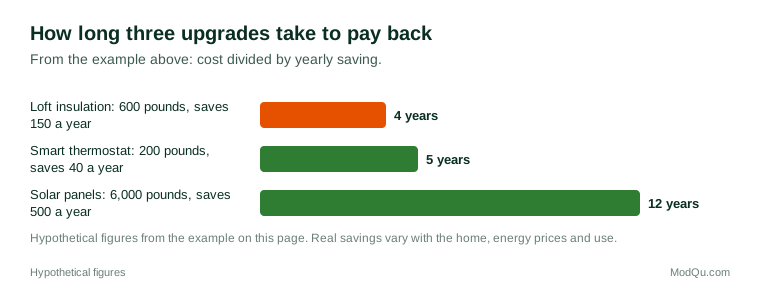
A homeowner compares three upgrades. Loft insulation costs 600 pounds and saves 150 pounds a year, a payback of 4 years. A smart thermostat costs 200 pounds and saves 40 pounds a year, a payback of 5 years. Solar panels cost 6,000 pounds and save 500 pounds a year, a payback of 12 years. They start with the insulation.
Figure 1 compares the payback periods in that example. Actual savings vary a great deal, and comfort, health and the value of the home also matter to people, not only payback.
Why people make changes, and what stops them
Reasons people give for making their homes more efficient include:
- lower energy bills;
- a warmer or cooler, more comfortable home;
- concern about climate change;
- grants, rebates or tax incentives;
- adding value to the home;
- energy security, for example solar and batteries during power cuts.
Common barriers include:
- Upfront cost and lack of savings;
- Renting: tenants usually cannot make major changes, and landlords may have little reason to pay;
- Uncertainty about which changes are worth it;
- Finding trustworthy installers;
- Disruption during works;
- Building limits, such as flats, older or heritage buildings;
- Plans to move before an upgrade pays back.
Example
A family considers a heat pump to replace an old gas boiler. A government grant would cover part of the cost, but they are unsure whether their radiators are large enough and whether their running costs would go up. They ask two installers for assessments, get different advice from each and decide to wait another year.
Government programs and rules
Many governments support efficiency through grants, rebates, low-interest loans and tax credits for insulation, heat pumps, solar panels and efficient appliances. Some require energy performance certificates when homes are sold or rented, set minimum efficiency standards for rented homes, or set building codes for new homes. Programs change often and differ between countries, regions and cities.
Trends and debates
Trends include more heat pumps and solar panels, time-of-use electricity tariffs, electric vehicle charging at home, and smart devices that work together across brands. Debates include who should pay for upgrades in rented homes, whether grants mainly help better-off households, how reliable advice and installers are, and how much smart homes add to privacy risks.
Questions that businesses want answered here include which upgrades people have made, what they spent and saved, which smart devices they use, and what would help them do more.
Key terms
- Energy efficiencyUsing less energy to get the same comfort or result.
- InsulationMaterial that slows the flow of heat into or out of a home.
- Heat pumpA device that moves heat from the air or ground to heat a home, and in some cases cool it.
- Smart thermostatA thermostat that can learn routines and be controlled by phone.
- Smart meterA meter that records energy use and sends readings automatically.
- Payback periodThe time an upgrade takes to save as much as it cost.
- Energy performance certificateA rating of a building's energy efficiency, required in some countries.
- Time-of-use tariffAn electricity price that changes by time of day.
Full glossary: building energy systems terms on EditingTests.com.
Smart and energy-efficient homes vocabulary test
How well do you know the language of this topic? Try 8 quick questions. Your score is shown straight away and is not saved.
What the smart and energy-efficient homes survey asks
This survey is part of ModQu's Home and Property survey. The smart and energy-efficient homes part takes about five minutes and covers:
- Whether you have made your home more energy efficient, and which upgrades you made.
- Which smart devices you use, such as thermostats, plugs or meters.
- What the upgrades cost, and what you think they save.
- Why you made the changes.
- What stops you from doing more.
- Whether you used a grant, rebate or loan, and how easy it was.
After that you can choose to continue with other short parts of the Home and Property survey, such as buying a home or renting, or stop.
Ready to take part?
Your answers help show what people really think and do. Results are only ever reported as totals; no one can see your individual answers.
Start the surveyQuestions about this survey
Who can take part?
Homeowners and renters.
Do I have to give my name?
No. You may be asked for your age group, region and similar details so results can be broken down, but not your name. ModQu never asks for passwords, card numbers or account numbers.
How are the results used?
Answers are combined into totals and percentages and published in ModQu reports. Individual answers are never shown.
Is the vocabulary test part of the survey?
No. It is optional and separate, and your score is not stored.
What can renters do to save energy?
Renters can often switch to LED bulbs, seal draughts with removable strips, use curtains and blinds, adjust thermostats and use timers and smart plugs. Larger changes usually need the landlord's agreement.
Do smart thermostats always save money?
Not always. Savings depend on the home, the heating system and how the household used heating before. People who already managed their heating carefully may save less.