
Share your experience of real estate agents
Tell us whether you used an agent to buy or sell, how you chose them and how satisfied you were. Your answers are combined with other people's and reported only as totals.
Start the real estate agents surveyAbout 5 minutes. No account needed. You can stop at any time.
What this topic covers
A real estate agent, also called an estate agent, realtor or property agent depending on the country, is a person or company that helps people buy, sell or rent property. This topic focuses on buying and selling homes. It covers:
- whether people used an agent, and in what role;
- how they found and chose an agent;
- what the agent did;
- what they paid;
- how satisfied they were, and why;
- alternatives such as selling privately or using online services.
What agents do for sellers
A seller's agent, often called a listing agent, usually:
- suggests an asking price based on recent sales nearby;
- prepares the listing: photos, floor plans, descriptions and sometimes video tours;
- advertises the home on property websites and in other places;
- arranges and conducts viewings or open houses;
- receives offers and negotiates with buyers or their agents;
- helps manage the process until the sale completes, working with lawyers, notaries or conveyancers.
Agents may also advise on small repairs, cleaning and staging, which means arranging furniture to make a home look appealing.
What agents do for buyers
In some countries, buyers commonly have their own agent. A buyer's agent:
- helps the buyer understand the market and what they can afford;
- searches for homes and arranges viewings;
- advises on how much to offer and how to make an offer stronger;
- negotiates with the seller's agent;
- helps with inspections, conditions and closing steps.
In other countries, such as the United Kingdom and much of Europe, buyers usually deal directly with the seller's agent, and buyer's agents are less common.
How people choose an agent
People choose agents in several ways:
- Recommendations from friends, family and neighbours;
- Online reviews and ratings;
- Local presence: signs, offices and past sales in the area;
- Interviews with several agents, comparing their suggested prices, fees and marketing plans;
- The agent who sold them their current home;
- Fees, which some sellers negotiate.
A common risk for sellers is choosing the agent who suggests the highest asking price. If the price is too high, the home may sit unsold and later need a price cut.
Example
A seller invites three agents to value their house. Two suggest similar prices; the third suggests a much higher figure. The seller chooses one of the first two, who has sold several similar houses on the same street. The house sells within a month close to the suggested price.
Commissions and fees
How agents are paid differs a great deal between countries:
- In Canada and the United States, sellers have traditionally paid a percentage commission, often split between the seller's and buyer's agents. Rules and practices on how buyer's agents are paid have been changing in the United States since 2024.
- In the United Kingdom, sellers usually pay their agent a percentage of the sale price or a fixed fee, and buyers usually pay no agent fee.
- In some European countries, the buyer pays all or part of the commission, or it is shared, and some countries have rules on who pays.
- In parts of Asia and Australia, percentages and practices vary by city and property type.
- Fixed-fee and online agents charge a set fee instead of a percentage, sometimes paid in advance, usually with fewer services.
Example (hypothetical figures)
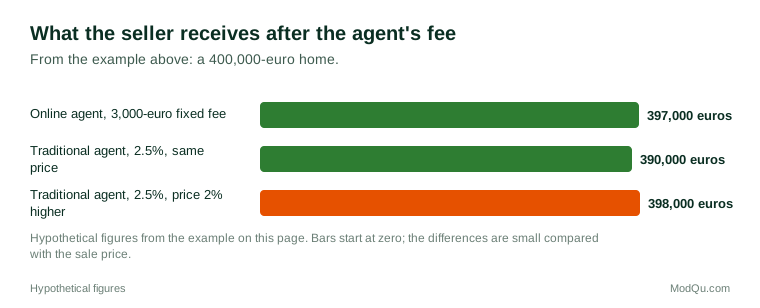
A home sells for 400,000 euros. A traditional agent charging 2.5% would cost 10,000 euros. An online agent charging a fixed fee of 3,000 euros would save 7,000 euros, but the seller would show buyers around the home themselves. If the traditional agent achieved a price 2% higher, 408,000 euros, the seller would receive 398,000 euros after the fee, compared with 397,000 euros with the online agent.
Figure 1 compares the two results. The example shows that the cheaper option depends on whether a full-service agent can achieve a higher price, which is difficult to know in advance.
Selling or buying without an agent
Some people sell their home privately, sometimes called "for sale by owner". They may list on property websites, use signs, or sell to someone they know. Reasons include saving fees and wanting control. Difficulties include setting the right price, handling viewings and negotiations, and dealing with the legal process. In some countries, a lawyer or notary handles much of the legal work regardless of whether an agent is involved.
Satisfaction and common complaints
Clients who are satisfied with their agent often mention:
- clear and regular communication;
- accurate pricing advice;
- good marketing and photos;
- strong negotiation;
- honesty about problems and delays.
Common complaints include:
- poor communication and not returning calls;
- overpricing to win the listing, followed by price cuts;
- pressure to accept an offer quickly;
- high fees for the work done;
- conflicts of interest, such as one agent acting for both buyer and seller;
- not disclosing known problems with a property.
Example
A buyer's agent pushes a first-time buyer to offer above the asking price after one viewing, saying other offers are expected. The buyer later learns there were no other offers. They are happy with the home but say they would choose a different agent next time and would ask more questions.
Agents are regulated in many countries, with licensing, codes of conduct and complaint schemes, though the strength of regulation varies.
Trends and debates
Trends include online and hybrid agents, virtual tours and online viewings, property portals that show price history, and changing commission rules in some countries. Debates include whether traditional commissions are fair, how agents should disclose conflicts of interest, and how much value agents add when much information is now online.
Questions that businesses want answered here include how people choose agents, what they pay, which services they value and how satisfied they are with the result.
Key terms
- Listing agentThe agent who represents the seller and markets the home.
- Buyer's agentAn agent who represents the buyer in a purchase.
- CommissionA fee calculated as a percentage of the sale price.
- Asking priceThe price at which a home is advertised.
- ValuationAn agent's or professional's estimate of what a home will sell for.
- StagingArranging furniture and decor to make a home look appealing to buyers.
- Dual agencyWhen one agent or agency acts for both buyer and seller.
- For sale by ownerSelling a home without using an agent.
Full glossary: residential property management terms on EditingTests.com.
Real estate agents vocabulary test
How well do you know the language of this topic? Try 8 quick questions. Your score is shown straight away and is not saved.
What the real estate agents survey asks
This survey is part of ModQu's Home and Property survey. The real estate agents part takes about five minutes and covers:
- Whether you used an agent to buy or sell a home in the last five years, and in which role.
- How you found and chose your agent.
- What the agent did for you, and which services mattered most.
- What you paid in fees or commission, and how it was calculated.
- How satisfied you were, and what went well or badly.
- Whether you would use an agent, an online service or sell privately next time.
After that you can choose to continue with other short parts of the Home and Property survey, such as buying a home or renting, or stop.
Ready to take part?
Your answers help show what people really think and do. Results are only ever reported as totals; no one can see your individual answers.
Start the surveyQuestions about this survey
Who can take part?
Adults who bought or sold a home in the last five years.
Do I have to give my name?
No. You may be asked for your age group, region and similar details so results can be broken down, but not your name. ModQu never asks for passwords, card numbers or account numbers.
How are the results used?
Answers are combined into totals and percentages and published in ModQu reports. Individual answers are never shown.
Is the vocabulary test part of the survey?
No. It is optional and separate, and your score is not stored.
Can I negotiate an agent's fee?
Often, yes. Fees and commission rates are usually negotiable, and sellers commonly compare several agents. Lower fees may come with fewer services, so sellers compare what each agent will do.
Do buyers need their own agent?
It depends on the country. In some places buyers commonly have their own agent; in others they deal directly with the seller's agent and rely on a lawyer or notary for the legal steps.