
Insights · Customer and market insight
Customer Lifetime Value and Insight-Led Retention
What customer lifetime value is, how it is estimated, why retention has such a large effect on it, and why the best retention efforts target the customers whose behaviour can be changed rather than those most likely to leave.
Customer lifetime value is an estimate of the total profit a customer will generate over the whole of their relationship with an organisation, expressed in today's money. It shifts attention from the value of a single sale to the value of a relationship, and so from winning customers to keeping them. This article explains how lifetime value is estimated, why retention matters so much, and how insight can make retention efforts more effective.
Estimating lifetime value
In its simplest form, lifetime value depends on three things: the profit margin a customer generates each period, the probability that they remain a customer from one period to the next, and a discount rate that reflects the time value of money. Gupta et al. (2004) used this logic to value the customer bases of several companies and found that, for most of them, a 1% improvement in retention increased the value of the customer base far more than a 1% improvement in margin or a 1% reduction in the cost of acquiring customers.
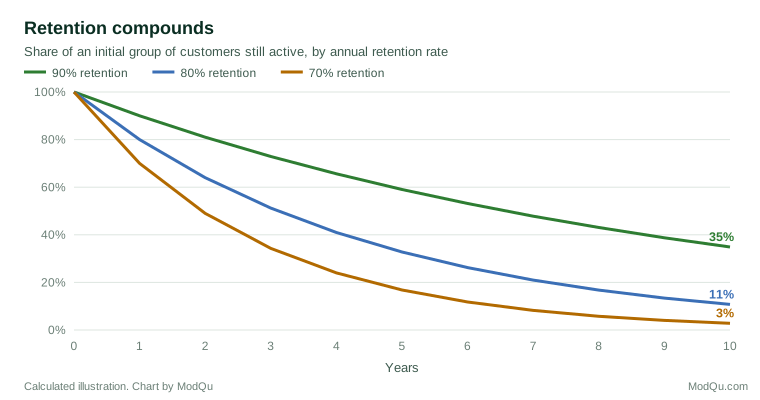
A simple illustration shows why. With an annual margin of 100 per customer and a discount rate of 10%, a customer with an 80% chance of staying each year is worth about 267 over their lifetime, while one with a 90% chance is worth about 450. A ten-point increase in retention raises lifetime value by roughly 70%.
Reichheld and Sasser (1990) drew attention to the economics of retention, arguing that profits from a customer often rise over time as costs of serving them fall and purchases grow. Gupta et al. (2006) reviewed the many models used to estimate lifetime value, from simple formulas to probability models that account for differences between customers.
Where customers can leave without telling the organisation, as in most retailing, it is harder to know who is still a customer. Schmittlein et al. (1987) developed a model that estimates, from each customer's purchase history, the probability that they are still active. Fader et al. (2005) developed a simpler alternative that is easier to estimate and performs similarly.
Loyalty is not always profitable
Long relationships are not automatically profitable. Reinartz and Kumar (2000) studied customers of a catalogue retailer and found that long-life customers were not necessarily more profitable than short-life ones, and that some loyal customers cost more to serve than they generated. Reinartz and Kumar (2002) argued that organisations should manage loyalty and profitability together, rather than assuming that loyal customers are always the most valuable.
Targeting retention with insight
Retention programmes typically target customers predicted to be most likely to leave. Ascarza (2018) showed that this can be a mistake. Analysing field experiments, Ascarza found that the customers most likely to leave were not necessarily those whose behaviour a retention offer would change. Targeting customers by their estimated response to the intervention, rather than by their risk of leaving, produced substantially better results.
This is where insight adds value. Knowing why customers leave, and which reasons can be addressed, helps identify customers who can be retained. A customer leaving because they have moved abroad cannot be saved by a discount; one leaving because of a service failure might be. Rust et al. (2004) argued that marketing investments should be evaluated by their effect on customer equity, the combined lifetime value of all customers, which links retention efforts directly to the value of the business.
An example
Consider a hypothetical streaming service that sends a discount offer every month to the 10% of subscribers its model rates most likely to cancel. Retention among those subscribers looks good, but a test reveals a problem. When a random half of the high-risk group receives no offer, most of them cancel anyway, at almost the same rate as those who received it. The offer is mainly going to people who have already decided to leave.
The insight team then studies why subscribers cancel. Exit surveys and viewing data show two broad groups. One leaves after finishing a particular series and rarely returns whatever it is offered. The other leaves because it is watching less and feels it is not getting value, but responds well to personalised recommendations and a temporary move to a cheaper plan. The second group is smaller in the high-risk list but much more responsive.
The service redesigns its programme. Instead of targeting by risk alone, it estimates for each subscriber how much an intervention is likely to change their behaviour, using the results of further randomised tests, and chooses the intervention to match the likely reason for leaving. The cost of retention offers falls, and the number of subscribers retained rises. Lifetime value improves not because the service spends more on retention, but because it spends on the customers whose decisions can be changed.
Key takeaways
Customer lifetime value estimates the total value of a customer relationship. Because retention compounds over time, small improvements in it have large effects on value. But long relationships are not always profitable, and the customers most likely to leave are not always those who can be persuaded to stay. Retention efforts work best when insight into why customers leave is used to target those whose decision can be changed.
References
Ascarza, E. (2018). Retention futility: Targeting high-risk customers might be ineffective. Journal of Marketing Research, 55(1), 80–98. https://doi.org/10.1509/jmr.16.0163
Fader, P. S., Hardie, B. G. S., & Lee, K. L. (2005). "Counting your customers" the easy way: An alternative to the Pareto/NBD model. Marketing Science, 24(2), 275–284. https://doi.org/10.1287/mksc.1040.0098
Gupta, S., Hanssens, D., Hardie, B., Kahn, W., Kumar, V., Lin, N., Ravishanker, N., & Sriram, S. (2006). Modeling customer lifetime value. Journal of Service Research, 9(2), 139–155. https://doi.org/10.1177/1094670506293810
Gupta, S., Lehmann, D. R., & Stuart, J. A. (2004). Valuing customers. Journal of Marketing Research, 41(1), 7–18. https://doi.org/10.1509/jmkr.41.1.7.25084
Reichheld, F. F., & Sasser, W. E., Jr. (1990). Zero defections: Quality comes to services. Harvard Business Review, 68(5), 105–111.
Reinartz, W. J., & Kumar, V. (2000). On the profitability of long-life customers in a noncontractual setting: An empirical investigation and implications for marketing. Journal of Marketing, 64(4), 17–35. https://doi.org/10.1509/jmkg.64.4.17.18077
Reinartz, W., & Kumar, V. (2002). The mismanagement of customer loyalty. Harvard Business Review, 80(7), 86–94.
Rust, R. T., Lemon, K. N., & Zeithaml, V. A. (2004). Return on marketing: Using customer equity to focus marketing strategy. Journal of Marketing, 68(1), 109–127. https://doi.org/10.1509/jmkg.68.1.109.24030
Schmittlein, D. C., Morrison, D. G., & Colombo, R. (1987). Counting your customers: Who are they and what will they do next? Management Science, 33(1), 1–24. https://doi.org/10.1287/mnsc.33.1.1