
The Generation of Knowledge · Knowledge economy
Information Asymmetry and the Value of Knowledge in Markets
How unequal knowledge between buyers and sellers shapes markets, from Akerlof's market for lemons to signalling, screening, reputation and disclosure, and why independent, trustworthy information has economic value.
Markets work best when buyers and sellers know what they are trading. In practice, one side often knows much more than the other. The seller of a used car knows its history; the buyer does not. A job applicant knows how hard they will work; the employer can only guess. A company's managers know more about its prospects than its investors. Economists call this situation information asymmetry. Since the 1970s, the study of information asymmetry has transformed economics, earning Nobel prizes for George Akerlof, Michael Spence and Joseph Stiglitz in 2001. It explains why some markets fail, why many institutions exist and why trustworthy knowledge has economic value. This article examines the main ideas, the evidence and the implications for those who produce and use information.
Before asymmetry: the price system as a source of knowledge
Hayek (1945) argued that the central economic problem is not how to allocate known resources but how to use knowledge that is dispersed among many people, much of it about particular circumstances of time and place. The price system, he argued, solves this problem remarkably well, because prices carry information: a rise in the price of a material tells users to economise on it, without their needing to know why it has become scarce.
Stigler (1961) added that information is costly to obtain. Buyers must search to find the best price, and because search is costly, they stop before finding the lowest price available. As a result, different sellers can charge different prices for the same good. Information, in this view, is an economic good with costs and benefits, and markets reflect how much of it people find worth acquiring.
The work on asymmetric information went further. It showed that when the parties to a transaction know different things, markets may not just work less well but may fail to work at all.
The market for lemons
Akerlof (1970) used the market for used cars to show how hidden quality can undermine a market. Suppose some used cars are good and some are bad, known in American slang as "lemons". Sellers know which kind they have, but buyers cannot tell them apart before buying. Buyers will therefore offer a price that reflects the average quality of cars on the market. But at that price, owners of good cars, whose cars are worth more than the average, will be reluctant to sell. As they withdraw, the average quality of cars for sale falls, buyers lower their offers, and more owners of relatively good cars withdraw. In the extreme case, the market unravels until only the worst cars are traded, or none at all. Figure 1 illustrates the process with a simple example.
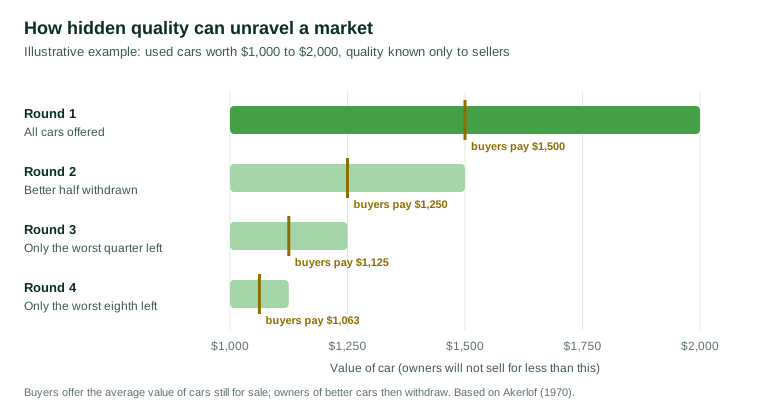
The problem is called adverse selection: because of the hidden information, the goods or customers that remain in the market are disproportionately those that are worse from the uninformed party's point of view. Akerlof showed that the same reasoning applied to many markets, including insurance for older people, employment of minority workers and credit in developing countries. He also noted that many institutions, such as guarantees, brand names and licensing, exist to counteract the problem.
Hidden actions as well as hidden qualities
A related problem arises when one party cannot observe what the other does after an agreement is made. Arrow (1963), writing about medical care, observed that insurance may change behaviour, and that patients must trust doctors whose knowledge far exceeds their own. This problem of hidden action is called moral hazard. Jensen and Meckling (1976) applied similar reasoning to the relationship between shareholders and the managers who run companies on their behalf, showing how the costs of monitoring and aligning managers' interests with owners' shape the structure of firms.
How markets respond
If information asymmetry can undermine markets, why do so many markets with hidden quality continue to work? The answer lies in a range of mechanisms through which information is revealed, inferred or certified.
Signalling
Spence (1973) showed that the informed party can sometimes reveal its type through a costly action. In his model of the job market, employers cannot observe workers' productivity directly. Education can serve as a signal if it is less costly for more productive workers to obtain. Employers then rationally pay more to workers with more education, even if education itself does not make workers more productive, because it reveals who is likely to be productive. The key condition is that the signal must be harder or more expensive for low-quality types to imitate. Spence (2002) later reviewed how signalling had been applied to many settings, including warranties, advertising, dividends and the structure of financial contracts.
Screening
The uninformed party can also act. Rothschild and Stiglitz (1976) showed how insurers can screen customers by offering a menu of contracts. A policy with low premiums and limited coverage appeals to low-risk customers, while one with high coverage at a higher premium appeals to high-risk customers. By choosing, customers reveal their type. Screening allows the market to function, though often at a cost: low-risk customers may be offered less coverage than they would want if their risk could be observed directly.
Stiglitz and Weiss (1981) applied similar reasoning to credit. Because lenders cannot fully observe borrowers' risk or behaviour, raising interest rates may attract riskier borrowers and encourage riskier projects. Lenders may therefore prefer to ration credit, refusing some borrowers even at higher rates, rather than raise prices.
Reputation
Where sellers trade repeatedly, reputation can solve the problem. Shapiro (1983) showed that firms can earn a premium for high quality because they have a reputation to protect: the premium compensates them for the investment in building a reputation and gives them a reason not to cut quality, since doing so would destroy future earnings.
Online markets have made reputation systems explicit. Resnick and Zeckhauser (2002) studied the feedback system on the auction site eBay, through which buyers and sellers rate each other after each transaction. They found that the system worked better than might be expected, encouraging trade among strangers, although feedback was overwhelmingly positive and the effect of reputation on prices was modest. Luca (2016) studied restaurant reviews on the website Yelp and found that a higher rating led to higher revenue for independent restaurants, while chain restaurants, whose brands already conveyed information, were less affected.
Disclosure and certification
Information can also be provided by third parties or required by law. Dranove and Jin (2010) reviewed research on quality disclosure and certification, such as report cards for hospitals and schools, product ratings and certification marks. They found that disclosure often improved the information available to consumers and gave sellers incentives to improve quality, but that its effects depended on how the information was designed and whether consumers understood it.
Jin and Leslie (2003) studied a striking example. In 1998, Los Angeles County began requiring restaurants to display hygiene grade cards in their windows, showing the result of their latest inspection. After the cards were introduced, inspection scores improved, consumers shifted towards restaurants with better grades and hospital admissions for food-borne illness in the county fell. Making existing knowledge visible changed the behaviour of both buyers and sellers.
The limits of the remedies
None of these responses is perfect. Signals can be wasteful: in Spence's (1973) model, education that reveals productivity without increasing it is a cost to society, paid only because information is hidden. Screening can leave some customers worse served than they would be if their type were known. Reputation systems can be distorted by fake or strategic reviews, and they work poorly for new sellers, who have no history to show. Certification depends on the independence and competence of the certifier; when certifiers are paid by those they assess, they may face pressure to be lenient. Disclosure helps only if the information disclosed is accurate, relevant and understood. Each remedy reduces the problem of hidden information but introduces costs and risks of its own, and markets usually rely on several remedies at once.
Information asymmetry in financial markets
Financial markets are built on information. Myers and Majluf (1984) showed that when managers know more about a firm's value than outside investors, the decision to issue new shares can itself be read as a signal that managers think the shares are overvalued. Investors therefore react negatively to share issues, and firms may forgo good investments rather than raise equity on unfavourable terms.
Healy and Palepu (2001) reviewed research on corporate disclosure and concluded that information asymmetry between managers and investors creates demand for financial reporting, audits, analysts and rating agencies. Better disclosure is associated with greater liquidity and a lower cost of capital, because investors require less compensation for the risk of trading with better-informed parties.
Fama (1970) set out the efficient markets hypothesis, according to which prices fully reflect available information. Grossman and Stiglitz (1980) identified a paradox in this idea. If prices fully reflected all information, nobody would have an incentive to spend money gathering information, because they could simply read it from prices. But if nobody gathered information, prices could not reflect it. They concluded that markets must be somewhat inefficient, so that those who invest in information earn a return that covers its cost. This insight explains why there is a market for research and analysis at all.
What the evidence shows
Empirical research has found that the effects of information asymmetry vary considerably between markets.
In the market Akerlof used as his example, evidence is mixed. Bond (1982) compared used pickup trucks that had been bought second-hand with those still owned by their original buyers and found no evidence that traded trucks needed more maintenance, suggesting that mechanisms such as inspection and reputation had limited the problem. Genesove (1993) studied wholesale used-car auctions and found evidence of adverse selection for some sellers but not others, consistent with the idea that the strength of the problem depends on the incentives and reputations of particular sellers.
In insurance, Finkelstein and Poterba (2004) studied annuities in the United Kingdom, which pay an income for life. They found that people who bought annuities with features more valuable to those expecting to live longer did tend to live longer, evidence of adverse selection along those features.
Stiglitz (2000) argued that the economics of information had changed economics as a whole, showing that many results of traditional theory depended on the assumption of perfect information, and that once information is imperfect and unequal, markets may not be efficient, and institutions and policies can make a difference.
The value of information
If information asymmetry causes problems, then information that reduces it has value. But what determines that value?
Private and social value
Hirshleifer (1971) distinguished between the private and social value of information. Information that helps a trader anticipate a price change may be very valuable to the trader, who can profit from it, while adding little to society, because it merely redistributes wealth from less informed to better informed traders. Information that improves decisions about production, on the other hand, such as knowledge of which products customers want or which technologies work, creates value for society as well. This distinction matters for judging whether investment in information is socially worthwhile.
Experience goods and credence goods
Nelson (1970) distinguished between search goods, whose quality can be judged before purchase, and experience goods, whose quality can be judged only after use. Darby and Karni (1973) added credence goods, whose quality may never be fully known by the buyer, even after use, such as many medical, legal and repair services. The harder quality is to judge, the more buyers depend on reputation, certification and trusted advice, and the greater the scope for exploitation by sellers.
Research and data products have many of the features of credence goods. A client who buys a survey cannot easily check whether the sample was drawn properly, whether the questions were well designed or whether the data were processed correctly. Even after using the results, the client may never know whether a different and better study would have reached a different conclusion. This puts research markets at risk of the problems Akerlof described: if clients cannot tell good research from bad, they may be unwilling to pay for quality, and good providers may struggle to compete with cheaper, poorer ones.
Implications for research and information providers
The theory of information asymmetry suggests how providers of research and data can earn trust and how clients can protect themselves.
Transparency as a signal. A provider that discloses its methods in full, including sample design, response rates, weighting and question wording, sends a signal that is costly to imitate for a provider with poor methods, because disclosure invites scrutiny. Professional codes of practice in survey research encourage such disclosure for this reason.
Certification and standards. Independent quality standards and certification schemes allow clients to rely on a third party's assessment rather than their own. As Dranove and Jin (2010) found for other markets, their value depends on whether they measure what matters and whether users understand them.
Reputation. In markets for research, as in others, reputation built over repeated transactions gives providers a reason to maintain quality. A provider whose findings are later shown to be accurate, and who reports uncertainty honestly, builds a reputation that commands a premium.
Screening by clients. Clients can screen providers by asking for methodological details, requesting pilot results, comparing findings with other sources and including checks, such as questions with known answers, that test data quality.
Aligning incentives. Moral hazard arises in research when providers face incentives to cut corners that clients cannot observe, such as reducing effort to improve response rates or using cheaper samples. Contracts that specify quality measures, and relationships that reward reliability over time, reduce this risk.
Asymmetry inside research itself
Information asymmetry also arises within the process of research. Respondents to a survey know their own circumstances, opinions and behaviour; the researcher knows only what respondents choose to report. When respondents have reasons to conceal or embellish, such as on sensitive topics, or when they give little effort to answering, the data may be biased in ways the researcher cannot see. Survey methods address this problem in ways that echo the market remedies described above. Anonymity and confidentiality reduce respondents' incentives to conceal. Carefully designed questions make honest answers easier. Checks for inattentive or inconsistent responding screen out unreliable data. And transparency about how data were collected allows users to judge how much weight the results can bear.
Information as a public concern
Information asymmetry also concerns policy. Governments require disclosure in many markets, license professions, regulate advertising and publish statistics, partly to reduce asymmetries that markets alone cannot resolve. Official statistics, for example, provide a shared base of trustworthy information on prices, employment and economic activity that individual market participants could not produce for themselves.
In the digital economy, new asymmetries have emerged. Online platforms often know far more about their users than users know about how their data are used. Reputation systems can be manipulated by fake reviews. Algorithms that rank products or set prices may be opaque. Each of these raises the old question in a new form: how can those with less information trust those with more?
Questions for buyers of information
The theory suggests a few simple questions that any buyer of research or data can ask. Who produced the information, and what do they gain if it points one way rather than another? What has been disclosed about how it was produced, and could an independent expert check it? Is there a track record against which past information from the same source can be judged? And is there a way to test some part of the information against another source? Asking these questions does not remove the asymmetry, but it reduces the risk of paying for information whose quality cannot be known.
Conclusion
Information asymmetry is one of the most important ideas in modern economics. When one side of a market knows more than the other, adverse selection and moral hazard can reduce the quality of what is traded, distort prices and, in extreme cases, cause markets to fail. Markets and societies have developed many responses: signalling, screening, reputation, warranties, disclosure, certification and regulation. Each works by making hidden knowledge visible or by giving those who hold it reasons to act honestly. The theory also explains why trustworthy information has economic value, and why it is hard to sell: its quality is often difficult to judge. For providers of research and data, the lessons are clear. Transparency, independent standards and a reputation for reliability are not merely matters of professional ethics; they are the means by which good information can be told apart from bad.
References
Akerlof, G. A. (1970). The market for "lemons": Quality uncertainty and the market mechanism. Quarterly Journal of Economics, 84(3), 488–500. https://doi.org/10.2307/1879431
Arrow, K. J. (1963). Uncertainty and the welfare economics of medical care. American Economic Review, 53(5), 941–973.
Bond, E. W. (1982). A direct test of the "lemons" model: The market for used pickup trucks. American Economic Review, 72(4), 836–840.
Darby, M. R., & Karni, E. (1973). Free competition and the optimal amount of fraud. Journal of Law and Economics, 16(1), 67–88. https://doi.org/10.1086/466756
Dranove, D., & Jin, G. Z. (2010). Quality disclosure and certification: Theory and practice. Journal of Economic Literature, 48(4), 935–963. https://doi.org/10.1257/jel.48.4.935
Fama, E. F. (1970). Efficient capital markets: A review of theory and empirical work. Journal of Finance, 25(2), 383–417. https://doi.org/10.2307/2325486
Finkelstein, A., & Poterba, J. (2004). Adverse selection in insurance markets: Policyholder evidence from the U.K. annuity market. Journal of Political Economy, 112(1), 183–208. https://doi.org/10.1086/379936
Genesove, D. (1993). Adverse selection in the wholesale used car market. Journal of Political Economy, 101(4), 644–665. https://doi.org/10.1086/261891
Grossman, S. J., & Stiglitz, J. E. (1980). On the impossibility of informationally efficient markets. American Economic Review, 70(3), 393–408.
Hayek, F. A. (1945). The use of knowledge in society. American Economic Review, 35(4), 519–530.
Healy, P. M., & Palepu, K. G. (2001). Information asymmetry, corporate disclosure, and the capital markets: A review of the empirical disclosure literature. Journal of Accounting and Economics, 31(1–3), 405–440. https://doi.org/10.1016/S0165-4101(01)00018-0
Hirshleifer, J. (1971). The private and social value of information and the reward to inventive activity. American Economic Review, 61(4), 561–574.
Jensen, M. C., & Meckling, W. H. (1976). Theory of the firm: Managerial behavior, agency costs and ownership structure. Journal of Financial Economics, 3(4), 305–360. https://doi.org/10.1016/0304-405X(76)90026-X
Jin, G. Z., & Leslie, P. (2003). The effect of information on product quality: Evidence from restaurant hygiene grade cards. Quarterly Journal of Economics, 118(2), 409–451. https://doi.org/10.1162/003355303321675428
Luca, M. (2016). Reviews, reputation, and revenue: The case of Yelp.com (Working Paper No. 12-016). Harvard Business School.
Myers, S. C., & Majluf, N. S. (1984). Corporate financing and investment decisions when firms have information that investors do not have. Journal of Financial Economics, 13(2), 187–221. https://doi.org/10.1016/0304-405X(84)90023-0
Nelson, P. (1970). Information and consumer behavior. Journal of Political Economy, 78(2), 311–329. https://doi.org/10.1086/259630
Resnick, P., & Zeckhauser, R. (2002). Trust among strangers in Internet transactions: Empirical analysis of eBay's reputation system. In M. R. Baye (Ed.), The economics of the Internet and e-commerce (Advances in Applied Microeconomics, Vol. 11, pp. 127–157). Emerald Group Publishing. https://doi.org/10.1016/S0278-0984(02)11030-3
Rothschild, M., & Stiglitz, J. (1976). Equilibrium in competitive insurance markets: An essay on the economics of imperfect information. Quarterly Journal of Economics, 90(4), 629–649. https://doi.org/10.2307/1885326
Shapiro, C. (1983). Premiums for high quality products as returns to reputations. Quarterly Journal of Economics, 98(4), 659–679. https://doi.org/10.2307/1881782
Spence, M. (1973). Job market signaling. Quarterly Journal of Economics, 87(3), 355–374. https://doi.org/10.2307/1882010
Spence, M. (2002). Signaling in retrospect and the informational structure of markets. American Economic Review, 92(3), 434–459. https://doi.org/10.1257/00028280260136200
Stigler, G. J. (1961). The economics of information. Journal of Political Economy, 69(3), 213–225. https://doi.org/10.1086/258464
Stiglitz, J. E. (2000). The contributions of the economics of information to twentieth century economics. Quarterly Journal of Economics, 115(4), 1441–1478.
Stiglitz, J. E., & Weiss, A. (1981). Credit rationing in markets with imperfect information. American Economic Review, 71(3), 393–410.