
The Generation of Knowledge · Knowledge economy
The Economics of Information: Knowledge as a Public Good
Why economists describe knowledge as a public good, what follows for how much knowledge markets produce, how patents, public funding and open science respond to the problem, and what it means for data and research.
Knowledge has unusual economic properties. Once a theorem has been proved, a medicine discovered or a survey published, any number of people can use it without reducing what is available to others. And once it is known, it is often hard to stop people from using it. These two properties make knowledge, in economists' terms, a public good. This article explains what that means, why it causes markets to produce too little knowledge, how societies have responded and what it implies for those who produce and sell research and data.
Public goods
Samuelson (1954) defined a public good as one that everyone can consume without reducing anyone else's consumption. Economists now usually describe public goods by two properties. They are non-rival: one person's use does not reduce what others can use. And they are non-excludable: it is difficult or costly to prevent people from using them. National defence and street lighting are standard examples.
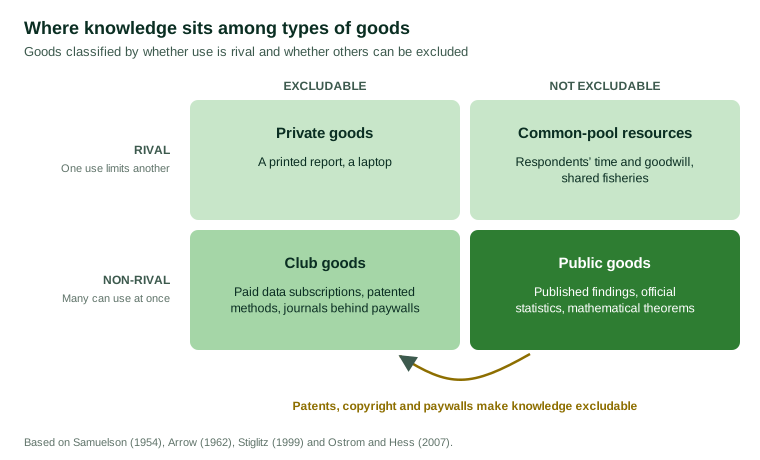
Goods can be classified by these two properties, as Figure 1 shows. Private goods, such as food or a laptop, are rival and excludable. Club goods, such as a subscription service, are non-rival but excludable. Common-pool resources, such as fisheries, are rival but hard to exclude people from. Ostrom and Hess (2007) argued that knowledge can fall into different categories depending on how it is stored and governed: an idea is naturally non-rival, but books, databases and legal rules can make access to it excludable.
Why knowledge is a public good
Arrow (1962) set out the economic problem of knowledge in a classic essay on invention. He noted three difficulties. First, knowledge is indivisible and costly to produce but cheap to reproduce: the cost of discovering something is large, while the cost of passing it on is small. Second, it is hard to appropriate: once knowledge is revealed, the producer cannot easily stop others from using it without paying. Third, there is a paradox in selling it: a buyer cannot judge the value of information without knowing it, but once the buyer knows it, they have acquired it without paying.
Nelson (1959) applied this reasoning to basic scientific research. Because the results of basic research are uncertain, often far removed from commercial use and easily used by others once published, private firms will invest less in it than would be best for society. Nelson argued that this justified public funding of basic science.
Stiglitz (1999) extended the argument, describing knowledge as a global public good. A mathematical theorem or a scientific discovery can benefit people everywhere, and knowledge about health, agriculture or the environment can be used across borders. Because no single country captures all the benefits of the knowledge it produces, he argued, each has reason to invest less than the world as a whole would want.
Too little knowledge
The public-good properties of knowledge lead to a central prediction: markets will produce less knowledge than is socially desirable, because producers capture only part of its value. Others benefit through spillovers, by using, building on or imitating new knowledge.
Empirical research supports this prediction. Mansfield et al. (1977) studied a sample of industrial innovations and estimated both the return to the innovating firm and the return to society, including benefits to customers and imitators. The median social return was roughly twice the median private return. Griliches (1992) reviewed studies of R&D spillovers and concluded that they were substantial and that social returns to R&D exceeded private returns. Jones and Williams (1998) used a model of economic growth to estimate that the optimal level of R&D investment in the United States was several times higher than actual investment. Bloom et al. (2013) separated the beneficial effects of knowledge spillovers from the competitive effects of rivalry between firms, and again found that the social returns to R&D were well above the private returns.
How societies respond
If markets underproduce knowledge, how can more be encouraged? Three main responses have developed, each with strengths and drawbacks.
Intellectual property
The first response is to make knowledge excludable through intellectual property such as patents and copyright. A patent gives an inventor the exclusive right to use an invention for a limited time, in exchange for publishing how it works. This allows inventors to earn a return, which encourages invention.
But intellectual property has costs. While the patent lasts, the price of the invention is higher than the near-zero cost of sharing it, so some people who could benefit do not use it. Nordhaus (1969) analysed this trade-off between encouraging invention and restricting use, which determines the best length of patent protection. Heller and Eisenberg (1998) warned that in biomedical research, too many overlapping patents on research tools and gene fragments could create an anticommons, in which the need to obtain many licences discourages further research. Williams (2013) studied genes sequenced by the private company Celera, whose data were protected by contract-based restrictions until they were placed in the public domain, and found that the restrictions were associated with less subsequent scientific research and product development on those genes. Moser (2013) reviewed historical evidence and found that patent laws had less effect on the overall rate of innovation than is often assumed, though they influenced its direction.
Public funding
The second response is for governments to fund knowledge directly, through universities, research councils, public laboratories and statistical agencies. Public funding is especially important for basic research, whose benefits are broad, uncertain and distant from the market (Nelson, 1959).
Official statistics are a clear example. Data on population, prices, employment, trade and output are used by governments, businesses and citizens alike. If each user had to collect such data for themselves, the cost would be enormous and the results inconsistent. The United Nations' Fundamental Principles of Official Statistics describe official statistics as an indispensable element of the information system of a democratic society, to be compiled impartially and made available on an equal basis (United Nations General Assembly, 2014).
Open science and reward by priority
The third response lies in the institutions of science itself. Merton (1973) described the norm of communism in science, by which findings are treated as common property, shared openly so that others can test and build on them. Scientists are rewarded not by selling their findings but by the recognition that comes from being first to publish them. Dasgupta and David (1994) analysed this system economically, arguing that the priority rule solves part of the public-good problem: by rewarding scientists for disclosing findings quickly, it encourages both the production and the sharing of knowledge.
Selling information goods
Not all knowledge is a pure public good. Much commercially produced information can be made excludable through contracts, access controls and copyright, and sold. Shapiro and Varian (1999) analysed how businesses sell information goods, which are costly to produce but cheap to copy. Because the cost of an extra copy is close to zero, prices cannot be based on cost. Instead, sellers price according to the value to different customers, offering different versions at different prices, bundling products together and using subscriptions.
Even so, sellers of information face the difficulties Arrow (1962) identified. Buyers cannot judge the value of information before they have it, and once sold, information can be shared beyond the original buyer. Sellers respond with samples, previews, reputations and licensing terms.
Data as a non-rival good
The same reasoning applies to data. A dataset can be analysed by many people at once without being used up, so data are non-rival. Jones and Tonetti (2020) examined the economic consequences of this property. They argued that because data can be used by many firms simultaneously, the economy as a whole gains when data are used widely, but individual firms that hold data have reasons to keep them to themselves, both to protect their competitive position and because they cannot easily charge others for them. The result can be that data are used less widely than would be best. Jones and Tonetti also considered who should control data and concluded that giving consumers more control over data about themselves could lead to wider and more beneficial use, because consumers would weigh the gains from sharing against concerns about privacy.
These questions are now central to debates about data policy, from open government data to rules on data portability and data sharing between businesses.
Respondents as a shared resource
One part of the research process is rival rather than non-rival: the time and goodwill of the people who take part in surveys. Each request for participation uses some of a limited resource. When people are asked to complete too many surveys, or surveys that are too long or poorly designed, they become less willing to take part in any of them. In this sense, public willingness to participate in research is a common-pool resource, shared by all who conduct surveys and at risk of being overused. No single research organisation bears the full cost of over-surveying, so each has a reason to ask more than would be best for the field as a whole. Professional standards that encourage short, relevant and respectful surveys help protect this shared resource, on which all survey-based knowledge depends.
Implications for research and data
For organisations that produce research and data, the public-good nature of knowledge has several consequences.
Some knowledge is better shared. Methodological knowledge, such as which survey methods work and how to correct for bias, benefits the whole field when shared openly, and providers that contribute to it build reputations that support their commercial work.
Commercial knowledge must be excludable to be sold. Client-specific research and proprietary datasets are sold as club goods, with access controlled by contract. Their value depends partly on their exclusivity.
Public data provide a shared foundation. Official statistics and open datasets give commercial researchers benchmarks against which to weight and check their own samples. Commercial research and public statistics are complements, not just competitors.
Spillovers benefit society. Findings published from commercial research, such as summaries released to the media, add to public knowledge, even when the full data remain private.
Conclusion
Knowledge is non-rival and often non-excludable, which makes it a public good. As a result, markets alone tend to produce less of it than society would want, because producers capture only part of the value they create. Societies respond with intellectual property, public funding and the open norms of science, each of which helps but brings its own costs. For research and data organisations, the economics of knowledge as a public good explains why some knowledge is sold under licence, why some is better shared and why public and private sources of evidence depend on one another.
References
Arrow, K. J. (1962). Economic welfare and the allocation of resources for invention. In National Bureau of Economic Research (Ed.), The rate and direction of inventive activity: Economic and social factors (pp. 609–626). Princeton University Press.
Bloom, N., Schankerman, M., & Van Reenen, J. (2013). Identifying technology spillovers and product market rivalry. Econometrica, 81(4), 1347–1393. https://doi.org/10.3982/ECTA9466
Dasgupta, P., & David, P. A. (1994). Toward a new economics of science. Research Policy, 23(5), 487–521. https://doi.org/10.1016/0048-7333(94)01002-1
Griliches, Z. (1992). The search for R&D spillovers. Scandinavian Journal of Economics, 94(Suppl.), S29–S47. https://doi.org/10.2307/3440244
Heller, M. A., & Eisenberg, R. S. (1998). Can patents deter innovation? The anticommons in biomedical research. Science, 280(5364), 698–701. https://doi.org/10.1126/science.280.5364.698
Jones, C. I., & Tonetti, C. (2020). Nonrivalry and the economics of data. American Economic Review, 110(9), 2819–2858. https://doi.org/10.1257/aer.20191330
Jones, C. I., & Williams, J. C. (1998). Measuring the social return to R&D. Quarterly Journal of Economics, 113(4), 1119–1135. https://doi.org/10.1162/003355398555856
Mansfield, E., Rapoport, J., Romeo, A., Wagner, S., & Beardsley, G. (1977). Social and private rates of return from industrial innovations. Quarterly Journal of Economics, 91(2), 221–240. https://doi.org/10.2307/1885415
Merton, R. K. (1973). The sociology of science: Theoretical and empirical investigations. University of Chicago Press.
Moser, P. (2013). Patents and innovation: Evidence from economic history. Journal of Economic Perspectives, 27(1), 23–44. https://doi.org/10.1257/jep.27.1.23
Nelson, R. R. (1959). The simple economics of basic scientific research. Journal of Political Economy, 67(3), 297–306. https://doi.org/10.1086/258177
Nordhaus, W. D. (1969). Invention, growth, and welfare: A theoretical treatment of technological change. MIT Press.
Ostrom, E., & Hess, C. (2007). A framework for analyzing the knowledge commons. In C. Hess & E. Ostrom (Eds.), Understanding knowledge as a commons: From theory to practice (pp. 41–81). MIT Press.
Samuelson, P. A. (1954). The pure theory of public expenditure. Review of Economics and Statistics, 36(4), 387–389. https://doi.org/10.2307/1925895
Shapiro, C., & Varian, H. R. (1999). Information rules: A strategic guide to the network economy. Harvard Business School Press.
Stiglitz, J. E. (1999). Knowledge as a global public good. In I. Kaul, I. Grunberg, & M. A. Stern (Eds.), Global public goods: International cooperation in the 21st century (pp. 308–325). Oxford University Press.
United Nations General Assembly. (2014). Fundamental principles of official statistics (A/RES/68/261). United Nations.
Williams, H. L. (2013). Intellectual property rights and innovation: Evidence from the human genome. Journal of Political Economy, 121(1), 1–27. https://doi.org/10.1086/669706