
The Generation of Knowledge · Knowledge economy
The Market for Data and Research Products
How the market for data and research is organised, from custom and syndicated research to analytics and data brokers, how such products are priced, how buyers judge quality and how the market is changing.
Organisations buy knowledge as well as producing it. They commission surveys, subscribe to market trackers, buy consumer data, hire analysts and draw on official statistics. Together, these purchases make up a substantial market for data and research products. This article describes how that market is organised, the economic features that shape it, how buyers can judge what they are buying and how the market has changed with new technology.
What is bought and sold
Products in this market can be classified in two ways: by how the data arise, and by whether a product is made for one buyer or sold to many. Figure 1 maps the main types.
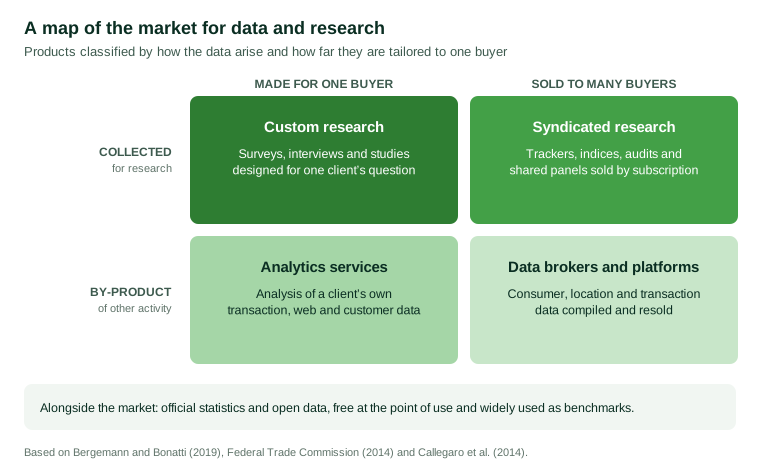
Custom research is designed for a single client to answer a particular question, such as whether a new product will appeal to a target market or why customers are leaving. The client usually owns the results.
Syndicated research is produced once and sold to many clients. Examples include market share audits, consumer trackers, opinion indices and industry reports. Because costs are shared, each buyer pays less than for a custom study, but the product is the same for everyone.
Analytics services help clients make use of data they already hold, such as records of transactions, website visits or customer contacts.
Data brokers and platforms compile data generated as a by-product of other activities, such as purchases, online behaviour and location, and sell them, often to many buyers. The Federal Trade Commission (2014) studied nine data brokers in the United States and found that they collected vast amounts of information about consumers, largely without consumers' knowledge, and combined it into products for marketing, risk mitigation and people search.
Alongside the market sit official statistics and open data, provided free at the point of use by governments and public bodies. They are not sold, but they shape the market: they provide benchmarks that commercial researchers use to weight and check their samples, and they set expectations of what reliable data look like.
The economics of selling information
Information products share the economic features of other knowledge goods. They are costly to produce but cheap to copy. Shapiro and Varian (1999) showed that sellers of such goods cannot price according to cost, because the cost of an extra copy is close to zero. Instead they price according to value, using strategies such as versioning, offering different versions at different prices so that customers select themselves, and bundling several products together.
Bergemann and Bonatti (2019) reviewed the economics of markets for information. They distinguished between selling data directly and selling the results of analysis, and showed that sellers often do better by selling information tailored to a buyer's decision than by selling raw data. Bergemann et al. (2018) analysed how a monopolist should design and price information for buyers with different prior knowledge, and found that the seller should offer a menu of more and less informative products, with the most informative sold to those who value it most.
Information is also an experience good, and often a credence good. Buyers cannot judge its quality before purchase, and may never fully judge it afterwards (Nelson, 1970; Darby & Karni, 1973). As Akerlof (1970) showed for other markets, when buyers cannot distinguish good quality from bad, they may be unwilling to pay for quality, and good producers may be driven out. Markets for research rely on reputation, disclosure and standards to counter this risk.
Pricing in practice
In practice, the prices of research products reflect these economic features. Custom research is usually priced on the basis of the work involved: the number and type of respondents, the length of the questionnaire, the difficulty of reaching the people required and the depth of analysis and reporting. Hard-to-reach groups, such as senior executives or people with rare conditions, cost much more per interview than members of the general public. Syndicated products are usually sold by subscription, often in tiers, with basic summaries at a lower price and detailed data, more frequent updates or custom analysis at higher prices, a direct application of versioning. Data products are often licensed rather than sold outright, with terms that restrict how buyers may use and share the data, so that the seller can continue to sell the same data to others.
Who buys and why
Buyers of data and research include businesses, governments, public bodies, charities, political parties, media organisations and academic researchers. Their purposes differ. Businesses commission research to understand customers, test products, track brands and assess markets. Governments and public bodies need evidence to design and evaluate policies and services. Media organisations commission polls to report public opinion. In each case, the buyer is paying not for data as such but for reduced uncertainty about a decision or a question. The value of a research product therefore depends on the buyer's situation as much as on the product itself: the same survey may be worth a great deal to one organisation facing a major decision and little to another.
Judging quality
Because quality is hard to observe, the market has developed several mechanisms to help buyers.
Standards. International standards set requirements for research service providers. ISO 20252 specifies requirements for market, opinion and social research, covering matters such as project management, data collection, sampling, data processing and reporting (International Organization for Standardization, 2019). Certification against such standards gives buyers an independent check.
Codes of practice. Professional bodies publish codes that require researchers to be honest, protect respondents and disclose methods. The ICC/ESOMAR International Code (ICC/ESOMAR, 2016) sets out such principles for market, opinion and social research and data analytics.
Disclosure. A provider that reports its methods in full, including how the sample was drawn, response rates, weighting and question wording, allows buyers to judge the strength of the evidence. Dranove and Jin (2010) found that in many markets, quality disclosure improves both buyers' choices and sellers' incentives.
Evidence on methods. Research on research also helps buyers. Baker et al. (2010) reviewed evidence on online panels for the American Association for Public Opinion Research and cautioned that results from non-probability online panels should not be treated as representative of the general population without careful justification. Yeager et al. (2011) compared surveys conducted by telephone with probability samples, internet surveys with probability samples and internet surveys with non-probability samples, and found that the probability-based surveys were consistently more accurate when compared with official benchmarks. Such evidence gives buyers a basis for asking the right questions.
A changing market
The market for data and research has changed considerably. Groves (2011) described three eras of survey research: an era of invention up to about 1960, an era of expansion to about 1990, when telephone surveys became dominant, and an era of designed data supplemented by organic data, the data generated as a by-product of digital life. Couper (2017) reviewed how data collection had shifted towards online and mobile methods, and how the declining willingness of people to respond to surveys had increased costs and raised questions about quality.
Several trends stand out.
Online data collection. Online panels have greatly reduced the cost and time of collecting survey data, but raised questions about representativeness and data quality (Callegaro et al., 2014).
Self-service tools. Software platforms allow organisations to design and field their own surveys, reducing their need for specialist providers for simple studies while increasing the risk of poorly designed research.
Organic and big data. Transaction, web and social media data offer large volumes of information about behaviour. They complement surveys but cannot replace them, because they rarely measure attitudes, motives or the views of people who leave no digital trace.
Data-driven decision-making. Brynjolfsson and McElheran (2016) found that data-driven decision-making spread rapidly through American manufacturing in the decade after 2005, increasing demand for data and analysis.
Privacy and regulation. Growing concern about personal data has led to stricter rules on how data about individuals can be collected, combined and sold, affecting data brokers in particular.
Implications for buyers and providers
For buyers, the main lesson is to match the product to the decision. Syndicated data are efficient for questions many organisations share; custom research is needed for questions specific to one organisation. Buyers should ask how data were collected, from whom and with what checks, and should prefer providers that disclose their methods.
For providers, the lesson is that trust is the basis of the market. Because buyers cannot easily observe quality, providers that invest in transparent methods, independent standards and a record of accurate results earn a premium that less careful competitors cannot easily match.
Conclusion
The market for data and research products includes custom research, syndicated products, analytics services and data brokers, alongside free official statistics and open data. Its economics are shaped by the features of information goods: high production costs, low copying costs and quality that is hard to observe. Pricing strategies such as versioning and bundling, and quality mechanisms such as standards, codes and disclosure, have developed in response. The market continues to change with online methods, new data sources and new rules on privacy, but its foundation remains the same: buyers pay for information they can trust.
References
Akerlof, G. A. (1970). The market for "lemons": Quality uncertainty and the market mechanism. Quarterly Journal of Economics, 84(3), 488–500. https://doi.org/10.2307/1879431
Baker, R., Blumberg, S. J., Brick, J. M., Couper, M. P., Courtright, M., Dennis, J. M., Dillman, D., Frankel, M. R., Garland, P., Groves, R. M., Kennedy, C., Krosnick, J., Lavrakas, P. J., Lee, S., Link, M., Piekarski, L., Rao, K., Thomas, R. K., & Zahs, D. (2010). Research synthesis: AAPOR report on online panels. Public Opinion Quarterly, 74(4), 711–781. https://doi.org/10.1093/poq/nfq048
Bergemann, D., & Bonatti, A. (2019). Markets for information: An introduction. Annual Review of Economics, 11, 85–107. https://doi.org/10.1146/annurev-economics-080315-015439
Bergemann, D., Bonatti, A., & Smolin, A. (2018). The design and price of information. American Economic Review, 108(1), 1–48. https://doi.org/10.1257/aer.20161079
Brynjolfsson, E., & McElheran, K. (2016). The rapid adoption of data-driven decision-making. American Economic Review, 106(5), 133–139. https://doi.org/10.1257/aer.p20161016
Callegaro, M., Baker, R., Bethlehem, J., Göritz, A. S., Krosnick, J. A., & Lavrakas, P. J. (Eds.). (2014). Online panel research: A data quality perspective. Wiley. https://doi.org/10.1002/9781118763520
Couper, M. P. (2017). New developments in survey data collection. Annual Review of Sociology, 43, 121–145. https://doi.org/10.1146/annurev-soc-060116-053613
Darby, M. R., & Karni, E. (1973). Free competition and the optimal amount of fraud. Journal of Law and Economics, 16(1), 67–88. https://doi.org/10.1086/466756
Dranove, D., & Jin, G. Z. (2010). Quality disclosure and certification: Theory and practice. Journal of Economic Literature, 48(4), 935–963. https://doi.org/10.1257/jel.48.4.935
Federal Trade Commission. (2014). Data brokers: A call for transparency and accountability. Federal Trade Commission.
Groves, R. M. (2011). Three eras of survey research. Public Opinion Quarterly, 75(5), 861–871. https://doi.org/10.1093/poq/nfr057
ICC/ESOMAR. (2016). ICC/ESOMAR international code on market, opinion and social research and data analytics. ESOMAR.
International Organization for Standardization. (2019). Market, opinion and social research, including insights and data analytics: Vocabulary and service requirements (ISO Standard No. 20252:2019). ISO.
Nelson, P. (1970). Information and consumer behavior. Journal of Political Economy, 78(2), 311–329. https://doi.org/10.1086/259630
Shapiro, C., & Varian, H. R. (1999). Information rules: A strategic guide to the network economy. Harvard Business School Press.
Yeager, D. S., Krosnick, J. A., Chang, L., Javitz, H. S., Levendusky, M. S., Simpser, A., & Wang, R. (2011). Comparing the accuracy of RDD telephone surveys and internet surveys conducted with probability and non-probability samples. Public Opinion Quarterly, 75(4), 709–747. https://doi.org/10.1093/poq/nfr020