
The Generation of Knowledge · Knowledge economy
Information Goods: Pricing and Selling Knowledge
Why information goods cannot be priced like ordinary products, and how sellers of knowledge use value-based pricing, versioning, bundling, subscriptions, free samples and reputation to sell reports, data and research.
A research report, a database or a piece of analysis may cost a great deal to produce, yet very little to copy and send to another customer. Economists call products with this cost structure information goods. Because their costs behave so differently from those of physical products, the usual rules for setting prices do not apply. This article explains the economics of information goods and the strategies that sellers of knowledge use to price and sell them.
The cost structure of information
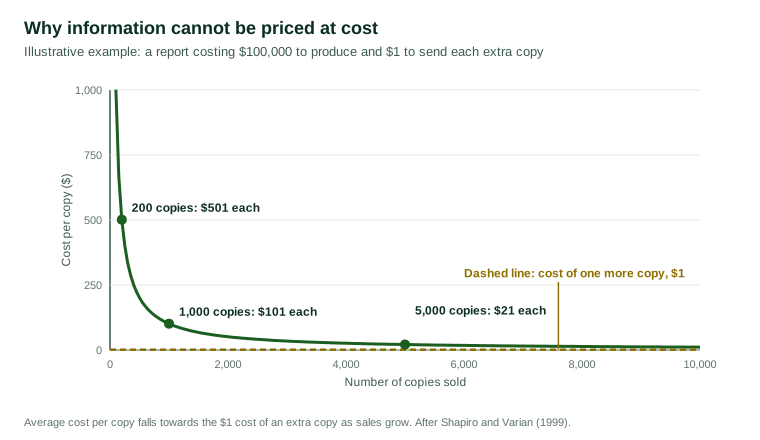
Shapiro and Varian (1999) summarised the defining feature of information goods: they are costly to produce but cheap to reproduce. The first copy of a report requires research, analysis and writing; each further copy costs almost nothing, especially in digital form. Most costs are fixed and sunk: they do not vary with the number of copies sold, and they cannot be recovered if the product fails.
Figure 1 shows what follows. As sales grow, the average cost per copy falls steadily towards the very small cost of an extra copy. If competition drove prices down to that extra cost, as it tends to do for ordinary goods, sellers could never recover the cost of producing the first copy. Information goods must therefore be priced according to their value to buyers, not their cost.
Information goods have two further features that complicate selling them. They are experience goods: buyers cannot judge their value before using them (Nelson, 1970). And they are vulnerable to the paradox identified by Arrow (1962): revealing information to show its value may give it away.
Pricing by value
Because buyers value information very differently, sellers gain by charging different prices to different buyers, a practice economists call price discrimination. Varian (1989) reviewed its forms. In the most precise form, each buyer pays a personal price; more commonly, sellers set different prices for different groups, such as students and businesses, or let buyers choose among options that reveal how much they value the product.
Versioning
Shapiro and Varian (1999) argued that the most effective strategy for information goods is versioning: offering a product line of different versions designed to appeal to different types of buyer. Versions can differ in timeliness, detail, completeness, convenience, support or the rights granted. A summary report may be sold cheaply, the full report at a higher price and the underlying data with analytical support at a higher price still. Buyers who value the product most choose the premium version, while others buy cheaper ones, so the seller reaches more of the market than a single price would allow.
Deneckere and McAfee (1996) showed that sellers sometimes deliberately create inferior versions of a product, which they called damaged goods, at extra cost, so as to sell to buyers who would not pay for the full version. With information goods, creating such versions is often cheap, which makes versioning especially attractive. Bergemann et al. (2018) showed that a seller of information facing buyers with different prior knowledge does best by offering a menu of more and less informative products.
Bundling
Information goods are also often sold in bundles, such as a subscription to a collection of reports or a database. Adams and Yellen (1976) showed that bundling can increase profits when buyers value the components differently. Bakos and Brynjolfsson (1999) showed that for information goods, whose extra copies cost almost nothing, bundling large numbers of goods together is particularly effective. Buyers' valuations of a large bundle are more predictable than their valuations of individual items, so the seller can set a price that captures more of the total value. This helps explain why many publishers and data providers sell subscriptions to large collections rather than individual items.
Subscriptions and licences
Varian (2000) examined how information goods can be sold, shared or rented, and showed that allowing sharing or rental can sometimes increase a seller's profits, for example when libraries buy at a higher price on behalf of many users. Many sellers of data and research use licences that define who may use the product and how, allowing prices to vary with the number of users or the purpose of use.
Subscriptions also raise questions about how buyers choose. Lambrecht and Skiera (2006) found that many customers chose flat-rate tariffs even when paying per use would have cost them less, often because they valued the certainty of a fixed bill. Sellers that offer flat-rate subscriptions may therefore earn more than the customers' actual use would suggest.
Pricing by history
Digital sales make it possible to set prices according to what is known about each buyer, including what they have bought before. Acquisti and Varian (2005) analysed when a seller gains from conditioning prices on purchase history. They found that it pays mainly when the seller can offer returning customers something extra, such as more tailored service, rather than simply charging them more, because buyers who expect to be penalised for revealing their interest learn to hide it.
Lock-in and network effects
Two further features shape markets for information. The first is switching costs. A buyer who has built processes, reports and comparisons around one provider's data finds it costly to change to another, because past results may no longer be comparable and staff must learn new systems. Klemperer (1987) showed that markets with switching costs encourage sellers to compete hard for new customers, often with low introductory prices, and then charge more to customers who are locked in. Shapiro and Varian (1999) argued that managing lock-in, from both the buyer's and the seller's side, is a central part of strategy in information markets. For buyers of long-running trackers and data series, switching costs are real: a change of provider can break a series that took years to build.
The second is network effects. Katz and Shapiro (1985) showed that when the value of a product to each user rises with the number of other users, markets can tip towards a single standard. Information products can show such effects: a widely used index, classification or benchmark becomes more valuable because others use it too, allowing comparisons across organisations. Sellers whose measures become the accepted standard in a field gain a lasting advantage.
Free as a price
Many information goods are offered free of charge, at least in part. A zero price has special effects on behaviour. Shampanier et al. (2007) found in experiments that people responded much more strongly to a reduction in price to zero than to equivalent reductions between positive prices, treating free products as if they had extra value.
Sellers use free offers in several ways. Free samples and summaries allow buyers to judge quality before paying, addressing the experience-good problem. Free basic versions attract users who may later pay for premium versions, a model often called freemium. Free content can also attract an audience to be sold to advertisers. Pauwels and Weiss (2008) studied an online content provider that moved from free access to paid subscriptions and found that the change could succeed when the firm marketed the paid service carefully to existing users, though it lost some visitors.
Reputation and trust
Because buyers cannot judge the quality of information before using it, sellers must earn trust. Shapiro (1983) showed that firms with a reputation for quality can charge a premium, which in turn gives them a reason to maintain quality. For sellers of research and data, reputation rests on the accuracy of past results, the transparency of methods and the honesty with which limitations are reported. A seller whose information proves reliable over time can charge more than a new or less reliable competitor.
Selling research and data in practice
These principles apply directly to the sale of survey and research products.
Custom research is priced for one buyer and owned by that buyer, so the seller cannot spread its fixed costs. Prices therefore reflect the full cost of design, data collection and analysis, together with the value of the decision the research informs.
Syndicated research spreads fixed costs across many buyers, making each copy cheaper. It is well suited to versioning: headline findings may be released free or cheaply to build awareness, with detailed results, data tables and custom analysis offered at higher prices.
Data products are often sold by subscription and licence, with prices varying by the number of users, the level of detail and how current the data are.
In each case, sellers benefit from understanding what different buyers value: speed, detail, exclusivity, analysis or support. Versions designed around these differences allow the seller to serve more buyers and recover the high fixed costs of producing knowledge.
Conclusion
Information goods are costly to produce and cheap to copy, so they cannot be priced at cost. Sellers instead price according to value, using versioning, bundling, subscriptions and licences to charge different buyers different amounts, and use free samples and versions to overcome the difficulty buyers face in judging quality before purchase. Above all, sellers of knowledge depend on reputation: buyers pay a premium for information they have reason to trust. For organisations that sell research and data, these principles explain much about how their products are packaged and priced.
References
Acquisti, A., & Varian, H. R. (2005). Conditioning prices on purchase history. Marketing Science, 24(3), 367–381. https://doi.org/10.1287/mksc.1040.0103
Adams, W. J., & Yellen, J. L. (1976). Commodity bundling and the burden of monopoly. Quarterly Journal of Economics, 90(3), 475–498. https://doi.org/10.2307/1886045
Arrow, K. J. (1962). Economic welfare and the allocation of resources for invention. In National Bureau of Economic Research (Ed.), The rate and direction of inventive activity: Economic and social factors (pp. 609–626). Princeton University Press.
Bakos, Y., & Brynjolfsson, E. (1999). Bundling information goods: Pricing, profits, and efficiency. Management Science, 45(12), 1613–1630. https://doi.org/10.1287/mnsc.45.12.1613
Bergemann, D., Bonatti, A., & Smolin, A. (2018). The design and price of information. American Economic Review, 108(1), 1–48. https://doi.org/10.1257/aer.20161079
Deneckere, R. J., & McAfee, R. P. (1996). Damaged goods. Journal of Economics & Management Strategy, 5(2), 149–174. https://doi.org/10.1111/j.1430-9134.1996.00149.x
Katz, M. L., & Shapiro, C. (1985). Network externalities, competition, and compatibility. American Economic Review, 75(3), 424–440.
Klemperer, P. (1987). Markets with consumer switching costs. Quarterly Journal of Economics, 102(2), 375–394. https://doi.org/10.2307/1885068
Lambrecht, A., & Skiera, B. (2006). Paying too much and being happy about it: Existence, causes, and consequences of tariff-choice biases. Journal of Marketing Research, 43(2), 212–223. https://doi.org/10.1509/jmkr.43.2.212
Nelson, P. (1970). Information and consumer behavior. Journal of Political Economy, 78(2), 311–329. https://doi.org/10.1086/259630
Pauwels, K., & Weiss, A. (2008). Moving from free to fee: How online firms market to change their business model successfully. Journal of Marketing, 72(3), 14–31. https://doi.org/10.1509/jmkg.72.3.14
Shampanier, K., Mazar, N., & Ariely, D. (2007). Zero as a special price: The true value of free products. Marketing Science, 26(6), 742–757. https://doi.org/10.1287/mksc.1060.0254
Shapiro, C. (1983). Premiums for high quality products as returns to reputations. Quarterly Journal of Economics, 98(4), 659–679. https://doi.org/10.2307/1881782
Shapiro, C., & Varian, H. R. (1999). Information rules: A strategic guide to the network economy. Harvard Business School Press.
Varian, H. R. (1989). Price discrimination. In R. Schmalensee & R. Willig (Eds.), Handbook of industrial organization (Vol. 1, pp. 597–654). Elsevier. https://doi.org/10.1016/S1573-448X(89)01013-7
Varian, H. R. (2000). Buying, sharing and renting information goods. Journal of Industrial Economics, 48(4), 473–488. https://doi.org/10.1111/1467-6451.00133