
Share your experience of homeschooling
Tell us whether you have home-schooled a child, why and what resources you used. Your answers are combined with other people's and reported only as totals.
Start the homeschooling surveyAbout 5 minutes. No account needed. You can stop at any time.
What homeschooling is
Homeschooling is education led by parents or guardians outside a school. Children may learn at home, in libraries and museums, through online courses, with tutors, or in groups with other home-educating families. Some families home-school for all of their children's education; others do it for a year or two, or for one child only.
It is different from remote schooling, where a child is enrolled in a school and follows its lessons online, and from online schools, which are schools in their own right. The boundaries can blur: some home-educating families buy online courses, and some countries allow part-time school attendance alongside home education.
Why families choose it
Parents give many reasons, often more than one:
- Dissatisfaction with local schools: academic standards, class sizes or the school environment.
- Bullying or safety concerns.
- Special educational needs or disabilities that the school could not meet.
- Health: physical or mental health conditions, including anxiety about attending school.
- Religious or moral beliefs, and a wish to shape values at home.
- Teaching approach: a wish for child-led, outdoor or more flexible learning.
- Lifestyle: travel, frequent moves, performance or sports training.
- Distance: no suitable school within reach in remote areas.
Example
A ten-year-old with severe anxiety has missed many school days. After talks with the school fail to help, their parents withdraw them and teach at home. They follow a mathematics course online, read together each morning and spend afternoons at a nature reserve with another home-educating family. After a year, the child joins a small school part-time.
Approaches to home education
Home-educating families use a wide range of methods:
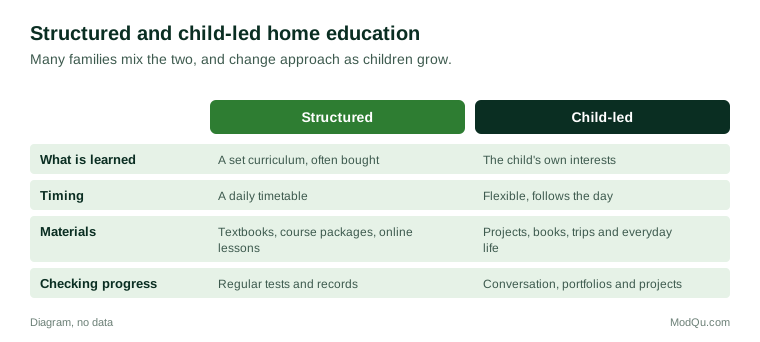
- School-at-home: a timetable and curriculum similar to a school's, often using bought course packages.
- Online courses: structured lessons from online providers, sometimes with teachers.
- Eclectic: mixing materials and methods to suit each child.
- Unschooling: child-led learning based on the child's interests, with little formal instruction.
- Classical, Charlotte Mason or Montessori-inspired methods with particular philosophies.
- Co-operatives: families sharing teaching, with parents leading subjects they know well.
- Tutors and classes for subjects such as science, languages or music.
Resources and costs
Home education can be inexpensive or costly depending on the approach. Families use libraries, free online resources, textbooks, course packages, educational software, museum memberships, tutoring, sports clubs and exam fees.
The largest cost is often indirect: one parent may work part-time or not at all to teach. Some countries or regions provide funding, materials or access to school facilities for home-educated children; most do not.
Example (hypothetical figures)
A family home-schooling two children spends, in local currency, 400 a year on books and course materials, 300 on online mathematics and language programs, 500 on a weekly science co-op and music lessons, and 200 on trips and museum visits. That is 1,400 a year. One parent has also reduced their work to three days a week.
Laws and rules
Rules on homeschooling vary more than almost any other area of education:
- In some countries, such as the United States, Canada, the United Kingdom and Australia, homeschooling is legal with differing requirements by state, province or nation, ranging from no registration to annual reports, approved plans or tests.
- In some countries, such as Germany, home education is generally not permitted and school attendance is compulsory, with narrow exceptions.
- Other countries permit it under conditions such as registration, inspection, following a national curriculum or sitting exams.
Rules also cover whether home-educated children can sit public exams, join school activities or return to school later. Families moving between countries need to check the rules in each.
Social life and exams
A frequent question about homeschooling is how children meet other children. Home-educating families often use groups, co-ops, sports clubs, community classes and organized outings. Experiences vary, and much depends on the family's location and effort.
At secondary level, families decide whether children will sit public exams, and how. Some exam centres accept private candidates; others make it difficult. Access to science laboratories and exam entry can be a challenge.
Example
A home-educated 15-year-old wants to sit national exams in three subjects. Their parent finds that the local school does not accept private candidates, so they register at an exam centre in a city an hour away and pay entry fees for each subject.
What people disagree about
Homeschooling is debated. Supporters see it as a parental right that allows learning suited to each child. Critics worry about children's social development, the quality of teaching, and the risk that children who need protection are hidden from view. Governments balance parents' rights with duties to ensure every child receives an education. There is also debate about how much oversight is fair, and whether public funding should support home education.
Questions that schools, education departments and learning-resource providers want answered include how many families home-school, why, for how long, what resources they use and whether children later return to school.
Returning to school
Many home-educated children return to school at some point, for example at the start of secondary school, for exam years or because family circumstances change. How easy this is depends on the school system and on whether the child's learning matches what the school expects. Some schools assess returning children to place them in the right class; others place them by age. Families say the move can be smooth when the school is welcoming and flexible, and harder when there are gaps in subjects such as science or languages.
Example
A child who was home-schooled from age eight to eleven joins a local secondary school at the start of the school year. They are ahead in reading and history but behind in written mathematics. The school arranges extra maths sessions for the first term.
Key terms
- HomeschoolingEducation led by parents outside a school.
- Home educationAnother term for homeschooling, used in many countries.
- UnschoolingChild-led learning with little formal instruction.
- Co-operativeFamilies sharing teaching and activities.
- CurriculumThe planned content and order of what is taught.
- Private candidateA student who sits a public exam without being enrolled at a school.
- Compulsory educationThe years of education required by law.
- DeregistrationFormally removing a child from a school roll to home-school.
Full glossary: k 12 administration terms on EditingTests.com.
Homeschooling vocabulary test
How well do you know the language of this topic? Try 8 quick questions. Your score is shown straight away and is not saved.
What the homeschooling survey asks
This survey is part of ModQu's Education and Learning survey. The homeschooling part takes about five minutes and covers:
- Whether you have home-schooled a child, now or in the past.
- Why you chose it and for how long.
- Which approach and resources you used.
- How much it cost, and whether it affected your work.
- How your child met other children and took exams.
- Whether your child returned to school, and why.
After that you can choose to continue with other short parts of the Education and Learning survey, such as choosing a college or university or online learning, or stop.
Ready to take part?
Your answers help show what people really think and do. Results are only ever reported as totals; no one can see your individual answers.
Start the surveyQuestions about this survey
Who can take part?
Parents.
Do I have to give my name?
No. You may be asked for your age group, region and similar details so results can be broken down, but not your name. ModQu never asks for passwords, card numbers or account numbers.
How are the results used?
Answers are combined into totals and percentages and published in ModQu reports. Individual answers are never shown.
Is the vocabulary test part of the survey?
No. It is optional and separate, and your score is not stored.
Do home-educated children get a school leaving certificate?
It depends on the country. Some issue certificates only through exams, some allow home-educated students to sit the same exams as school students, and some have no route at all.
Can I answer if I only considered homeschooling?
Yes. The survey asks people who have thought about it as well as those who have done it.
Does keeping a child home during school closures count?
That was usually remote schooling, but you can describe it, and the survey separates it from chosen home education.
Will my answers be shared with authorities?
No. ModQu does not ask for names or addresses, and results are reported only for groups.