
Share how you buy electronics
Tell us where you bought your last device, how you researched it and what decided your choice. Your answers are combined with other people's and reported only as totals.
Start the electronics and gadgets shopping surveyAbout 5 minutes. No account needed. You can stop at any time.
What counts as electronics and gadgets
Consumer electronics covers a wide range of products, including:
- phones, tablets and laptops;
- televisions, sound bars and speakers;
- headphones and earbuds;
- cameras and drones;
- gaming consoles and accessories;
- smart home devices, such as speakers, cameras and thermostats;
- wearables, such as smartwatches;
- small gadgets, such as chargers, power banks and electric toothbrushes.
These products range from small impulse buys to major household purchases.
How people research
For larger purchases, many people research before buying. Common sources include:
- Customer reviews on retailer sites.
- Expert reviews on websites, magazines and video channels.
- Comparison sites for prices and specifications.
- Friends, family and colleagues.
- In-store demonstrations, to see and hold the product.
- Forums and online communities for specialist products.
Example
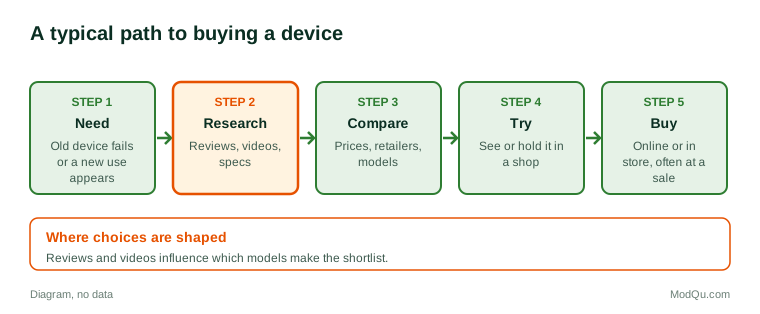
A student needs a laptop for university. She watches three video reviews, reads a comparison article, checks the university's recommended specifications, and visits a shop to try the keyboard. She then buys online from a different retailer where the price is lower.
Looking at a product in a shop and buying it online elsewhere is sometimes called showrooming. The reverse, researching online and buying in store, is called webrooming.
The figure below shows a typical research and buying path.
Specifications and features
Electronics are often compared on specifications, such as screen size, processor, memory, storage, battery life and camera quality. Many shoppers find these hard to interpret and rely on reviews or sales staff to explain what matters. Brand reputation, design and compatibility with devices they already own also weigh heavily.
Where people buy
Electronics are sold through:
- large electronics and department stores;
- online marketplaces and retailers;
- brand stores and websites;
- phone networks, for phones bought with contracts;
- supermarkets and discount chains, for smaller items;
- second-hand and refurbished sellers.
Price, delivery speed, stock availability, returns policies and after-sales service all affect where people buy.
Timing and sales
Electronics prices often change. Many shoppers wait for sales events, new model launches (when older models are discounted), or holiday periods. Price-tracking tools and alerts help some buyers time purchases.
Example (hypothetical figures)
A family wants a 55-inch television priced at 700. They set a price alert. During a sales event two months later, the same model drops to 560, a saving of 140, or 20%. They also notice that a newer model launched at 750, which is why the older one was cut.
Warranties, insurance and add-ons
At checkout, shoppers are often offered extended warranties, insurance, setup services, cables and accessories. Consumer groups often say extended warranties can be poor value because manufacturer warranties and consumer law already cover faults for a period. Some buyers value the peace of mind, especially for expensive items.
Trade-ins, refurbished and second-hand
Trade-in programs let people exchange an old device for credit toward a new one. Refurbished devices, checked and repaired by the manufacturer or a specialist, are cheaper than new and usually come with a warranty. Buying refurbished is increasingly popular for phones and laptops, both to save money and to reduce electronic waste.
Example
A small business owner trades in three old laptops for credit and buys three refurbished models with a one-year warranty. The total cost is less than two new laptops would have been.
Electronic waste
Old electronics contain materials that can be recovered and some that can be harmful if dumped. Many countries require retailers or manufacturers to take back old electronics for recycling. Many households still keep old phones and cables in drawers. Repair, reuse and recycling are increasingly part of how people think about buying.
After-sales service and repair
Support after purchase, including help with setup, repairs and software updates, matters to many buyers. Some manufacturers stop providing updates after a few years, which can shorten a device's useful life. Rules in some places now require longer availability of spare parts and repair information.
Buying for the household
Some electronics are bought for the whole household rather than one person, such as televisions, routers, smart speakers and family tablets. These purchases often involve discussion between family members about budget, features and where the device will go. Parents buying devices for children also weigh parental controls, durability and screen time. Surveys on electronics often ask who decided, who paid and who uses the device, because the answers are not always the same person.
Example
A family replaces its router after frequent drop-outs during video calls. The teenager researches models, the parent sets the budget and pays, and everyone in the house uses it. When asked who bought the router, each family member gives a different answer.
Compatibility and ecosystems
Many shoppers stay with one brand because their devices work together: a phone, watch, earbuds, laptop and smart speakers that share accounts, apps and settings. Switching brands can mean losing purchased apps, learning new systems and buying new accessories. Common charging standards adopted in some regions have reduced one barrier. Questions about ecosystems help explain why brand loyalty in electronics can be strong even when competitors offer lower prices.
What people disagree about
Some shoppers want the latest models and upgrade often; others keep devices until they stop working. There is debate about whether manufacturers deliberately shorten product life, how long software updates should be guaranteed, whether extended warranties are worth buying, and how to reduce electronic waste.
Questions that businesses want answered include where people bought their last device, how they researched it, what influenced the choice, whether they bought add-ons, how they time purchases, and what they do with old devices.
Key terms
- SpecificationA technical detail of a product, such as screen size or memory.
- ShowroomingLooking at a product in a shop, then buying online elsewhere.
- WebroomingResearching online, then buying in a shop.
- Extended warrantyPaid cover for faults after the manufacturer's warranty ends.
- Trade-inGiving an old device to a retailer for credit.
- RefurbishedA used device checked, repaired and resold, often with a warranty.
- Price alertA notification when a product's price changes.
- Electronic wasteDiscarded electrical and electronic devices.
Full glossary: consumer electronics manufacturing terms on EditingTests.com.
Electronics and gadgets shopping vocabulary test
How well do you know the language of this topic? Try 8 quick questions. Your score is shown straight away and is not saved.
What the electronics and gadgets shopping survey asks
This survey is part of ModQu's Shopping and Retail survey. The electronics and gadgets shopping part takes about five minutes and covers:
- Which electronic devices you have bought in the last year and where.
- How you researched your last major purchase.
- What decided your choice: price, brand, reviews, features or advice.
- Whether you bought an extended warranty, insurance or accessories.
- Whether you have bought refurbished or traded in an old device.
- What you do with old devices you no longer use.
After that you can choose to continue with other short parts of the Shopping and Retail survey, such as online shopping or groceries and food shopping, or stop.
Ready to take part?
Your answers help show what people really think and do. Results are only ever reported as totals; no one can see your individual answers.
Start the surveyQuestions about this survey
Who can take part?
Adults who bought electronics in the last year.
Do I have to give my name?
No. You may be asked for your age group, region and similar details so results can be broken down, but not your name. ModQu never asks for passwords, card numbers or account numbers.
How are the results used?
Answers are combined into totals and percentages and published in ModQu reports. Individual answers are never shown.
Is the vocabulary test part of the survey?
No. It is optional and separate, and your score is not stored.
Should I buy an extended warranty?
This page does not give advice. Check what the manufacturer's warranty and local consumer law already cover first.
Is refurbished as good as new?
Quality varies by seller. Look for a warranty, a clear grading of condition and a returns policy.