
Tell us about your subscriptions
Tell us how many paid subscriptions you have, whether you have paid for one you forgot and which you cancelled last. Your answers are combined with other people's and reported only as totals.
Start the subscriptions surveyAbout 5 minutes. No account needed. You can stop at any time.
What subscriptions cover
A subscription is an arrangement where a customer pays regularly, usually monthly or yearly, for continuing access to a product or service. Common types include:
- streaming video and music;
- news, magazines and online content;
- software and apps, including productivity, security and photo editing;
- cloud storage and phone or computer services;
- gaming services;
- fitness apps, gyms and online classes;
- subscription boxes and meal kits, delivering products on a schedule;
- memberships offering free shipping or discounts;
- auto-replenishment of products such as pet food, razors or contact lenses;
- car features and connected devices, where some functions require a subscription.
Why people subscribe
People choose subscriptions because they offer:
- convenience, with automatic renewal and no need to reorder;
- access to large libraries of content for a set price;
- lower up-front cost compared with buying outright;
- regular updates and new features;
- discounts for paying yearly or bundling services.
Some products are now available only by subscription, so customers have little choice.
How many subscriptions people have
Many households pay for several subscriptions at once. People often underestimate how many they have and how much they spend, because charges are small, arrive on different dates and are spread across different cards and accounts.
Example (hypothetical figures)
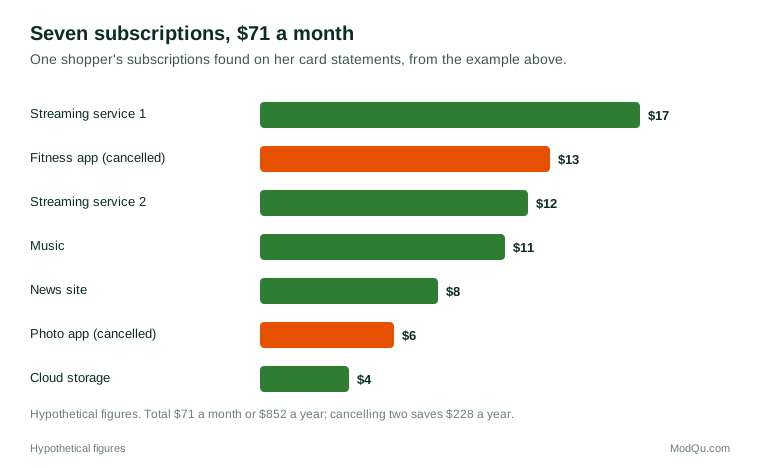
A shopper thinks she pays for three subscriptions. When she reviews her card statements, she finds seven: two streaming services at $17 and $12, music at $11, cloud storage at $4, a fitness app at $13, a news site at $8 and a photo app at $6. Her total is $71 a month, or $852 a year. She cancels the fitness app and the photo app, saving $228 a year.
Forgotten subscriptions and free trials
Free trials are a common way to attract new subscribers. Many require a card number and turn into paid subscriptions automatically unless cancelled. People who forget to cancel may pay for weeks or months before noticing. Others keep paying for services they rarely use because cancelling feels like a hassle or they expect to use them again.
Example
A student signs up for a 30-day free trial of a video editing app for a class project. He forgets about it, and the app charges $20 a month for five months before he notices the charges on his bank statement. The company refunds only the last month.
Price increases and changes
Subscription prices often rise over time. Services also change what is included, add advertising to cheaper plans, or limit sharing between households. Customers are usually notified by email, but many do not read these messages. Price rises are a common reason people review and cancel subscriptions.
Cancelling
How easy it is to cancel varies widely. Some services allow cancellation in a few clicks; others require a phone call, chat or several screens of offers to stay. Design practices that make cancelling hard, sometimes called dark patterns, have drawn attention from consumer protection agencies in several countries, and some places have introduced or proposed rules requiring cancellation to be as easy as sign-up.
Example
A man tries to cancel a gym membership online but finds that the website only allows cancellation in person or by registered letter. He visits the gym, where staff offer him three months at half price to stay. He declines, signs a form and is told the final payment will still be taken the next month under the contract's notice period.
Notice periods, cancellation fees and contracts with a minimum term are common in gym memberships and some telecom and software plans, and many customers say they did not notice these terms at sign-up.
Subscription switching and rotation
Some people rotate subscriptions, signing up for a streaming service to watch a particular series, then cancelling and moving to another. Services respond with yearly plans, bundles and discounts to keep customers.
Example
A couple keep one streaming service all year and rotate a second one every few months, depending on what they want to watch. They set a reminder in their calendar each time they sign up, so they remember to cancel.
Some services also offer a pause option, letting customers stop payments for a period without cancelling. Others send "win-back" offers to people who have cancelled, such as a month at a lower price. Shoppers who rotate services say they have become more aware of what each service offers and how much they actually watch or use it.
Managing subscriptions
People use several methods to keep track:
- reviewing bank and card statements;
- checking subscription lists in phone app stores;
- using budgeting or subscription-tracking apps;
- using a single card for all subscriptions;
- setting reminders before trials end.
Some banks and card issuers now show recurring charges in their apps.
Families who share accounts face extra questions about who pays, who uses what and what happens when a household changes. Account sharing rules have tightened for some streaming services, leading some families to drop a service or pay for extra members.
Bundles
Telecom companies, retailers and technology firms bundle subscriptions together, such as streaming with a phone plan or shipping with video. Bundles can save money but make it harder to see what each service costs and harder to cancel one part.
Businesses and subscriptions
Businesses like subscriptions because they bring predictable revenue and long-term customer relationships. They measure churn, the share of subscribers who cancel in a period, and work to reduce it through better service, offers and, sometimes, friction in the cancellation process.
What businesses and regulators want to know
Subscription businesses, banks and regulators want to understand how many subscriptions people have, how much they spend, how often they forget or regret subscriptions, why they cancel and how easy cancelling is.
Key terms
- SubscriptionRegular payment for continuing access to a product or service.
- Auto-renewalAutomatic renewal of a subscription at the end of each period unless cancelled.
- Free trialA period of free use that may turn into a paid subscription.
- ChurnThe share of subscribers who cancel in a given period.
- Dark patternA design that pushes users into choices they might not otherwise make.
- BundleSeveral products or services sold together for one price.
- Recurring chargeA payment taken automatically at regular intervals.
- Subscription rotationSigning up and cancelling services in turn rather than keeping them all.
Full glossary: subscription billing terms on EditingTests.com.
Subscriptions vocabulary test
How well do you know the language of this topic? Try 8 quick questions. Your score is shown straight away and is not saved.
What the subscriptions survey asks
This survey is part of ModQu's Shopping and Retail survey. The subscriptions part takes about five minutes and covers:
- How many paid subscriptions you have, and which kinds.
- How much you think you spend on subscriptions each month.
- Whether you have paid for a subscription you forgot about.
- Which subscription you cancelled last, and why.
- How easy or hard cancelling was.
- How you keep track of your subscriptions.
After that you can choose to continue with other short parts of the Shopping and Retail survey, such as online shopping or groceries and food shopping, or stop.
Ready to take part?
Your answers help show what people really think and do. Results are only ever reported as totals; no one can see your individual answers.
Start the surveyQuestions about this survey
Who can take part?
Adults.
Do I have to give my name?
No. You may be asked for your age group, region and similar details so results can be broken down, but not your name. ModQu never asks for passwords, card numbers or account numbers.
How are the results used?
Answers are combined into totals and percentages and published in ModQu reports. Individual answers are never shown.
Is the vocabulary test part of the survey?
No. It is optional and separate, and your score is not stored.