
Tell us about toys and children's products
Tell us where you buy toys, how much you spend and what matters most when you choose. Your answers are combined with other people's and reported only as totals.
Start the toys and children's products surveyAbout 5 minutes. No account needed. You can stop at any time.
What the category covers
Toys and children's products include:
- toys and games: dolls, action figures, building sets, vehicles, puzzles, board games and outdoor toys;
- baby and toddler products: car seats, strollers, cribs, high chairs and baby carriers;
- books and learning materials;
- arts and crafts supplies;
- electronic toys, video games and tablets for children;
- sports and outdoor equipment, such as bikes, scooters and helmets;
- children's furniture and room decor.
Who buys
Many people buy for children. Parents buy everyday toys and products, while grandparents, relatives and family friends buy many gifts. Buying peaks at birthdays and the holiday season, which accounts for a large share of yearly toy sales.
Example
A grandmother buys gifts for five grandchildren aged 2 to 12. She asks the parents for lists, because she has found that the toys she picked on her own were sometimes duplicates or not allowed. She buys most gifts online in November, and one special gift for each child at a local toy store.
Where people buy
Toys and children's products are sold by:
- mass merchandisers and big-box stores;
- specialty toy stores and independent shops;
- online retailers and marketplaces;
- bookstores, which often carry games and educational toys;
- baby specialty stores, for gear and furniture;
- dollar stores, for small items and party favours;
- second-hand sources, including resale apps, consignment shops and community groups.
Many families buy second-hand toys, books and clothes, because children outgrow them quickly. For car seats and cribs, safety rules mean second-hand buying needs care.
What buyers look for
Common considerations include:
- the child's age and interests, and what the child asks for;
- price and value;
- safety and age labels;
- educational or developmental value;
- durability and how long a child will play with it;
- whether it encourages active, creative or social play;
- screens and batteries;
- materials, packaging and environmental impact;
- characters and brands from films, shows and games.
Example
Parents of a six-year-old want to limit screen toys. For his birthday they ask relatives for building sets, books and outdoor toys. One uncle gives a handheld game anyway. The parents keep it for car trips only, and say a clear list for relatives would have avoided the problem.
Spending
Spending on toys varies widely by household income, number of children and family traditions. Many parents set a budget for birthdays and holidays and ask relatives to coordinate.
Example (hypothetical figures)
A family with two children spends about $300 per child at the holidays and $150 per child on birthdays, plus about $20 a month per child on small toys, books and craft supplies. That is about $690 per child, or $1,380 a year for both. Grandparents and relatives spend about the same again on gifts.
Safety and recalls
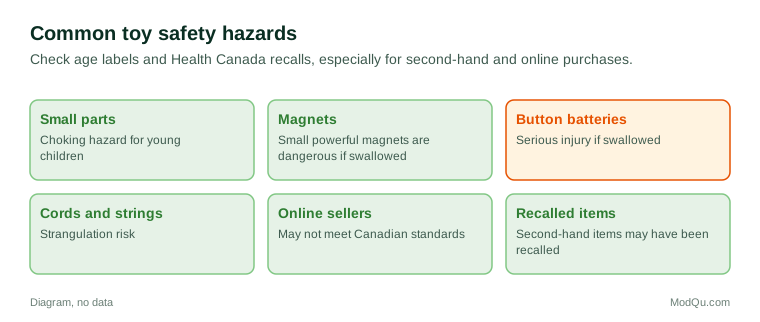
Toy safety is a top concern for parents. In Canada, toys and children's products are regulated under the Canada Consumer Product Safety Act and specific regulations, which set rules on small parts, sharp edges, lead and other hazards. Health Canada publishes recalls and safety warnings.
Common safety concerns include:
- small parts and choking hazards for young children;
- small powerful magnets and button batteries, which are dangerous if swallowed;
- cords and strings;
- products bought online from sellers who may not meet Canadian standards;
- second-hand items that have been recalled.
Age labels on toys are based on safety and development, not only on how clever a child is.
Educational value
Many parents look for toys with educational value, such as building sets, science kits, puzzles and books. STEM toys, designed to build skills in science, technology, engineering and mathematics, are a growing category. Experts in child development often say simple open-ended toys such as blocks, art supplies and pretend-play items are as valuable as products marketed as educational.
Screens and electronic toys
Tablets, video games and connected toys are part of many children's lives. Parents weigh entertainment and learning against concerns about screen time, advertising, in-game purchases and data collection. Some families set rules about screens; others limit electronic toys altogether.
Connected toys that use microphones, cameras or apps may collect information about children. Privacy laws and app store rules apply, but parents are often unsure what is collected or where it is stored. Many parents read reviews and check settings before allowing a connected toy or children's app at home.
Gender and toys
Toys have often been marketed separately to boys and girls. Many parents and some retailers now prefer gender-neutral displays and toys, while others are comfortable with traditional categories. Children's own preferences vary widely.
Too many toys and sustainability
Many parents feel their homes have too many toys, especially plastic toys that break or are quickly forgotten. Approaches include toy rotation, asking for experiences instead of gifts, toy libraries, swapping and buying second-hand. Some buyers prefer wooden or durable toys, or brands with take-back programs.
Licensed toys and trends
Toys based on films, television shows and games are a large part of the market. Trends can rise quickly through children's media and social media, and some toys sell out before holidays. Collectible toys and blind-box products appeal to children and adult collectors alike.
What toy makers and retailers want to know
Toy makers, retailers and safety regulators want to understand who buys toys, where, how much they spend, what they value most, how they think about safety, educational value and screens, and how often they buy second-hand.
Key terms
- Age gradingThe age label on a toy, based on safety and development.
- Choking hazardA small part that a young child could swallow and choke on.
- RecallA notice that a product should be returned, repaired or stopped being used because of a safety problem.
- STEM toyA toy designed to build skills in science, technology, engineering and mathematics.
- Open-ended toyA toy that can be played with in many ways, such as blocks.
- Licensed toyA toy based on a character or brand from a film, show or game.
- Toy rotationPutting some toys away and swapping them out over time.
- In-game purchaseBuying items or features inside a game, often with real money.
Full glossary: consumer goods terms on EditingTests.com.
Toys and children's products vocabulary test
How well do you know the language of this topic? Try 8 quick questions. Your score is shown straight away and is not saved.
What the toys and children's products survey asks
This survey is part of ModQu's Shopping and Retail survey. The toys and children's products part takes about five minutes and covers:
- Where you buy most toys and children's products.
- How much you spend per child each year, and on what occasions.
- How important educational value is when you choose.
- How you think about safety, including recalls and online sellers.
- How you manage screens and electronic toys.
- Whether you buy, sell or swap second-hand toys.
After that you can choose to continue with other short parts of the Shopping and Retail survey, such as online shopping or groceries and food shopping, or stop.
Ready to take part?
Your answers help show what people really think and do. Results are only ever reported as totals; no one can see your individual answers.
Start the surveyQuestions about this survey
Who can take part?
Parents and grandparents.
Do I have to give my name?
No. You may be asked for your age group, region and similar details so results can be broken down, but not your name. ModQu never asks for passwords, card numbers or account numbers.
How are the results used?
Answers are combined into totals and percentages and published in ModQu reports. Individual answers are never shown.
Is the vocabulary test part of the survey?
No. It is optional and separate, and your score is not stored.