
Tell us about convenience stores
Tell us how often you visit a convenience store, what you usually buy and what you think of the prices. Your answers are combined with other people's and reported only as totals.
Start the convenience stores surveyAbout 5 minutes. No account needed. You can stop at any time.
What convenience stores are
A convenience store is a small shop that sells a limited range of everyday goods, usually with long opening hours and a location close to homes, workplaces or main roads. Many are open late at night or all day and night. They sell items people need quickly, rather than a full weekly shop.
Common formats include:
- chain convenience stores, operated by large companies or franchisees;
- gas station stores, attached to fuel stations;
- independent corner stores, often family owned;
- stores in transit stations, hospitals, campuses and office buildings;
- small urban grocery formats run by supermarket chains, which sit between a convenience store and a supermarket.
What people buy
Typical purchases include:
- drinks, including coffee, soft drinks, energy drinks and water;
- snacks, candy and chips;
- ready-to-eat food such as sandwiches, hot food and baked goods;
- milk, bread, eggs and other basics;
- tobacco and vaping products, where permitted, and lottery tickets;
- in some provinces, beer, wine or cannabis-related accessories, depending on local rules;
- household items such as batteries, painkillers and personal care products;
- services such as bill payments, prepaid cards, parcel pickup and ATMs.
A typical convenience store visit is short and involves only a few items. Many purchases are unplanned.
Example
A delivery driver stops at the same gas station store every morning for a coffee and a breakfast sandwich. On Fridays he also buys a lottery ticket. He spends less than five minutes inside and says he chooses that store because the parking is easy and the coffee is ready when he arrives.
Why people use them
People use convenience stores because they are:
- close, within walking distance or on a regular route;
- fast, with short lines and quick service;
- open late or all night, when other stores are closed;
- useful for emergencies, such as running out of milk or needing medicine at night;
- familiar, with staff who know regular customers.
In neighbourhoods without a supermarket nearby, a convenience store may be the main source of food for some residents, even though its range of fresh food is limited.
Example
A nurse finishing a night shift at 7 a.m. stops at a convenience store near the hospital for milk, bread and a newspaper. The supermarket near her home does not open until 8, and she wants to be asleep by then. She knows she pays more, but says the store saves her an extra trip on her day off.
Visits also follow daily routines: a coffee on the way to work, a snack after school, a drink while filling the car. Stores near schools, transit stops and offices see sharp peaks at the start and end of the day.
Prices and value
Prices at convenience stores are usually higher than at supermarkets and discount stores. Stores have higher costs per sale, buy in smaller quantities and pay for long opening hours. Shoppers accept the higher price for convenience but often notice it on staple items.
Example (hypothetical figures)
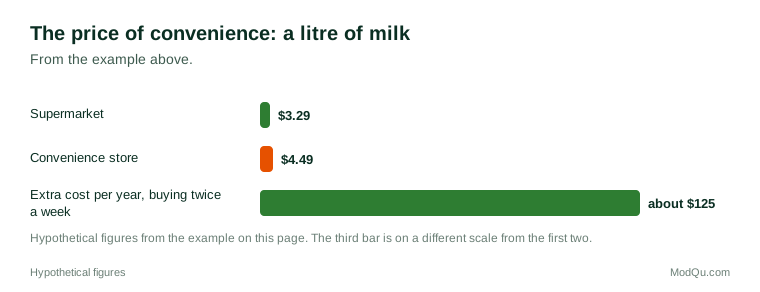
A litre of milk costs $3.29 at a supermarket and $4.49 at a convenience store, a difference of $1.20, or about 36%. A shopper who buys milk at the convenience store twice a week pays about $125 more a year than at the supermarket. She keeps doing it on weekdays because the store is on her way home, and buys milk at the supermarket on weekends.
Stores use promotions such as two-for-one drinks, combo meals and loyalty apps to give a sense of value.
Food to go
Many convenience chains have expanded their food offer, with fresh sandwiches, salads, hot food, pizza, roller grill items and specialty coffee. Food to go brings in more frequent visits and higher margins than packaged goods. Shoppers' views of quality vary widely between stores.
Some chains now promote their own coffee and baked goods as alternatives to coffee shops, often at lower prices. Others add seating, microwaves for customers and partnerships with restaurant brands. For shoppers, the question is often whether the food is fresh and whether it can be trusted for a quick meal on a busy day. Stores that sell fresh food must manage waste carefully, because unsold sandwiches and salads have a short shelf life.
Gas station stores
Gas station stores serve drivers who stop for fuel, as well as nearby residents. Many drivers now pay at the pump and never enter the store, so stations offer food, coffee, car washes and loyalty rewards to bring them inside. The growth of electric vehicles, which take longer to charge, may change how people use these stores in future.
Corner stores and their owners
Independent corner stores are often run by families who work long hours. Many owners say their business has become harder because of rising costs, competition from chains and discount stores, theft, and changes in the products they are allowed to sell, such as restrictions on flavoured tobacco and vaping products. Some corner stores are important community places where staff know regular customers by name.
Safety, theft and late-night work
Convenience stores open late can be targets for theft and robbery. Stores use cameras, limited cash on hand and staffing rules to reduce risk. Shoppers' sense of safety in a store, particularly at night, affects where they choose to stop.
Technology and new formats
Some stores now offer self-checkout, mobile ordering, delivery through apps and cashierless technology, where shoppers pick items and pay automatically. Rapid delivery services have also tried to replace short convenience trips by delivering snacks and basics within minutes, with mixed success.
What retailers and suppliers want to know
Convenience chains, independent owners, suppliers and policy makers want to understand how often people visit, what they buy, why they choose one store over another, how they see prices and how food to go and new services are changing visits.
Key terms
- Convenience storeA small shop with a limited range of everyday goods, long hours and a handy location.
- Corner storeAn independent neighbourhood convenience store, often family owned.
- Impulse purchaseAn unplanned purchase made on the spot.
- Food to goReady-to-eat food and drinks bought to eat elsewhere or immediately.
- FranchiseeA person who runs a store under a larger company's brand and system.
- Basket sizeThe number of items or the amount spent in one shopping trip.
- Pay at the pumpPaying for fuel at the pump without entering the store.
- MarginThe difference between what a product costs the store and what it sells for.
Full glossary: convenience retail terms on EditingTests.com.
Convenience stores vocabulary test
How well do you know the language of this topic? Try 8 quick questions. Your score is shown straight away and is not saved.
What the convenience stores survey asks
This survey is part of ModQu's Shopping and Retail survey. The convenience stores part takes about five minutes and covers:
- How often you visit a convenience store, and at what times of day.
- What you usually buy, and whether you planned to buy it.
- Whether you think convenience store prices are fair.
- Whether you use a gas station store, and whether you go inside or pay at the pump.
- How you rate the food and coffee at convenience stores.
- What would make you visit more or less often.
After that you can choose to continue with other short parts of the Shopping and Retail survey, such as online shopping or groceries and food shopping, or stop.
Ready to take part?
Your answers help show what people really think and do. Results are only ever reported as totals; no one can see your individual answers.
Start the surveyQuestions about this survey
Who can take part?
Adults.
Do I have to give my name?
No. You may be asked for your age group, region and similar details so results can be broken down, but not your name. ModQu never asks for passwords, card numbers or account numbers.
How are the results used?
Answers are combined into totals and percentages and published in ModQu reports. Individual answers are never shown.
Is the vocabulary test part of the survey?
No. It is optional and separate, and your score is not stored.