
Tell us about jewellery and watches
Tell us when you last bought jewellery or a watch, whether it was a gift and how you chose it. Your answers are combined with other people's and reported only as totals.
Start the jewellery and watches surveyAbout 5 minutes. No account needed. You can stop at any time.
What the category covers
Jewellery and watches include:
- fine jewellery, made of precious metals such as gold, platinum and silver, often with diamonds or other gemstones;
- fashion or costume jewellery, made of less expensive materials and bought for style;
- bridal jewellery, such as engagement rings and wedding bands;
- watches, from inexpensive fashion watches to luxury mechanical watches;
- smartwatches and fitness trackers, which are also sold as technology products;
- vintage, estate and second-hand pieces.
Occasions and reasons for buying
Many jewellery purchases are linked to occasions:
- engagements and weddings;
- anniversaries, birthdays and holidays such as Christmas and Valentine's Day;
- graduations, retirements and other milestones;
- religious and cultural ceremonies;
- self-purchase, as a reward or for personal style.
Gifts make up a large share of fine jewellery purchases. Self-purchase, especially by women buying jewellery for themselves, has become more common.
Example
A woman buys herself a pair of gold earrings after paying off her student loan. She says she wanted something lasting to mark the moment, rather than a trip or a meal. She chose a local jeweller because she wanted to see the pieces in person and ask about the gold content.
Where people buy
Jewellery and watches are sold by:
- independent jewellers, often family businesses with repair and custom services;
- jewellery chains in shopping centres;
- department stores;
- luxury brand boutiques;
- online retailers and brand websites, including direct-to-consumer brands;
- marketplaces and artisans, for handmade pieces;
- pawn shops, estate sales and resale platforms.
Trust is especially important for high-value purchases. Many buyers return to the same jeweller over years, or ask friends and family for recommendations.
Judging quality and value
Buyers find it hard to judge jewellery quality without expertise. Common considerations are:
- metal: the purity of gold is shown in karats, with 24-karat being pure gold and 14-karat and 18-karat more common in jewellery; platinum and silver have their own purity marks;
- gemstones: diamonds are often described by the four Cs, carat (weight), cut, colour and clarity;
- certification: grading reports from independent laboratories for diamonds and some other gems;
- craftsmanship: settings, clasps and finish;
- brand and design.
Resale values for most jewellery are much lower than the retail price, which surprises some buyers.
Lab-grown and natural diamonds
Lab-grown diamonds have the same physical and chemical properties as natural diamonds but are made in a laboratory rather than mined. Their prices have fallen sharply and are now much lower than natural diamonds of similar size and quality. They have become a large part of engagement ring sales in some markets.
Buyers choose lab-grown diamonds for lower cost, larger stones for the same budget and concerns about mining. Others prefer natural diamonds for their rarity, tradition or belief that they will hold value better. Sellers must clearly disclose whether a diamond is lab-grown.
Example (hypothetical figures)
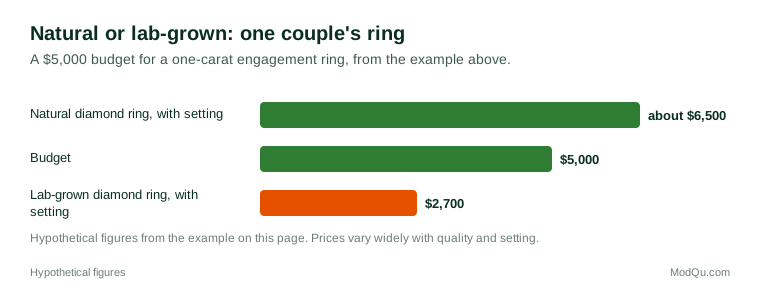
A couple has a $5,000 budget for an engagement ring. A natural one-carat diamond of the quality they like would cost about $6,500 with the setting. A lab-grown stone of similar size and grade costs about $1,800, and with a $900 setting the total is $2,700. They choose the lab-grown ring and put the difference toward their wedding.
Engagement rings and wedding bands
Engagement rings are among the largest jewellery purchases many people make. Couples increasingly shop together, choose custom designs and consider alternatives such as coloured gemstones, vintage rings or lab-grown diamonds. Spending varies widely, and many couples now ignore old rules about how much to spend.
Watches
The watch market has divided into several parts:
- inexpensive and fashion watches, bought for style;
- mid-range and luxury mechanical watches, valued for craftsmanship and brand, and sometimes bought as collectibles or investments;
- smartwatches, which track health and fitness, show notifications and make payments.
Many younger people do not wear a traditional watch, using their phones instead, while others have embraced smartwatches. Interest in pre-owned luxury watches has grown.
Collecting luxury watches has become more visible through online forums and social media, and some models sell for more on the resale market than in stores. Many buyers of pre-owned luxury watches look for documents, original boxes and service records, and buy from dealers who authenticate watches before sale.
Online buying and trust
Buying jewellery online offers more choice and often lower prices, but buyers worry about quality, sizing, authenticity and returns. Clear return policies, certification, reviews and secure payment are important to online buyers. Counterfeit luxury watches and jewellery are a concern, especially on marketplaces and social media.
Some online jewellers offer virtual try-on, home try-on of sample rings and free resizing to reduce the risks of buying without seeing a piece in person. Buyers of high-value items often want to see an independent grading report and know the return period before they pay.
Ethics and sourcing
Some buyers ask where gold and gemstones come from and how they were mined. Industry schemes aim to keep conflict diamonds out of the market, and some brands use recycled gold and traceable stones. Sourcing matters a great deal to some buyers and very little to others.
Care, repair and insurance
Jewellery needs cleaning, inspection and occasional repair, such as resizing a ring or fixing a clasp. Valuable pieces can be added to home or tenant insurance, often with an appraisal, because standard policies may have low limits for jewellery theft.
Example
A man's watch stops after he inherits it from his grandfather. A watchmaker services it for $350. He says the cost is worth it because the watch has family meaning, and he adds it to his home insurance after getting an appraisal.
What jewellers and brands want to know
Jewellers, watch brands and online retailers want to understand when and why people buy, how much they spend, where they shop, how they judge quality and how they feel about lab-grown diamonds, smartwatches and buying online.
Key terms
- Fine jewelleryJewellery made of precious metals, often with genuine gemstones.
- Costume jewelleryJewellery made of less expensive materials, bought for style.
- KaratA measure of gold purity; 24-karat is pure gold.
- CaratThe unit of weight for gemstones; one carat is 0.2 grams.
- Four CsCarat, cut, colour and clarity, used to describe diamonds.
- Lab-grown diamondA diamond made in a laboratory, with the same properties as a mined diamond.
- AppraisalA written estimate of an item's value, often used for insurance.
- Mechanical watchA watch powered by a spring and gears rather than a battery.
Full glossary: jewelry design terms on EditingTests.com.
Jewellery and watches vocabulary test
How well do you know the language of this topic? Try 8 quick questions. Your score is shown straight away and is not saved.
What the jewellery and watches survey asks
This survey is part of ModQu's Shopping and Retail survey. The jewellery and watches part takes about five minutes and covers:
- When you last bought jewellery or a watch, and what it was.
- Whether it was a gift, and for what occasion.
- Where you bought it, and why you chose that seller.
- How you judged quality and value.
- Whether you would buy a lab-grown diamond, and why or why not.
- Whether you wear a watch or smartwatch, and what you use it for.
After that you can choose to continue with other short parts of the Shopping and Retail survey, such as online shopping or groceries and food shopping, or stop.
Ready to take part?
Your answers help show what people really think and do. Results are only ever reported as totals; no one can see your individual answers.
Start the surveyQuestions about this survey
Who can take part?
Adults.
Do I have to give my name?
No. You may be asked for your age group, region and similar details so results can be broken down, but not your name. ModQu never asks for passwords, card numbers or account numbers.
How are the results used?
Answers are combined into totals and percentages and published in ModQu reports. Individual answers are never shown.
Is the vocabulary test part of the survey?
No. It is optional and separate, and your score is not stored.