
Tell us how you shop for groceries
Tell us where you buy groceries, how you look for savings and whether you order food online. Your answers are combined with other people's and reported only as totals.
Start the groceries and food shopping surveyAbout 5 minutes. No account needed. You can stop at any time.
What grocery shopping covers
Grocery shopping covers food and everyday household items bought for the home: fresh produce, meat and fish, dairy, bakery, packaged foods, frozen foods, drinks, cleaning products and personal care items. For most households it is a regular routine, often weekly, with smaller top-up trips in between.
People buy groceries from several kinds of store:
- full-service supermarkets, with a wide range, service counters and in-store bakeries;
- discount grocers, with fewer services, a narrower range and lower prices;
- warehouse clubs, which sell large packs to paying members;
- mass merchandisers and general retailers that also sell food;
- specialty and ethnic grocers, which carry products from particular cuisines and regions;
- farmers' markets, butchers, bakeries and other independent shops;
- pharmacies, dollar stores and convenience stores, for some packaged items;
- online grocery services, run by supermarkets or by delivery platforms.
How people choose a grocery store
Most households have a main store and one or more secondary stores. Common reasons for choosing a main store include:
- price, and whether the store feels good value;
- location and travel time;
- the quality of fresh produce and meat;
- product range, including specific brands or foods for a diet or culture;
- the store's loyalty program and personalized offers;
- cleanliness, layout and how busy the store is;
- staff and checkout speed.
Many shoppers split their spending: staples at a discount grocer or warehouse club, fresh food at a supermarket or market, and specialty items at a smaller shop.
Example
A family of four buys most staples at a discount grocer near home. Every two weeks they drive to a warehouse club for bulk items such as rice, coffee and toilet paper. On Saturdays they visit a farmers' market in summer for fruit and vegetables. Their main store gets about two-thirds of their grocery spending, but they say no single store meets all their needs.
Rising food prices
Food prices rose sharply in Canada and many other countries from 2021 onward. Price increases slowed later, but prices did not return to earlier levels. Many shoppers say grocery prices are among their biggest money worries.
Shoppers have responded in several ways:
- switching to discount stores;
- buying more store brands;
- buying more items on sale and stocking up;
- planning meals and making shopping lists;
- cutting back on meat, snacks or treats;
- throwing away less food;
- using food banks, which have reported higher demand.
Some shoppers have also noticed shrinkflation, when a product's package size gets smaller while the price stays the same or rises.
Store brands
Store brands, also called private labels, are products sold under a retailer's own name. Many supermarkets have a value range, a standard range and a premium range. Store brands are usually cheaper than national brands, and quality has improved over time. Their share of grocery sales has grown, particularly when prices rise.
Shoppers often buy store brands for basics such as milk, eggs, flour, canned goods and cleaning products, and stay with national brands for items where taste or loyalty matters more, such as coffee, snacks or breakfast cereal.
Example (hypothetical figures)
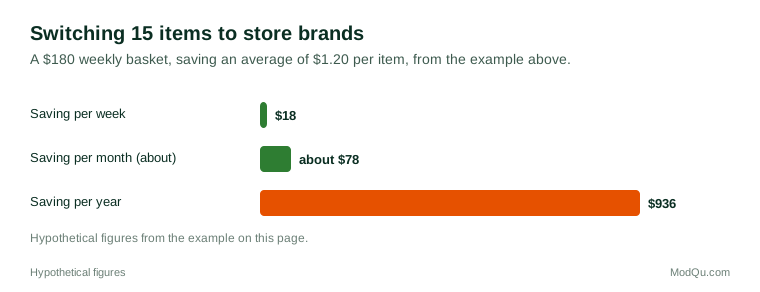
A shopper's weekly basket costs $180. They switch 15 items to store brands and save an average of $1.20 per item, or $18 a week. Over a year that is about $936. They keep their usual coffee and peanut butter brands because their family notices the difference.
Flyers, apps and loyalty programs
Weekly flyers, now often viewed in apps, remain a common way to plan grocery trips. Price-comparison and flyer apps collect offers from many stores in one place. Some stores will match a lower advertised price from a competitor.
Supermarket loyalty programs reward spending with points and send personalized offers based on what a shopper buys. Many shoppers value these offers, while others find them hard to track or are uneasy about how their data is used.
Online grocery
Online grocery grew quickly during the pandemic. Shoppers can choose:
- home delivery from a supermarket or through a delivery platform;
- click and collect, ordering online and picking up at the store;
- same-day delivery in many cities, often at a higher price.
Online shopping saves time and helps people who cannot easily get to a store. Common concerns are delivery and service fees, higher item prices on some platforms, substitutions when items are out of stock, and not being able to choose fresh produce. Many households now combine online orders for heavy or routine items with in-store trips for fresh food.
Example
A parent who works long hours orders groceries for pickup every Sunday. The store's app remembers her usual items, so the order takes ten minutes. Twice the store substituted a different size of yogurt without asking, so she now turns off substitutions for dairy products and buys fresh fish in person.
Meal planning and food waste
Households that plan meals and make lists tend to waste less food and spend less. A significant share of food bought for the home is thrown away, including produce that spoils and leftovers that are not eaten. Some people use meal kits, which deliver recipes and measured ingredients, though these usually cost more per meal than cooking from groceries.
Shopping for special diets and cultures
Shoppers with allergies, intolerances or medical diets, and people who follow religious or cultural food rules, often need particular products. They may shop at specialty grocers or rely on supermarkets that stock halal, kosher, gluten-free, plant-based or international foods. A wider range of such products is one reason people choose one store over another.
Trust and fairness
Many shoppers feel that grocery chains have too much power over prices. Concentration in the grocery industry has drawn attention from government, and an industry code of conduct between grocers and suppliers has been developed in Canada. Shoppers' trust also depends on clear pricing, accurate shelf labels and honest promotions.
What grocers and food companies want to know
Grocers, food manufacturers, delivery services and policy makers want to understand where households shop, how they choose stores, how much they buy store brands, how they use flyers and loyalty programs, how often they order online and how food prices affect what they buy.
Key terms
- Private labelA product sold under a retailer's own brand name, also called a store brand.
- Discount grocerA grocery store that offers lower prices with fewer services and a narrower range.
- Warehouse clubA membership store that sells large packs at lower unit prices.
- Unit priceThe price per standard unit, such as per 100 g or per litre, used to compare sizes.
- ShrinkflationReducing a product's size while keeping the price the same or raising it.
- Click and collectOrdering online and picking up the order at the store.
- SubstitutionA replacement item sent when an ordered product is out of stock.
- Loss leaderA product sold at a very low price to bring shoppers into a store.
Full glossary: consumer packaged goods terms on EditingTests.com.
Groceries and food shopping vocabulary test
How well do you know the language of this topic? Try 8 quick questions. Your score is shown straight away and is not saved.
What the groceries and food shopping survey asks
This survey is part of ModQu's Shopping and Retail survey. The groceries and food shopping part takes about five minutes and covers:
- Where you do most of your grocery shopping, and which other stores you use.
- How often you shop, and how you plan your trips.
- How often you buy store-brand products, and for which items.
- Whether you have ordered groceries online in the last three months, and how it went.
- How rising food prices have changed what or where you buy.
- Which flyers, apps or loyalty programs you use to save money.
After that you can choose to continue with other short parts of the Shopping and Retail survey, such as online shopping or fashion and clothing, or stop.
Ready to take part?
Your answers help show what people really think and do. Results are only ever reported as totals; no one can see your individual answers.
Start the surveyQuestions about this survey
Who can take part?
Main or shared household grocery shoppers.
Do I have to give my name?
No. You may be asked for your age group, region and similar details so results can be broken down, but not your name. ModQu never asks for passwords, card numbers or account numbers.
How are the results used?
Answers are combined into totals and percentages and published in ModQu reports. Individual answers are never shown.
Is the vocabulary test part of the survey?
No. It is optional and separate, and your score is not stored.