
Share your experience of second-hand shopping
Tell us what you have bought or sold second-hand, where, and why. Your answers are combined with other people's and reported only as totals.
Start the second-hand and resale shopping surveyAbout 5 minutes. No account needed. You can stop at any time.
What second-hand shopping covers
Second-hand or resale shopping means buying goods that have been owned before. It covers almost every category: clothing, furniture, books, electronics, toys, sports equipment, cars, tools, collectibles and baby goods. Some goods are sold as-is; others are checked, cleaned or repaired before resale, which is often called refurbished or pre-owned.
Where people buy and sell
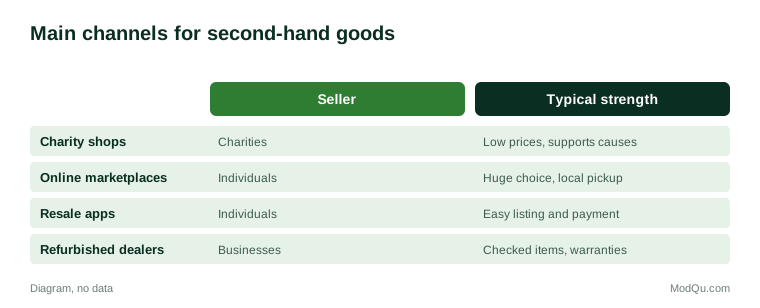
The main channels include:
- Charity and thrift shops, which sell donated goods to raise money.
- Online marketplaces and classified sites, where individuals sell to each other.
- Resale apps focused on fashion, electronics or furniture.
- Specialist dealers, such as vintage clothing, antiques or refurbished phones.
- Retailers' own resale and trade-in programs.
- Markets, garage sales, yard sales and car boot sales.
- Community swap groups and free-to-collect listings.
The figure below compares the main channels.
Why people buy second-hand
People give several reasons:
- Price: second-hand goods are usually cheaper.
- Environment: reusing goods reduces waste and demand for new production.
- Uniqueness: vintage and one-off items not found in shops.
- Quality: older items, such as solid furniture, may be better made than new equivalents.
- Treasure hunting: the enjoyment of searching for bargains.
- Practicality: buying items needed only for a short time, such as baby equipment.
Example
A couple furnishing their first flat buy a solid wooden table, four chairs and a bookcase from online listings for less than the price of one new flat-pack table. They spend two weekends sanding and painting, and say they enjoy knowing where each piece came from.
Why people sell
Selling used goods helps people:
- earn extra money;
- clear space;
- avoid throwing things away;
- recover some of the cost of expensive items, such as phones or designer clothes.
Some people sell regularly as a side business, buying items cheaply and reselling them for a profit. In some countries, tax rules apply once sales pass a certain level.
Example (hypothetical figures)
A parent sells outgrown children's clothes and toys on a resale app. Over a year they list 120 items and sell 85, earning 640 before fees. After fees and postage of 110, they keep 530, which they use toward new school uniforms.
Trust and safety between strangers
Buying from individuals involves risks that buying from a shop does not:
- items not as described;
- fake or counterfeit goods;
- payment scams, such as fake payment confirmations;
- stolen goods;
- safety when meeting in person.
Platforms try to build trust with seller ratings, buyer protection schemes, secure payment systems and identity checks. Common advice includes paying through the platform, meeting in public places and checking items before paying.
What sells well
Categories that often do well second-hand include branded clothing and trainers, children's clothes and equipment, furniture, books, phones and gaming equipment, bicycles and tools. Items that are hard to sell include large old furniture, outdated electronics and fast fashion, which often has little resale value.
Condition, cleaning and safety rules
Some items need extra care when bought second-hand. Child car seats, cot mattresses, helmets and some electrical goods may have safety concerns if their history is unknown or they do not meet current standards. Some countries restrict the resale of certain products. Buyers also consider hygiene for items such as mattresses and clothing.
Example
A grandparent finds a cheap second-hand car seat online. A friend points out that car seats should not be used after an accident and that the seat's history is unknown. The grandparent buys a new one instead and uses the money saved on a second-hand pram.
The rise of resale apps
Resale apps have made selling easier by letting people photograph and list items in minutes, handle payments and print postage labels. Many focus on fashion. Some charge sellers a fee; others charge buyers. These apps have helped second-hand shopping become more mainstream among younger people, and some brands now run their own resale platforms.
The environmental angle
Reusing goods means fewer new items need to be made, which can reduce resource use and waste. Second-hand shopping is often promoted as part of a circular economy, where products are kept in use for longer. Some critics note that resale can also encourage people to buy more new items, knowing they can sell them on, and that shipping individual items has its own footprint.
Pricing used goods
Setting a price for a used item is one of the hardest parts of selling. Sellers often check what similar items have sold for, not just what they are listed at. Condition, brand, age, original packaging and season all affect value: winter coats sell better in autumn, and garden furniture in spring. Many sellers start high and lower the price if nothing sells, while buyers often make lower offers. Some apps suggest prices based on past sales.
Example
A student lists a used textbook at the same price as a new copy. After two weeks with no interest, they check sold listings and find similar copies went for about half that. They lower the price and it sells the next day.
What people disagree about
Some see second-hand shopping as a practical, sustainable choice for everyone. Others worry that rising popularity has pushed up prices in charity shops, making them less affordable for people on low incomes. There is also debate about professional resellers who buy up bargains and resell at higher prices.
Questions that businesses want answered include how often people buy and sell second-hand, in which categories, through which channels, why they do it, how much they trust sellers, and whether they buy less new as a result.
Key terms
- Second-handPreviously owned by someone else.
- RefurbishedUsed goods that have been checked, repaired and cleaned for resale.
- Resale appAn app for selling and buying used goods between individuals.
- Charity shopA shop selling donated goods to raise money for a charity.
- Buyer protectionA platform scheme that refunds buyers if items are not as described.
- CounterfeitA fake copy of a branded product.
- Circular economyAn approach that keeps products and materials in use for longer.
- Trade-inGiving an old item to a retailer in exchange for credit.
Full glossary: e commerce terms on EditingTests.com.
Second-hand and resale shopping vocabulary test
How well do you know the language of this topic? Try 8 quick questions. Your score is shown straight away and is not saved.
What the second-hand and resale shopping survey asks
This survey is part of ModQu's Shopping and Retail survey. The second-hand and resale shopping part takes about five minutes and covers:
- What you have bought or sold second-hand in the last year.
- Where you buy and sell: shops, apps, websites or markets.
- Why you choose second-hand items.
- How much you trust sellers and how you protect yourself.
- Whether second-hand shopping has changed how much you buy new.
- Which categories you would never buy second-hand, and why.
After that you can choose to continue with other short parts of the Shopping and Retail survey, such as online shopping or groceries and food shopping, or stop.
Ready to take part?
Your answers help show what people really think and do. Results are only ever reported as totals; no one can see your individual answers.
Start the surveyQuestions about this survey
Who can take part?
Adults.
Do I have to give my name?
No. You may be asked for your age group, region and similar details so results can be broken down, but not your name. ModQu never asks for passwords, card numbers or account numbers.
How are the results used?
Answers are combined into totals and percentages and published in ModQu reports. Individual answers are never shown.
Is the vocabulary test part of the survey?
No. It is optional and separate, and your score is not stored.
Do I have the same rights buying from an individual as from a shop?
Usually fewer. Consumer laws often apply mainly to business sellers. Platform buyer protection may help.
Do I pay tax on items I sell?
It depends on the country and how much you sell. Occasional sales of personal items are often treated differently from trading.