
Share how you use reviews
Tell us how often you read and write reviews and how much you trust them. Your answers are combined with other people's and reported only as totals.
Start the product reviews and ratings surveyAbout 5 minutes. No account needed. You can stop at any time.
How reviews work
Online reviews are opinions left by customers about products, services, places and sellers. They usually include a star rating, often from one to five, and may include text, photos or videos. Reviews appear on:
- retailer and marketplace websites;
- brand websites;
- dedicated review sites;
- maps and local search listings;
- social media and video platforms;
- app stores.
Ratings are often summarized as an average score and a count, such as 4.3 from 2,000 reviews.
How people use reviews
Shoppers use reviews in different ways:
- to filter options, for example only considering products above four stars;
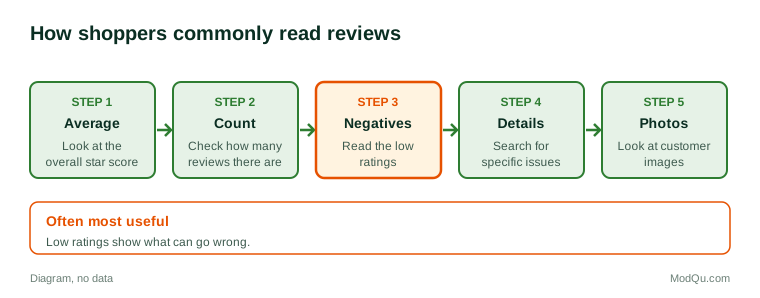
- to read the negative reviews to see what can go wrong;
- to check specific details, such as sizing, noise or battery life;
- to compare similar products;
- to judge a seller's reliability.
Example
A shopper narrows down three vacuum cleaners with similar ratings. Instead of the average, they read the one- and two-star reviews. Complaints about one model mostly concern slow delivery; complaints about another describe the motor failing after a year. They choose the first.
The figure below shows how shoppers commonly read reviews.
What makes a review useful
People tend to find reviews more useful when they:
- describe specific experiences rather than general praise;
- mention how long the product has been used;
- include photos or videos;
- come from verified buyers;
- describe the reviewer's situation, such as a large family or a small kitchen.
Very short or very emotional reviews are often seen as less useful.
Fake and misleading reviews
Not all reviews are genuine. Problems include:
- fake positive reviews written or bought by sellers;
- fake negative reviews posted about competitors;
- incentivized reviews, where reviewers get free products or discounts;
- review gating, where only happy customers are asked to review;
- merged listings, where reviews for one product appear on another;
- suppressed reviews, where negative ones are hidden.
Example (hypothetical figures)
A new phone charger has 480 reviews, 470 of them five stars, most posted in the same two weeks and many with similar wording. An older charger has 1,200 reviews with a spread from one to five stars and an average of 4.2. A shopper trusts the second more, despite its lower average.
How platforms and regulators respond
Platforms use automated systems and staff to detect fake reviews, mark verified purchases, and remove suspicious content. Some countries have made buying or selling fake reviews illegal and require businesses to take reasonable steps to prevent them. Penalties and enforcement vary. Some regulators have also targeted hiding negative reviews.
Writing reviews
A minority of customers write most reviews. People are more likely to write one after a very good or very bad experience, which can make ratings less representative of typical experiences. Prompts by email or app after purchase increase the number of reviews.
Example
A diner has an average meal and never reviews it. The next week, a restaurant forgets her order and is rude when she complains, so she writes a detailed one-star review. She admits she only reviews places when something goes very wrong.
Responding to reviews
Many businesses reply to reviews, especially negative ones. Shoppers often say a calm, helpful reply to a complaint increases their trust, while defensive replies reduce it. Some businesses use reviews to improve products and services.
Reviews for local services and professionals
Reviews are also important for restaurants, hotels, tradespeople, doctors, lawyers and other services. For tradespeople and professionals, a few negative reviews can have a large effect on small businesses. Some professions have rules about responding to reviews because of confidentiality.
Trust in reviews
Surveys in many countries show that most shoppers read reviews and many trust them, but a large share also suspect some are fake. Trust tends to be higher for reviews on well-known platforms with verified purchases, and lower for reviews on unknown websites.
Reviews and the ratings scale
Star averages can be misleading in several ways. Many products cluster between four and five stars, so small differences in the average may not mean much. A product with a 4.8 average from ten reviews is less certain than one with 4.5 from thousands. Some platforms weight recent reviews more heavily, and some show a breakdown of how many reviews received each star level. Shoppers who look at the distribution, not just the average, often get a clearer picture.
Example (hypothetical figures)
Two blenders both average 4.0 stars. The first has most ratings at four stars. The second has 70% five-star and 25% one-star ratings. Reading the one-star reviews shows that the second model often breaks after a few months, which the average alone hid.
Expert reviews and comparison tests
Alongside customer reviews, many shoppers use expert reviews from magazines, websites and consumer organizations that test products under controlled conditions. Expert reviews can compare performance in detail, while customer reviews show long-term reliability and everyday use. Some consumer organizations are funded by members rather than advertisers, which some shoppers see as more independent.
What people disagree about
Some argue that reviews give consumers power and hold businesses to account. Others say they are easily manipulated, unfair to small businesses, and encourage extreme opinions. There is also debate about whether platforms do enough to remove fake reviews and how much responsibility they should bear.
Questions that businesses want answered include how often people read and write reviews, which sites they trust, what features make reviews useful, how many suspect fake reviews, and how reviews influence purchases.
Key terms
- Star ratingA score, usually from one to five, showing satisfaction.
- Verified purchaseA review from someone confirmed to have bought the product.
- Fake reviewA review not based on a genuine experience.
- Incentivized reviewA review written in return for a free product or reward.
- Review gatingAsking only satisfied customers to leave reviews.
- Average ratingThe mean of all star ratings for an item.
- Review countThe number of reviews an item has received.
- User-generated contentContent such as reviews and photos created by customers.
Full glossary: customer experience platforms terms on EditingTests.com.
Product reviews and ratings vocabulary test
How well do you know the language of this topic? Try 8 quick questions. Your score is shown straight away and is not saved.
What the product reviews and ratings survey asks
This survey is part of ModQu's Shopping and Retail survey. The product reviews and ratings part takes about five minutes and covers:
- How often you read reviews before buying, and where.
- What you look at first: the average, the count or particular reviews.
- How often you write reviews, and what prompts you.
- How much you trust online reviews, and on which sites.
- Whether you have suspected or spotted fake reviews.
- How reviews have changed a purchase decision.
After that you can choose to continue with other short parts of the Shopping and Retail survey, such as online shopping or groceries and food shopping, or stop.
Ready to take part?
Your answers help show what people really think and do. Results are only ever reported as totals; no one can see your individual answers.
Start the surveyQuestions about this survey
Who can take part?
Adults who shop online.
Do I have to give my name?
No. You may be asked for your age group, region and similar details so results can be broken down, but not your name. ModQu never asks for passwords, card numbers or account numbers.
How are the results used?
Answers are combined into totals and percentages and published in ModQu reports. Individual answers are never shown.
Is the vocabulary test part of the survey?
No. It is optional and separate, and your score is not stored.
Are fake reviews illegal?
In some countries buying or posting fake reviews is illegal. Rules and enforcement differ.
Can a business remove my review?
Usually not directly, but platforms may remove reviews that break their rules.