
Share your experience of buying on social media
Tell us whether you have bought something through a social media app, what made you buy and how it went. Your answers are combined with other people's and reported only as totals.
Start the shopping on social media surveyAbout 5 minutes. No account needed. You can stop at any time.
What social shopping means
Social shopping, or social commerce, covers buying products directly through social media or after seeing them there. Forms include:
- Shoppable posts and ads that let users tap a product and buy within the app or on a linked website.
- In-app shops run by brands and small sellers.
- Live shopping: live video streams where a host shows products and viewers buy in real time.
- Creator and influencer links: recommendations with links or discount codes.
- Group and community selling: buying through social media groups and direct messages.
- Messaging apps used by small businesses to take orders and payments.
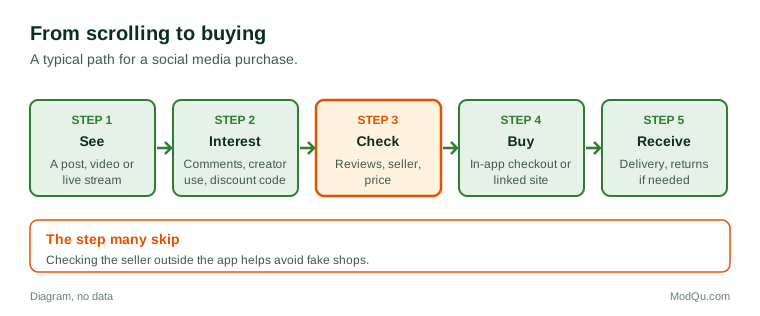
The figure below shows a typical path from seeing a product to buying it.
Why people buy on social media
People give a range of reasons:
- discovering products they would not have searched for;
- seeing products used by real people rather than in studio photos;
- convenience of buying without leaving the app;
- limited-time offers and discount codes from creators;
- entertainment, especially in live shopping;
- supporting small and local businesses.
Example
A young man watches a short video of a creator testing a portable coffee maker on a camping trip. He taps the product tag, sees a discount code in the caption, and buys it in under a minute without leaving the app. He says he had never thought of buying one before seeing the video.
Live shopping
Live shopping is especially popular in parts of Asia and is growing elsewhere. Hosts demonstrate products, answer comments, and offer time-limited discounts, which creates a sense of urgency. Some streams sell large quantities in minutes. Viewers say they enjoy the interaction and seeing products in use; critics say the pressure encourages impulse buying.
Small businesses and messaging
For many small businesses, especially in countries where messaging apps are widely used, social media is the main shop. Sellers post photos, take orders by message, and arrange payment by bank transfer or mobile money. This lowers costs for sellers but can mean fewer protections for buyers.
Example (hypothetical figures)
A home baker sells cakes through a social media page and messaging app. In a month she receives 60 orders averaging 25 each, or 1,500 in sales. She pays nothing to a marketplace, but spends about 8 hours a week answering messages and arranging collections.
Trust and scams
Social shopping also brings risks:
- Fake shops that take payment and never deliver.
- Counterfeit goods sold as genuine.
- Products that differ from photos and videos.
- Hidden advertising, where creators do not make clear they are paid.
- Dropshipping from distant suppliers, with long delivery times and difficult returns.
Advice from consumer bodies often includes checking reviews outside the app, paying by methods that offer protection, looking for contact details and returns policies, and being cautious with prices that seem too low.
Example
A shopper orders a jacket from an ad on social media. The site looks professional, but after six weeks the jacket has not arrived and the site has disappeared. Because she paid by credit card, she is able to dispute the charge and get her money back.
Disclosure and advertising rules
In many countries, creators must clearly label paid partnerships and ads. Platforms have tools to tag sponsored posts. Enforcement varies, and many users say they cannot always tell when content is advertising. Regulators have taken action against undisclosed promotions in several countries.
Buyer rights
Rights when buying through social media depend on who the seller is and where they are based. Buying from a business usually brings consumer protections such as refunds for faulty goods and, for online purchases, cooling-off periods in some countries. Buying from an individual or a seller abroad may give fewer rights. Payment method also matters, since some offer chargebacks or buyer protection.
Who shops on social media
Social shopping is generally more common among younger adults, though use is spreading across age groups. Fashion, beauty, home goods, gadgets and food are among the most bought categories. Many people discover products on social media but buy elsewhere, such as on a brand's website or in a shop.
Data and personalization
Social platforms use data about what people watch, like and buy to show them products. Many users find personalized recommendations useful, while others find them intrusive or feel they encourage overspending. Privacy settings and ad preferences can change what is shown.
Returns and customer service
Returning items bought through social media can be harder than returning items bought from a large online retailer. Small sellers may not have clear returns policies, and sellers based abroad may require costly international postage. Some platforms now require sellers in their in-app shops to follow standard return rules and offer platform-backed refunds. Buyers often say they check the returns policy only after something goes wrong.
Example
A shopper buys a dress through an in-app shop. It does not fit, and the platform's standard return process lets her send it back free within 30 days. A friend who bought from a seller found through direct messages has no such option and keeps a pair of shoes that are too small.
What people disagree about
Some see social shopping as a fun, convenient way to discover products and support small sellers. Others worry about impulse buying, scams, hidden advertising and pressure on young people to keep up with trends. There is also debate about how far platforms should be responsible for fake shops and counterfeit goods sold through them.
Questions that businesses want answered include how often people buy through social media, which platforms and formats they use, what makes them buy, how much they trust sellers and creators, and how often purchases go wrong.
Key terms
- Social commerceBuying and selling directly through social media.
- Shoppable postA post with product tags that link to a purchase.
- Live shoppingSelling products during a live video stream.
- InfluencerA person with a social media following who promotes products.
- Paid partnershipA post a creator is paid to make, which must be disclosed in many countries.
- DropshippingSelling goods that are sent directly from a supplier, often abroad.
- ChargebackReversing a card payment through the card issuer.
- Impulse buyingBuying without planning, often prompted by offers or urgency.
Full glossary: social media platforms terms on EditingTests.com.
Shopping on social media vocabulary test
How well do you know the language of this topic? Try 8 quick questions. Your score is shown straight away and is not saved.
What the shopping on social media survey asks
This survey is part of ModQu's Shopping and Retail survey. The shopping on social media part takes about five minutes and covers:
- Whether you have bought something through a social media app in the last year.
- Which platforms and formats you used: posts, live streams, creator links or messages.
- What made you buy.
- How much you trust sellers and creators on social media.
- Whether a purchase has gone wrong, and how it was resolved.
- How social media affects what you buy elsewhere.
After that you can choose to continue with other short parts of the Shopping and Retail survey, such as online shopping or groceries and food shopping, or stop.
Ready to take part?
Your answers help show what people really think and do. Results are only ever reported as totals; no one can see your individual answers.
Start the surveyQuestions about this survey
Who can take part?
Adults who use social media.
Do I have to give my name?
No. You may be asked for your age group, region and similar details so results can be broken down, but not your name. ModQu never asks for passwords, card numbers or account numbers.
How are the results used?
Answers are combined into totals and percentages and published in ModQu reports. Individual answers are never shown.
Is the vocabulary test part of the survey?
No. It is optional and separate, and your score is not stored.
How can I tell if a social media shop is genuine?
Check reviews outside the app, look for contact details and a returns policy, and be cautious with very low prices.
Do I have refund rights for social media purchases?
It depends on whether the seller is a business, where they are based, and how you paid.