
Share your experience of buying from abroad
Tell us whether you have bought from websites in other countries, what you bought and how it went. Your answers are combined with other people's and reported only as totals.
Start the cross-border online shopping surveyAbout 5 minutes. No account needed. You can stop at any time.
What cross-border shopping is
Cross-border online shopping means buying from a seller based in another country. It includes:
- buying directly from a foreign retailer or brand website;
- buying through a global marketplace where sellers are based abroad;
- buying from a local-looking website that ships from overseas;
- using a forwarding service that gives a foreign address and sends parcels on.
Many shoppers do not realize a seller is abroad until they see delivery times or extra charges.
Why people buy from abroad
Common reasons include:
- Lower prices, especially for clothing, electronics, accessories and small household items.
- Wider choice, including products not sold locally.
- Specific brands or styles from other countries.
- Availability, when items are out of stock locally.
- Speciality goods, such as foods, cosmetics or hobby supplies.
Example
A hobbyist builds model trains. The parts he needs are made by a small company in another country and are not sold locally. He orders directly from the maker's website, waits three weeks for delivery, and pays a small import charge, which he considers worth it.
Delivery times and tracking
Delivery from abroad can take from a few days to several weeks, depending on the shipping method, customs checks and the countries involved. Tracking may stop working when the parcel crosses borders or is handed to a local postal service. Delays are a common complaint.
Duties, taxes and fees
Imported goods may be subject to:
- Customs duties, depending on the type of product and its origin;
- Import taxes, such as value added tax or goods and services tax;
- Handling fees charged by the courier or postal service for processing customs;
- Currency conversion fees charged by the shopper's bank or card provider.
Many countries have a threshold below which no duty is charged, though rules have been changing, with some countries removing low-value exemptions for taxes. Some websites collect taxes at checkout so there is nothing to pay on delivery; others leave it to the buyer.
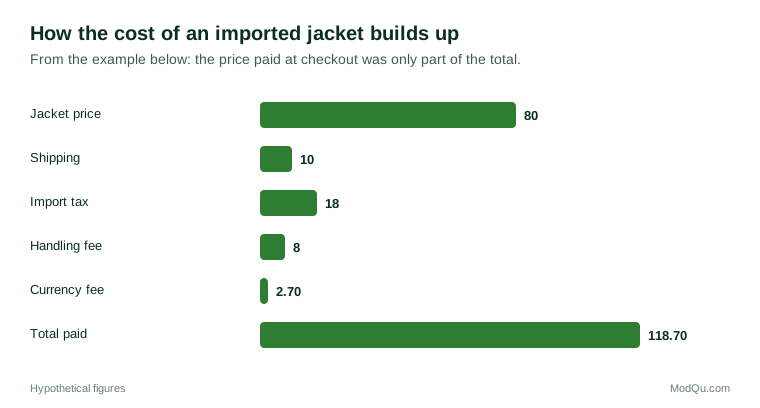
The figure below shows how the final cost of an imported item can build up.
Example (hypothetical figures)
A shopper buys a jacket for 80 from a foreign website, with 10 shipping. On arrival, they pay 18 import tax and an 8 handling fee before the courier will deliver. Their card provider also charges a 3% currency fee, or 2.70. The jacket costs 118.70 in total, not the 90 they expected.
Consumer rights and returns
Consumer rights depend on where the seller is based and on agreements between countries. Shoppers may find that:
- local consumer laws do not apply to a seller abroad;
- returns are expensive or not offered;
- warranties may not be valid in their country;
- electrical goods may not meet local safety standards or plug types;
- sizes differ between countries.
Paying by a method with buyer protection, such as some credit cards or marketplace payment systems, can help if things go wrong.
Safety and counterfeits
Some products sold across borders do not meet safety standards in the buyer's country, especially toys, electrical items, cosmetics and children's products. Counterfeit branded goods are also common on some sites. Authorities in many countries warn about checking product safety marks and buying from reputable sellers.
Example
A parent buys a cheap phone charger from an overseas marketplace. It overheats after a week. A consumer group's tests later find that many similar chargers fail basic safety checks. The parent switches to buying chargers from a local retailer.
Marketplaces and platforms
Global marketplaces make cross-border shopping easy by listing sellers from many countries in one place, often with low prices and free shipping. Questions have been raised about product safety, environmental effects of shipping many small parcels, and fair competition with local retailers who must follow local rules. Some governments have introduced rules requiring platforms to take more responsibility.
Language and currency
Websites often offer automatic translation and prices in the buyer's currency. Shoppers may still face unclear terms, unfamiliar size charts and differences in product descriptions. Some prefer to pay in the seller's currency to avoid poor conversion rates offered at checkout.
The environmental question
Shipping individual parcels across long distances, often by air, adds to transport emissions and packaging. Some shoppers consider this; many prioritize price and choice.
Checking a foreign seller before buying
Shoppers who buy from abroad regularly often follow a few checks: looking for the seller's company name and address, reading reviews on independent sites, checking whether prices include taxes and duties, looking for the returns policy and who pays return postage, and confirming that sizes, plugs and voltages suit their country. Some also check whether the website's domain matches the brand, because fake shops often copy the look of genuine ones.
What people disagree about
Some see cross-border shopping as giving consumers more choice and lower prices. Others say it harms local businesses, avoids taxes and safety rules, and increases waste. There is debate about whether low-value imports should be exempt from duties and taxes, and how far platforms should be responsible for products sold through them.
Questions that businesses want answered include how often people buy from abroad, what they buy, from which countries or sites, whether they paid extra charges, how delivery and returns went, and how this affects where they shop.
Key terms
- Cross-border shoppingBuying from a seller based in another country.
- Customs dutyA tax on certain imported goods.
- Import taxA tax such as VAT or GST charged on imported goods.
- Duty thresholdThe value below which no duty is charged.
- Handling feeA charge by a courier or post office for processing customs.
- Currency conversion feeA charge for paying in a foreign currency.
- Parcel forwardingA service that receives parcels at a foreign address and sends them on.
- Safety markA label showing a product meets safety standards.
Full glossary: e commerce terms on EditingTests.com.
Cross-border online shopping vocabulary test
How well do you know the language of this topic? Try 8 quick questions. Your score is shown straight away and is not saved.
What the cross-border online shopping survey asks
This survey is part of ModQu's Shopping and Retail survey. The cross-border online shopping part takes about five minutes and covers:
- Whether you have bought from websites or sellers in other countries in the last year.
- What you bought and why you bought from abroad.
- Whether you paid import charges or fees, and whether you expected them.
- How long delivery took and whether there were problems.
- Whether you returned anything, and how easy it was.
- How cross-border shopping compares with buying from local shops.
After that you can choose to continue with other short parts of the Shopping and Retail survey, such as online shopping or groceries and food shopping, or stop.
Ready to take part?
Your answers help show what people really think and do. Results are only ever reported as totals; no one can see your individual answers.
Start the surveyQuestions about this survey
Who can take part?
Adults who shop online.
Do I have to give my name?
No. You may be asked for your age group, region and similar details so results can be broken down, but not your name. ModQu never asks for passwords, card numbers or account numbers.
How are the results used?
Answers are combined into totals and percentages and published in ModQu reports. Individual answers are never shown.
Is the vocabulary test part of the survey?
No. It is optional and separate, and your score is not stored.
Will I have to pay tax on items from abroad?
It depends on your country, the item and its value. Some websites collect taxes at checkout.
Do my local consumer rights apply?
Often not fully when the seller is abroad. Payment protection can help.