
Share how you buy gifts
Tell us which occasions you buy gifts for, how much you spend and how you choose. Your answers are combined with other people's and reported only as totals.
Start the gifts and gift-giving surveyAbout 5 minutes. No account needed. You can stop at any time.
Occasions for gifts
Gifts are given for many reasons. Common occasions include:
- birthdays;
- religious and cultural festivals, such as Christmas, Eid, Diwali, Lunar New Year and Hanukkah;
- weddings, engagements and anniversaries;
- births and baby showers;
- graduations and new jobs;
- housewarmings;
- thank-yous to teachers, hosts or colleagues;
- visits to family and friends, where bringing a gift is expected in many cultures.
Which occasions matter most, and how big the gifts are, differs greatly between cultures and families.
How people choose gifts
People choose gifts in different ways:
- asking the recipient or using a wish list;
- thinking about the person's interests and needs;
- following tradition, such as money in red envelopes or sweets at festivals;
- choosing something practical;
- buying something they themselves like;
- relying on suggestions from shops, websites or social media.
Example
A man struggles every year to choose a gift for his father. This year he asks his sister for ideas, and they agree to buy one larger gift together: a weekend fishing trip. Their father says it is the best present he has had in years.
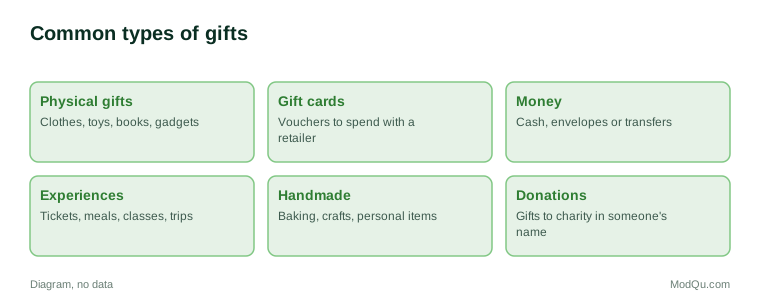
The figure below shows common types of gifts.
How much people spend
Gift budgets depend on income, relationship, occasion and custom. Many people spend most around one or two major festivals each year. Some households set budgets per person; others agree to limits, such as a fixed amount for a group exchange.
Example (hypothetical figures)
A family of four lists the gifts they bought in a year: 600 at a main festival, 320 for eight birthdays, 150 for two weddings and 80 for teachers and hosts. The total is 1,150, of which more than half was spent in one month.
Pressure to spend
Many people say they feel pressure to spend more than they can afford, especially at major festivals or when children compare gifts. Some take on debt or use buy now, pay later plans. Ways families manage this include setting limits, drawing names for a single gift each ("secret Santa"-style exchanges), making gifts, or agreeing not to exchange gifts among adults.
Gift cards and money
Gift cards and vouchers have become one of the most common gifts. Givers like that they let the recipient choose. Recipients often appreciate them but may forget to use them, and some cards expire or lose value with fees in some places. Giving money directly is traditional in many cultures and is increasingly done through bank or mobile transfers.
Example
A grandmother gives her grandson a gift card for a bookshop. Eighteen months later, he finds it in a drawer. In his country, cards must be valid for a minimum period, so it still works. A friend's card from another retailer had expired after a year.
Experiences instead of things
Many people now give experiences, such as concert tickets, meals out, classes, trips or spa days. Givers say experiences create memories and avoid clutter. Research on wellbeing has suggested that people often value experiences more than objects over time, though this varies.
Online shopping and delivery
Online shopping makes gift-buying easier, especially for people who live far apart. Features such as gift wrapping, gift messages and direct delivery to the recipient are common. Delivery deadlines before major festivals drive peaks in online orders.
Unwanted gifts
Not every gift is welcome. People deal with unwanted gifts by exchanging or returning them (often with a gift receipt), passing them on to others ("regifting"), selling them online, donating them, or keeping them unused. Many retailers extend return periods after festive seasons.
Gift-giving at work
Workplaces have their own customs, such as collections for colleagues' birthdays or leaving gifts, gifts from managers, and corporate gifts to clients. Many organizations have rules on accepting gifts to avoid conflicts of interest or bribery.
Sustainable gifting
Concern about waste has led some people to choose second-hand or handmade gifts, avoid wrapping paper that cannot be recycled, give consumable gifts or experiences, or donate to charity in someone's name.
Gifts for children
Gifts for children often make up a large share of spending, especially at major festivals and birthdays. Parents weigh what children ask for, what is age-appropriate, how many gifts to give, and how to balance gifts from different relatives. Some families use rules such as "something you want, something you need, something to wear, something to read" to limit the number of gifts. Children's birthday parties can also bring gift costs for guests' families, and some parents agree on low limits or ask for book swaps instead.
Example
At a seven-year-old's birthday party, the parents ask each guest to bring a wrapped second-hand book instead of a new toy. Each child goes home with a different book. Other parents say the idea reduced pressure on their budgets.
What people disagree about
Some see gift-giving as an important way to show care and maintain relationships. Others feel it has become too commercial and expensive. People also differ on whether gift cards and money are thoughtful or impersonal, and whether it is acceptable to regift.
Questions that businesses want answered include which occasions people buy gifts for, how much they spend, how they choose, where they shop, whether they give gift cards or experiences, and how they handle unwanted gifts.
Key terms
- Gift cardA prepaid card or voucher to spend with a retailer.
- Gift receiptA receipt without the price that lets a recipient return or exchange a gift.
- RegiftingPassing on a gift you received to someone else.
- Wish listA list of items a person would like to receive.
- Experience giftA gift of an activity, such as tickets or a class.
- Gift exchangeA group arrangement where each person buys for one other person.
- Expiry dateThe date after which a gift card can no longer be used.
- Corporate giftA gift from an organization to staff or clients.
Full glossary: consumer goods terms on EditingTests.com.
Gifts and gift-giving vocabulary test
How well do you know the language of this topic? Try 8 quick questions. Your score is shown straight away and is not saved.
What the gifts and gift-giving survey asks
This survey is part of ModQu's Shopping and Retail survey. The gifts and gift-giving part takes about five minutes and covers:
- Which occasions you buy gifts for, and which matter most.
- How much you spent on gifts in the last year, roughly.
- How you choose gifts and where you buy them.
- Whether you give gift cards, money or experiences.
- Whether you feel pressure to spend more than you want.
- What you do with gifts you do not want.
After that you can choose to continue with other short parts of the Shopping and Retail survey, such as online shopping or groceries and food shopping, or stop.
Ready to take part?
Your answers help show what people really think and do. Results are only ever reported as totals; no one can see your individual answers.
Start the surveyQuestions about this survey
Who can take part?
Adults.
Do I have to give my name?
No. You may be asked for your age group, region and similar details so results can be broken down, but not your name. ModQu never asks for passwords, card numbers or account numbers.
How are the results used?
Answers are combined into totals and percentages and published in ModQu reports. Individual answers are never shown.
Is the vocabulary test part of the survey?
No. It is optional and separate, and your score is not stored.
Do gift cards expire?
In some places they do, while others set minimum validity periods. Check the terms on the card.
Is it rude to give money as a gift?
It depends on the culture and occasion. In many cultures money is a traditional and welcome gift.