
Share your experience of consultants and outsourcing
Tell us which tasks your business outsources, whether you have hired a consultant in the last year and whether it was good value. Your answers are combined with other people's and reported only as totals.
Start the consultants and outsourcing surveyAbout 5 minutes. No account needed. You can stop at any time.
Outsourcing and consulting: the difference
Outsourcing means paying an outside firm or person to carry out a task or function on an ongoing basis, instead of doing it in-house. Consulting usually means hiring an outside expert to give advice, solve a specific problem or lead a project for a limited time. The line between them can blur: a consultant may help set up a new system and then continue to run it.
What businesses outsource
Commonly outsourced tasks include:
- bookkeeping, payroll and accounting;
- IT support, cybersecurity and cloud services;
- marketing, design, websites and social media;
- human resources support and recruitment;
- customer service and call handling;
- cleaning, security and facilities;
- logistics and warehousing;
- legal work;
- manufacturing, through contract manufacturers.
Some businesses outsource to firms in the same town; others use providers in other countries, sometimes called offshoring, often to reduce costs or access skills. Nearshoring means using providers in nearby countries, often in similar time zones.
Why businesses outsource
Reasons owners give include:
- access to skills they do not have in-house;
- lower or more predictable costs;
- flexibility to scale up or down;
- freeing time to focus on the core business;
- covering tasks too small for a full-time employee;
- keeping up with changing rules, such as payroll and tax.
Example
A 12-person manufacturing firm has a staff member who handles IT alongside their main job. After a ransomware attack locks the firm's files for two days, the owner signs a contract with a managed IT provider for monitoring, backups and support. The monthly fee is less than the cost of the two days of lost production.
When businesses hire consultants
Consultants are often hired for:
- strategy: growth plans, new markets, pricing;
- operations: improving processes, reducing waste, quality systems;
- technology: choosing and implementing software;
- finance: raising money, restructuring, preparing for sale;
- people: organizational change, leadership training, culture;
- compliance: meeting regulations and certifications;
- specialist problems: energy use, export rules, product design.
Consultants range from individual specialists to large international firms. Small businesses mostly use independent consultants or small firms. Some governments subsidize consulting for small businesses through business support programmes.
Choosing and paying outside help
Businesses usually choose through recommendations, past experience, proposals from several providers, case studies, references and a first meeting. They weigh expertise, understanding of the business, price, communication and cultural fit.
Payment models include:
- hourly or daily rates;
- fixed project fees;
- monthly retainers for ongoing support;
- fees per transaction or per user, common in outsourced services such as payroll;
- success fees linked to results, for example a share of savings or money raised.
Example (hypothetical figures)
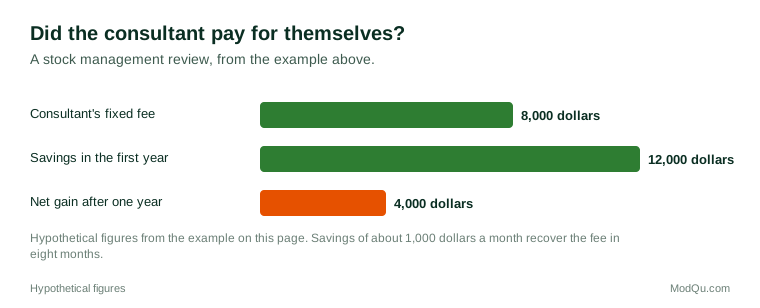
A retailer pays a consultant a fixed fee of 8,000 dollars to review its stock management. The consultant's changes reduce wasted and unsold stock by about 1,000 dollars a month. Over the first year the savings are 12,000 dollars, so the business recovers the fee in eight months and is 4,000 dollars better off by the end of the year.
Judging value
Businesses often find it hard to judge whether consulting or outsourcing was good value. Common ways include:
- comparing the cost with what doing it in-house would have cost;
- measuring results, such as savings, sales, fewer errors or faster processes;
- checking whether agreed tasks were delivered on time;
- staff feedback;
- whether the business learned skills it can keep.
Common complaints include reports that are not acted on, advice that does not fit a small business, costs that grow beyond the estimate, and losing knowledge when a contract ends.
Example
A small charity hires a consultant to write a five-year plan. The plan is well written, but staff were not involved and it sits unused. For its next project the charity asks the consultant to run workshops with staff and trustees, and says the resulting plan is shorter but actually used.
Managing risks
Outsourcing brings risks that businesses try to manage:
- dependence on one provider;
- data security and privacy, especially when providers handle customer or staff data;
- quality and service levels;
- hidden costs and price rises;
- loss of in-house knowledge;
- ending the contract and moving to another provider.
Service level agreements (SLAs) set out what a provider must deliver, such as response times and availability. Contracts often include terms on data, confidentiality and exit arrangements.
Working well with outside help
Businesses that report good experiences with consultants and outsourcing often mention a few practices: a clear brief with goals and limits, a named contact on each side, regular check-ins, agreed measures of success, and involving the staff who will live with the results. They also plan how knowledge will be kept in the business, for example by asking providers to document systems and train staff before a contract ends.
Doing it in-house instead
Some businesses bring outsourced work back in-house, sometimes called insourcing. Reasons include rising provider costs, poor service, wanting more control over quality or data, and growth that makes a full-time role worthwhile. Many businesses review each outsourced task every few years, comparing the provider's cost and service with what an employee or new software could do.
What people disagree about
Outsourcing and consulting raise several debates:
- whether outsourcing saves money in the long run or adds hidden costs;
- whether offshoring harms local jobs;
- whether consultants add real value or tell clients what they already know;
- how much public bodies should spend on consultants;
- whether software and automation will replace some outsourced services.
Questions B2B suppliers, consulting firms, software firms and accountants want answered include which tasks businesses outsource, when they hire consultants, how they choose, what they pay and whether they felt it was good value.
Key terms
- OutsourcingPaying an outside firm to carry out a task or function on an ongoing basis.
- ConsultantAn outside expert hired to give advice or solve a problem.
- OffshoringMoving work to providers in another country.
- NearshoringUsing providers in nearby countries, often in similar time zones.
- Managed service providerA firm that runs a function, such as IT, for a monthly fee.
- Service level agreementA contract setting out the standards a provider must meet.
- RetainerA regular fee for ongoing support.
- Success feeA payment linked to results achieved.
Full glossary: management consulting terms on EditingTests.com.
Consultants and outsourcing vocabulary test
How well do you know the language of this topic? Try 8 quick questions. Your score is shown straight away and is not saved.
What the consultants and outsourcing survey asks
This survey is part of ModQu's Business and Professional Services survey. The consultants and outsourcing part takes about five minutes and covers:
- Which tasks your business outsources, and to what kind of provider.
- Whether you have hired a consultant in the last year, and for what.
- How you chose the provider or consultant.
- How you paid, and whether costs matched the estimate.
- Whether you felt it was good value, and why.
- What you would do differently next time.
After that you can choose to continue with other short parts of the Business and Professional Services survey, such as small business owners or accounting and bookkeeping, or stop.
Ready to take part?
Your answers help show what people really think and do. Results are only ever reported as totals; no one can see your individual answers.
Start the surveyQuestions about this survey
Who can take part?
Business owners and managers.
Do I have to give my name?
No. You may be asked for your age group, region and similar details so results can be broken down, but not your name. ModQu never asks for passwords, card numbers or account numbers.
How are the results used?
Answers are combined into totals and percentages and published in ModQu reports. Individual answers are never shown.
Is the vocabulary test part of the survey?
No. It is optional and separate, and your score is not stored.
Can very small businesses take part?
Yes. Many small firms outsource tasks such as bookkeeping or IT.
Does the survey ask for provider names?
No. It asks about the kinds of tasks and providers, not their names.
What counts as a consultant?
Any outside expert hired for advice or a project, from an individual specialist to a large firm.