
Insights · Customer and market insight
B2B Buyer Insight: How Organisations Make Purchase Decisions
How organisations make purchasing decisions, covering buying situations, the roles in a buying centre, the influence of relationships, trust and emotion, and the methods insight teams use to understand business buyers, including win-loss analysis.
When an organisation buys software, machinery, consulting or raw materials, the decision is rarely made by one person in one moment. It usually involves several people with different roles and priorities, formal procedures, budgets, risk assessments and long relationships with suppliers. Understanding business-to-business (B2B) buyers therefore requires different questions and methods from consumer research. This article reviews what research shows about how organisations buy, and how insight teams can study it.
Buying situations
Robinson et al. (1967) distinguished three types of buying situation, or "buy classes", which differ in how much effort and information they involve.
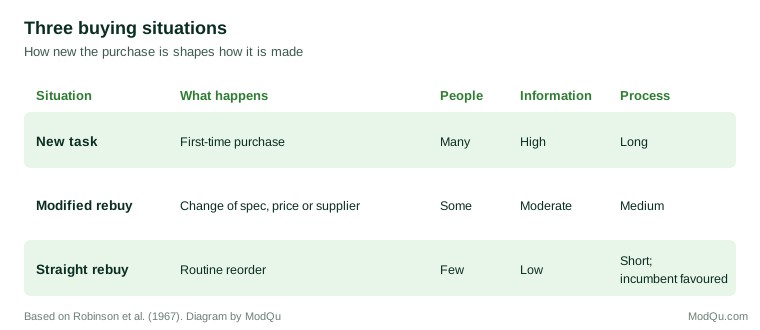
In a new task, the organisation faces a problem it has not solved before and must define its needs, search for suppliers and evaluate options carefully. In a modified rebuy, it reconsiders an existing purchase, perhaps because of dissatisfaction or a change in requirements. In a straight rebuy, it reorders routinely, and the incumbent supplier has a strong advantage. Bunn (1993) developed a more detailed taxonomy of buying decision approaches, based on how much search, analysis and procedural control buyers used, and found that these varied with the importance, complexity and uncertainty of the purchase.
For insight teams, the buying situation determines what to study. A supplier hoping to break into a straight rebuy needs to understand what would prompt the buyer to reconsider; one competing in a new task needs to understand how the buyer is defining the problem.
The buying centre
Webster and Wind (1972) described the "buying centre", all the people who take part in a purchasing decision, and identified five roles within it: users, who will use the product; influencers, who shape the specification or evaluation; buyers, who handle the formal purchase; deciders, who make the final choice; and gatekeepers, who control the flow of information.
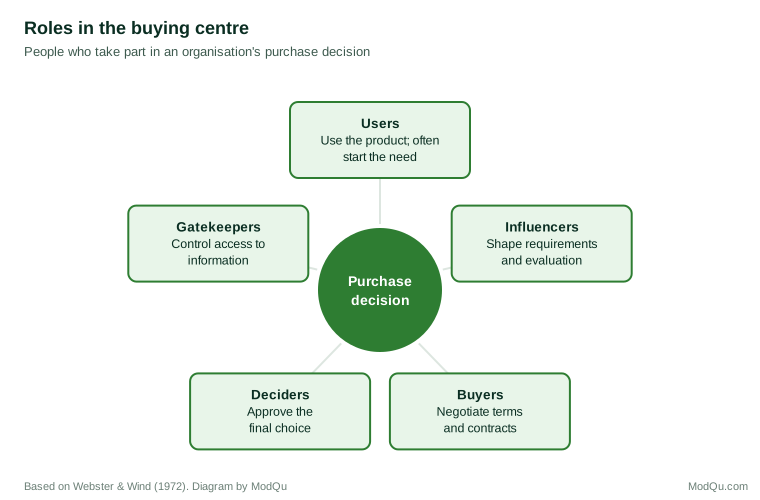
The roles may be held by many people or few, and one person may hold several. Johnston and Bonoma (1981) studied buying centres in a range of firms and found that their size and structure varied with the importance and complexity of the purchase: more important and complex purchases involved more people, more departments and more levels of management. Lilien and Wong (1984) studied buying centres in the metalworking industry and found that the influence of different functions varied across the stages of the decision.
Influence is not determined by role alone. Kohli (1989) examined what determined individuals' influence in buying decisions and found that it depended on factors such as their expertise, their control over rewards and information, and their position, with the importance of each varying according to the situation.
Sheth (1973) proposed a model of industrial buying that emphasised how the different expectations of buying centre members, shaped by their backgrounds and roles, can lead to conflict, which is resolved through problem solving, persuasion, bargaining or politics. More broadly, Cyert and March (1963) described organisational decisions as the result of negotiation among coalitions with different goals, rather than as the choices of a single rational actor.
Relationships and trust
Many B2B purchases take place within long-term relationships. Dwyer et al. (1987) described how buyer-seller relationships develop through stages of awareness, exploration, expansion and commitment, and sometimes dissolution. Morgan and Hunt (1994) argued that commitment and trust are central to successful relationships, because they encourage cooperation and reduce the temptation to switch to alternatives offering short-term gains. Doney and Cannon (1997) found that buyers' trust in both the supplier firm and its salesperson influenced their expectations of future business, although in their study it did not directly influence the current choice of supplier, which was driven more by price and performance.
Relationships also take different forms. Cannon and Perreault (1999) studied a large sample of buyer-supplier relationships and identified several distinct types, from basic buying and selling with little cooperation to highly collaborative relationships with close information sharing, operational links and mutual adaptation. They found that the type of relationship depended on the importance and complexity of the purchase and on the availability of alternative suppliers, and that buyers could be satisfied with relationships of any type when it suited their needs. Insight into business customers therefore needs to recognise that not every customer wants a close partnership; some want efficiency and a fair price.
Palmatier et al. (2006) conducted a meta-analysis of research on relationship marketing and found that relationship investments generally improved performance, with stronger effects when relationships were more important to customers and when they were built with individuals rather than only with firms.
Value and solutions
Business buyers are expected to justify purchases in terms of value to their organisation. Anderson et al. (2006) argued that suppliers should build value propositions that focus on the few points of difference that matter most to the customer, expressed in terms of the customer's own costs and benefits, and supported by evidence. Tuli et al. (2007) studied how suppliers and customers understood "solutions" and found that customers saw solutions not as bundles of products but as relational processes: understanding the customer's requirements, customising and integrating products, deploying them and providing support afterwards.
Emotion and brand in business buying
B2B buying is often described as rational, but it is not purely so. Mudambi (2002) surveyed buyers of industrial products and found that they differed in how much importance they placed on brands, with one group regarding branding as highly important. Lynch and de Chernatony (2004) argued that emotional brand values, such as trust, reassurance and the reduction of personal risk, matter in business markets because buyers are people whose careers can be affected by a poor decision.
The changing buying process
Buying processes have changed as information has moved online and buying groups have grown. Toman et al. (2017) argued that business purchases increasingly involve many stakeholders who struggle to reach agreement, and that suppliers succeed by helping buying groups reach consensus and make decisions, rather than simply persuading individuals. Grewal et al. (2015) reviewed challenges in B2B buying, including the growing complexity of buying processes and the role of digital channels, and called for more research on how organisations buy. Lilien (2016) argued that academic research on B2B markets had fallen behind its economic importance, partly because B2B data are harder to obtain than consumer data.
Methods for B2B buyer insight
Studying business buyers presents particular challenges. Populations are small, decision makers are busy and hard to reach, and each purchase involves several people. Several methods are especially useful.
In-depth interviews with people in different buying roles reveal how decisions were actually made, who influenced them and what mattered. Interviewing several members of the same buying centre shows how their perspectives differ.
Win-loss analysis interviews buyers shortly after a decision, whether the supplier won or lost, to understand why. Because the decision is recent and real, it gives more reliable insight than general questions about what buyers value. Independent interviewers often obtain more candid answers than the supplier's own salespeople.
Customer advisory boards bring together a small group of customers to discuss needs and plans, providing ongoing insight into how requirements are changing.
Account data and sales records show patterns in what is bought, by whom and when, and can reveal early signs of reduced commitment.
Surveys of business customers are useful for measuring satisfaction and perceptions across the customer base, but should be designed for small, specialised populations, with care to reach the right people in each organisation. Response rates among senior decision makers are often low, so results may reflect the views of more junior or more engaged contacts, and the people who respond from each organisation should be recorded so that their roles can be taken into account.
Digital behaviour, such as visits to the supplier's website, downloads of technical documents and attendance at webinars, can show which organisations are actively researching a purchase and which topics interest them. Such data indicate interest but not who in the buying centre is involved or why, so they are most useful as a prompt for further conversation rather than as insight in themselves.
Whatever the method, B2B insight benefits from looking at decisions rather than at individuals: reconstructing how a specific purchase unfolded, who took part at each stage, what information they used and what tipped the balance.
Common mistakes in B2B insight
Several mistakes recur. Interviewing only the main contact, usually the buyer or the user, misses the influencers and deciders whose views may have determined the outcome. Relying on the sales team's account of why deals were won or lost tends to emphasise price and competitor tactics, while buyers more often mention factors such as the supplier's understanding of their problem, the quality of the proposal or doubts about implementation. Asking general questions about what buyers value produces generic answers, such as quality, service and price, that do not distinguish one supplier from another. And treating a large customer as a single entity hides differences between its divisions, sites and functions, which may buy in quite different ways.
An example
Consider a hypothetical supplier of laboratory equipment whose win rate on large contracts has fallen. Its sales team believes it is losing on price to a lower-cost competitor.
The supplier commissions independent win-loss interviews with buyers involved in twenty recent decisions, both won and lost, and speaks to several people in each buying organisation: laboratory managers, scientists who use the equipment, procurement staff and finance approvers. The interviews show that price was rarely the deciding factor. In most lost deals, the scientists preferred the supplier's equipment, but the laboratory managers had concerns about installation and training, which the competitor had addressed with a detailed implementation plan. Procurement staff noted that the supplier's proposals were long and technical and did not set out the total cost of ownership clearly, which made them harder to defend to finance.
The supplier changes its approach. It adds an implementation plan and training schedule to every large proposal, presents total costs over five years in a single page for finance approvers, and asks its sales team to identify and meet the laboratory manager early in each process. Over the following year, its win rate on large contracts recovers. The decisive insight came from hearing several members of each buying centre, rather than relying on the single contact the sales team knew best.
Key takeaways
Organisations buy through processes that involve several people, formal procedures and often long relationships. The buying situation, whether a new task, a modified rebuy or a straight rebuy, shapes how much search and evaluation takes place. Buying centres include users, influencers, buyers, deciders and gatekeepers, whose influence varies with expertise, position and the stage of the decision. Trust, relationships and emotional factors such as personal risk matter alongside price and performance. B2B buyer insight relies on in-depth interviews across the buying centre, win-loss analysis, advisory boards and account data, and should focus on how real decisions were made.
References
Anderson, J. C., Narus, J. A., & van Rossum, W. (2006). Customer value propositions in business markets. Harvard Business Review, 84(3), 90–99.
Bunn, M. D. (1993). Taxonomy of buying decision approaches. Journal of Marketing, 57(1), 38–56. https://doi.org/10.1177/002224299305700103
Cannon, J. P., & Perreault, W. D., Jr. (1999). Buyer-seller relationships in business markets. Journal of Marketing Research, 36(4), 439–460. https://doi.org/10.1177/002224379903600403
Cyert, R. M., & March, J. G. (1963). A behavioral theory of the firm. Prentice-Hall.
Doney, P. M., & Cannon, J. P. (1997). An examination of the nature of trust in buyer-seller relationships. Journal of Marketing, 61(2), 35–51. https://doi.org/10.1177/002224299706100203
Dwyer, F. R., Schurr, P. H., & Oh, S. (1987). Developing buyer-seller relationships. Journal of Marketing, 51(2), 11–27. https://doi.org/10.1177/002224298705100202
Grewal, R., Lilien, G. L., Bharadwaj, S., Jindal, P., Kayande, U., Lusch, R. F., Mantrala, M., Palmatier, R. W., Rindfleisch, A., Scheer, L. K., Spekman, R., & Sridhar, S. (2015). Business-to-business buying: Challenges and opportunities. Customer Needs and Solutions, 2(3), 193–208. https://doi.org/10.1007/s40547-015-0040-5
Johnston, W. J., & Bonoma, T. V. (1981). The buying center: Structure and interaction patterns. Journal of Marketing, 45(3), 143–156. https://doi.org/10.1177/002224298104500313
Kohli, A. (1989). Determinants of influence in organizational buying: A contingency approach. Journal of Marketing, 53(3), 50–65. https://doi.org/10.1177/002224298905300305
Lilien, G. L. (2016). The B2B knowledge gap. International Journal of Research in Marketing, 33(3), 543–556. https://doi.org/10.1016/j.ijresmar.2016.01.003
Lilien, G. L., & Wong, M. A. (1984). An exploratory investigation of the structure of the buying center in the metalworking industry. Journal of Marketing Research, 21(1), 1–11. https://doi.org/10.1177/002224378402100101
Lynch, J., & de Chernatony, L. (2004). The power of emotion: Brand communication in business-to-business markets. Journal of Brand Management, 11(5), 403–419. https://doi.org/10.1057/palgrave.bm.2540185
Morgan, R. M., & Hunt, S. D. (1994). The commitment-trust theory of relationship marketing. Journal of Marketing, 58(3), 20–38. https://doi.org/10.1177/002224299405800302
Mudambi, S. (2002). Branding importance in business-to-business markets: Three buyer clusters. Industrial Marketing Management, 31(6), 525–533. https://doi.org/10.1016/S0019-8501(02)00184-0
Palmatier, R. W., Dant, R. P., Grewal, D., & Evans, K. R. (2006). Factors influencing the effectiveness of relationship marketing: A meta-analysis. Journal of Marketing, 70(4), 136–153. https://doi.org/10.1509/jmkg.70.4.136
Robinson, P. J., Faris, C. W., & Wind, Y. (1967). Industrial buying and creative marketing. Allyn and Bacon.
Sheth, J. N. (1973). A model of industrial buyer behavior. Journal of Marketing, 37(4), 50–56. https://doi.org/10.1177/002224297303700408
Toman, N., Adamson, B., & Gomez, C. (2017). The new sales imperative. Harvard Business Review, 95(2), 118–125.
Tuli, K. R., Kohli, A. K., & Bharadwaj, S. G. (2007). Rethinking customer solutions: From product bundles to relational processes. Journal of Marketing, 71(3), 1–17. https://doi.org/10.1509/jmkg.71.3.001
Webster, F. E., Jr., & Wind, Y. (1972). A general model for understanding organizational buying behavior. Journal of Marketing, 36(2), 12–19. https://doi.org/10.1177/002224297203600204