
Share your experience of working for yourself
Tell us how you find new clients, how stable your income is and which tools you pay for. Your answers are combined with other people's and reported only as totals.
Start the freelancers and sole traders surveyAbout 5 minutes. No account needed. You can stop at any time.
Who freelancers and sole traders are
A freelancer sells services to several clients rather than working for one employer. A sole trader (or sole proprietor) is a common legal form for a one-person business, in which the owner and the business are legally the same, so the owner is personally responsible for debts. Some self-employed people set up a limited company instead, which separates the business from the owner.
Self-employed people without staff work in almost every field:
- creative and digital work: design, writing, translation, photography, web development, marketing;
- professional services: consulting, accounting, coaching, training;
- skilled trades: plumbing, electrical work, building, decorating;
- personal services: hairdressing, beauty, fitness training, tutoring, cleaning;
- transport and delivery, including app-based driving and courier work;
- health and care, such as therapists and home carers.
In many low- and middle-income countries, self-employment and informal work make up a large part of all work. In others, freelancing has grown alongside online platforms and remote work.
Why people work for themselves
People choose self-employment for many reasons:
- control over when, where and how they work;
- choosing clients and projects;
- the chance to earn more than in a job;
- fitting work around family or caring;
- turning a skill or hobby into income;
- lack of suitable employment, or being made redundant.
Some people are self-employed by choice and would not go back; others would prefer a steady job.
Finding clients
Finding work is the most common challenge freelancers mention. Common sources include:
- word of mouth and referrals from past clients;
- former employers and colleagues;
- online platforms and marketplaces that match freelancers with clients;
- professional networking sites and social media;
- a personal website and portfolio;
- local advertising, directories and community groups, especially for trades and personal services;
- agencies that place freelancers with clients.
Many freelancers say that most of their work comes from a few long-standing clients, which is efficient but risky if one is lost.
Example
A freelance translator gets most of her work from two agencies and one direct client. When one agency switches to cheaper suppliers, she loses a third of her income overnight. She spends the next three months contacting former colleagues and joins a professional association's directory, and slowly builds up five smaller direct clients.
Setting prices
Freelancers price their work in several ways:
- hourly or daily rates;
- fixed prices per project or job;
- retainers, a regular fee for an agreed amount of work each month;
- value-based pricing, linked to the value of the result to the client;
- platform prices, where rates are shaped by competition on a marketplace.
Many freelancers say they underpriced at first, forgetting that their rate must cover unpaid time, such as finding clients, admin, holidays and sick days, as well as costs and tax.
Example (hypothetical figures)
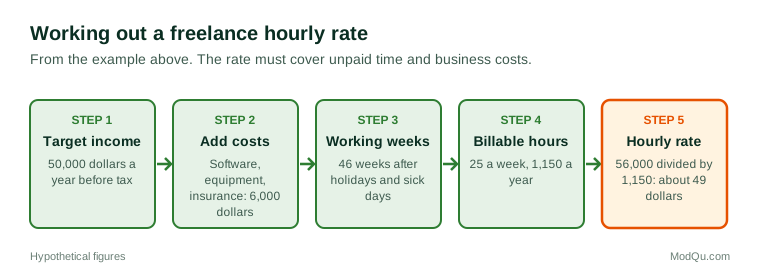
A designer wants to earn 50,000 dollars a year before tax. They plan to work 46 weeks a year, but only about 25 hours a week is billable because the rest goes on admin and finding clients. That is 1,150 billable hours. Business costs such as software, equipment and insurance come to 6,000 dollars a year. To cover 56,000 dollars, they need to charge about 49 dollars an hour.
Uneven income and cash flow
Income from freelancing often goes up and down. Common causes include seasonal work, gaps between projects, clients who pay late and the loss of a large client. Freelancers manage this by:
- keeping a cash buffer of several months' costs;
- asking for deposits or staged payments on large jobs;
- using clear contracts and payment terms;
- invoicing promptly and following up on late payments;
- spreading work across several clients.
Late payment is a frequent complaint. Some countries have laws that allow interest on late commercial payments.
Tax, admin and protection
Working for yourself means handling tasks an employer usually does. These include registering with the tax authority, keeping records, filing tax returns, paying tax and social contributions, and in some cases registering for sales tax or VAT. Rules differ widely by country.
Self-employed people usually do not get paid holiday, sick pay or employer pension contributions. Some buy income protection insurance or save into personal pensions. Professional indemnity and public liability insurance protect against claims from clients or the public.
Example
A self-employed electrician sets aside a fixed share of every payment in a separate account for tax. After a year in which a large tax bill came as a surprise, they say keeping the money apart was the single change that reduced their stress most.
Working alone
Many freelancers say the hardest part of self-employment is not the work but working alone. Without colleagues, they miss advice, feedback and social contact, and it can be hard to switch off when the office is at home. Common responses include joining professional associations and online communities, working some days from coworking spaces or cafés, partnering with other freelancers on larger projects, and setting fixed working hours.
Tools and services freelancers pay for
Common tools and services include accounting and invoicing software, a business bank account, project management and communication tools, design or specialist software, a website, insurance, professional association membership, and coworking space or equipment. Many freelancers also pay an accountant at least for their yearly tax return.
What people disagree about
Freelancing raises a number of debates:
- whether app-based workers should be treated as employees, which courts in several countries have considered;
- whether self-employed people should get sick pay, holiday and pensions through public schemes;
- whether online platforms push rates down;
- how tax rules should treat freelancers compared with employees.
Questions software firms, banks, accountants and insurers want answered include how freelancers find work, how they price, how stable their income is and which tools and services they pay for.
Key terms
- FreelancerA self-employed person who sells services to several clients.
- Sole traderA one-person business where the owner and business are legally the same.
- Limited companyA business that is legally separate from its owners.
- RetainerA regular fee for an agreed amount of ongoing work.
- Billable hoursHours of work that can be charged to clients.
- InvoiceA bill sent to a client asking for payment.
- Cash flowThe movement of money into and out of a business over time.
- Professional indemnity insuranceInsurance against claims that a professional's advice or work caused a loss.
Full glossary: contingent workforce management terms on EditingTests.com.
Freelancers and sole traders vocabulary test
How well do you know the language of this topic? Try 8 quick questions. Your score is shown straight away and is not saved.
What the freelancers and sole traders survey asks
This survey is part of ModQu's Business and Professional Services survey. The freelancers and sole traders part takes about five minutes and covers:
- What kind of work you do and how long you have been self-employed.
- How you find new clients.
- How you set your prices.
- How stable your income is from month to month.
- Which tools and services you pay for.
- What would make working for yourself easier.
After that you can choose to continue with other short parts of the Business and Professional Services survey, such as small business owners or accounting and bookkeeping, or stop.
Ready to take part?
Your answers help show what people really think and do. Results are only ever reported as totals; no one can see your individual answers.
Start the surveyQuestions about this survey
Who can take part?
Self-employed people without staff.
Do I have to give my name?
No. You may be asked for your age group, region and similar details so results can be broken down, but not your name. ModQu never asks for passwords, card numbers or account numbers.
How are the results used?
Answers are combined into totals and percentages and published in ModQu reports. Individual answers are never shown.
Is the vocabulary test part of the survey?
No. It is optional and separate, and your score is not stored.
Can I take part if I also have a job?
Yes. The survey asks about self-employment as your main or second income.
Does the survey ask for my exact income?
No. It uses broad ranges, and every question about money can be skipped.