
Share how your business manages travel
Tell us how your business books travel, whether you have a travel policy and how business travel has changed. Your answers are combined with other people's and reported only as totals.
Start the business travel management surveyAbout 5 minutes. No account needed. You can stop at any time.
What business travel management covers
Business travel management is how an organization plans, books, pays for and controls work travel. It covers:
- booking flights, trains, hotels and cars;
- travel policy: rules on what travellers may book and spend;
- approvals: who must agree before a trip;
- payment: company cards, central billing and personal cards with reimbursement;
- expenses: claiming, checking and paying back costs;
- duty of care: keeping travellers safe and knowing where they are;
- reporting: tracking spending and, increasingly, carbon emissions.
Small businesses often handle all of this informally. Larger organizations may have a travel manager and contracts with travel agencies.
How businesses book travel
Common approaches include:
- each traveller books for themselves directly with airlines, rail companies and hotels, or through public booking websites;
- an office manager or assistant books for everyone;
- a travel management company (TMC), a specialist agency that books trips, offers negotiated rates and provides support;
- online booking tools for businesses, which show options within the company's policy;
- expense and travel platforms that combine booking, cards and expense claims.
Smaller businesses often start with self-booking and move to a tool or agency as travel grows.
Example
A 25-person engineering firm lets staff book their own travel and claim it back. The finance manager finds that hotel prices for the same city vary widely and that receipts are often missing. The firm adopts an online booking tool with a nightly hotel limit for each city and company cards for travel, and expense claims become faster to check.
Travel policies
A travel policy sets rules so that travel is fair, safe and affordable. Common contents include:
- which class of travel is allowed, often economy for shorter flights;
- hotel price limits by city;
- how far in advance to book;
- when rail must be used instead of flying, for shorter routes;
- rules for car hire and use of personal cars, including mileage rates;
- meal and daily allowances, sometimes called per diems;
- who must approve trips and changes;
- safety requirements, such as registering trips with a travel service.
Some businesses keep policies short and flexible; others are detailed and strict. Employees often say they want rules that are clear and that allow some comfort on long journeys.
Expenses and payment
Travellers pay for trips in several ways:
- company credit or prepaid cards, issued to staff;
- central billing, where the company pays the agency or supplier directly;
- personal cards with reimbursement, which can leave staff out of pocket for weeks.
Checking expense claims takes time. Many businesses now use apps that photograph receipts, match them to card transactions and flag claims outside policy.
Example (hypothetical figures)
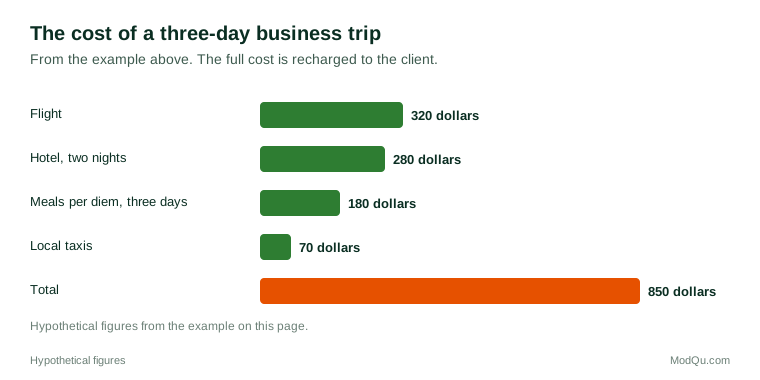
A consultant takes a three-day trip. The flight costs 320 dollars, two hotel nights at 140 dollars cost 280 dollars, and the per diem of 60 dollars a day for meals comes to 180 dollars. Local taxis cost 70 dollars. The total trip cost is 850 dollars. The client contract allows travel to be billed at cost, so the firm recharges the full 850 dollars to the client.
Duty of care
Employers in many countries have a legal or moral duty to look after the health and safety of staff who travel for work. This can include:
- risk assessments for destinations;
- travel insurance and medical assistance;
- tracking where travellers are, so they can be contacted in an emergency;
- security advice and support for higher-risk destinations;
- policies for travellers' wellbeing, such as rest after long flights.
Some groups of travellers may face particular risks in some destinations, and many employers now consider this in their planning.
How business travel has changed
Business travel fell sharply during the COVID-19 pandemic. Video calls replaced many internal meetings, and some businesses found they could do without much travel. Travel has since recovered in many sectors, but patterns have changed:
- fewer short internal trips, with travel focused on clients, sales and team gatherings;
- more combining of work and leisure, sometimes called bleisure;
- more attention to carbon emissions, with some companies setting travel carbon budgets;
- more use of rail for shorter routes in regions with good rail networks;
- higher prices for flights and hotels in many markets.
Example
A software company brings its remote team together twice a year for a week instead of sending staff on frequent short trips. Total travel spending is similar, but managers say the meetings are more useful and the company's travel emissions have fallen.
Travel in small businesses
In small businesses, travel is often handled by the owner, who may book trips in spare moments and pay on a personal card. Common problems include losing receipts, booking at the last minute when prices are high, and not knowing what the business spends on travel in a year. Simple steps such as a short written policy, a separate business card for travel and an expense app can help.
Example
The owner of a seven-person events company adds up a year of travel receipts for the first time and finds the business spent much more than expected, mostly on last-minute train tickets. They set a rule that trips known about two weeks ahead must be booked then, and travel costs fall the following year.
Sustainability
Many businesses now measure the emissions from travel and set targets to reduce them. Measures include travelling less, choosing rail, flying economy, choosing direct flights and staying longer on each trip. Some buy carbon offsets, which are debated. Travel emissions are often reported as part of company sustainability reporting.
What people disagree about
Business travel raises several debates:
- whether in-person meetings are worth the cost and emissions compared with video calls;
- how strict travel policies should be;
- whether staff should travel in economy on long flights;
- whether employers should allow bleisure trips;
- whether carbon offsets count as real reductions.
Questions travel agencies, booking tool providers, airlines, hotels and card providers want answered include how businesses book travel, what policies they use, how much they spend and how travel has changed.
Key terms
- Travel policyA company's rules for booking and paying for work travel.
- Travel management companyAn agency that books and manages business travel.
- Per diemA fixed daily allowance for meals and incidental costs.
- Duty of careAn employer's responsibility for staff health and safety.
- Expense claimA request to be repaid for costs paid for work.
- Central billingThe company pays suppliers directly instead of the traveller.
- BleisureCombining a business trip with leisure time.
- Mileage rateA set amount paid per kilometre or mile for using a personal car for work.
Full glossary: travel technology terms on EditingTests.com.
Business travel management vocabulary test
How well do you know the language of this topic? Try 8 quick questions. Your score is shown straight away and is not saved.
What the business travel management survey asks
This survey is part of ModQu's Business and Professional Services survey. The business travel management part takes about five minutes and covers:
- How your business books travel: self-booking, an assistant, a booking tool or an agency.
- Whether you have a written travel policy, and what it covers.
- How travel is paid for and how expenses are claimed.
- How much your business spends on travel, as a range.
- How business travel has changed in your business recently.
- What would make managing travel easier.
After that you can choose to continue with other short parts of the Business and Professional Services survey, such as small business owners or accounting and bookkeeping, or stop.
Ready to take part?
Your answers help show what people really think and do. Results are only ever reported as totals; no one can see your individual answers.
Start the surveyQuestions about this survey
Who can take part?
Business owners and managers.
Do I have to give my name?
No. You may be asked for your age group, region and similar details so results can be broken down, but not your name. ModQu never asks for passwords, card numbers or account numbers.
How are the results used?
Answers are combined into totals and percentages and published in ModQu reports. Individual answers are never shown.
Is the vocabulary test part of the survey?
No. It is optional and separate, and your score is not stored.
Can very small businesses take part?
Yes. The survey includes businesses that travel only a few times a year.
Does the survey ask for company names?
No. It asks about your business size and sector, not its name.