
Share how your business hires
Tell us how many people you hired, where you advertise jobs and whether you use skills tests. Your answers are combined with other people's and reported only as totals.
Start the hiring and recruitment in small businesses surveyAbout 5 minutes. No account needed. You can stop at any time.
What this topic covers
This topic is about how owners and managers of small businesses find and hire employees. It covers the decision to hire, writing a job posting, choosing where to advertise, screening applications, interviews, skills tests, reference checks, making an offer and the first weeks on the job. It also covers why some roles are hard to fill and how small firms compete with larger employers.
In a small business, hiring is usually done by the owner or a manager alongside their main job, without a dedicated human resources department. That shapes every step.
Deciding to hire
Owners often hire when work is piling up, a staff member leaves, the business is growing, or a new skill is needed. Before hiring they weigh:
- Cost: wages plus employer contributions such as CPP, EI and workers' compensation, vacation pay and any benefits.
- Type of role: full time, part time, seasonal, temporary or contract.
- Employee or contractor: the rules on who counts as an employee are set by the Canada Revenue Agency and provincial law, not by what the parties call the arrangement.
- Time to train the new person.
Example (hypothetical figures)
A shop owner plans to hire a full-time sales associate at $19 an hour for 37.5 hours a week, or $712.50 a week and $37,050 a year. The owner budgets about 10% more for employer payroll costs and vacation pay, about $3,705, for a total of about $40,755. They compare this with hiring two part-time staff at the same hourly rate.
Where small businesses advertise jobs
Common channels include:
- Word of mouth and referrals from staff, customers and friends.
- Online job boards, both general and industry-specific.
- The business's website and social media.
- Government job banks, such as Canada's Job Bank.
- Signs in the window, common for retail and restaurants.
- Colleges, universities and trade schools, including co-op and apprenticeship programs.
- Settlement agencies and employment services, which help newcomers and other job seekers.
- Recruitment agencies and staffing firms, usually for harder-to-fill or temporary roles.
Many small businesses rely heavily on referrals because they are cheap and come with a recommendation, though this can limit the range of people who apply.
Screening and interviews
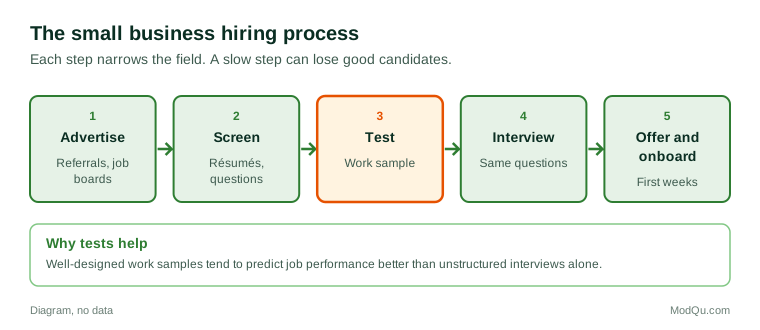
Screening narrows a pool of applicants to a few to interview. Small businesses usually read résumés and cover letters, sometimes ask a few screening questions by phone, then hold one or two interviews. Common interview styles include:
- Unstructured conversations, which are common but tend to be less reliable at predicting job performance.
- Structured interviews, where every candidate is asked the same job-related questions and answers are scored.
- Behavioural questions, such as "Tell me about a time you dealt with an angry customer."
- Working interviews or trial shifts, where the candidate does part of the job. Employment standards in many provinces require that trial work be paid.
Human rights laws in each province, and the Canadian Human Rights Act for federally regulated employers, prohibit discrimination in hiring on grounds such as race, sex, religion, disability, age and family status. Interview questions need to stay focused on the job.
Skills tests
Skills tests check whether a candidate can actually do key parts of the job. Examples include:
- a typing, spelling or grammar test for office and writing roles;
- a vocabulary or industry knowledge test for specialized roles;
- a short task, such as editing a document, building a spreadsheet or writing a social media post;
- a practical test in the trades or kitchens;
- a sales role-play or customer service scenario;
- tests of numeracy for cashiers and bookkeepers.
Research on hiring has generally found that well-designed work samples and job-related tests predict performance better than unstructured interviews alone. Tests should be relevant to the job, the same for all candidates and not take an unreasonable amount of unpaid time.
Example
A small marketing firm receives 60 applications for a junior writer role. Instead of interviewing ten people, the owner sends a 20-minute editing test and a short writing task to everyone who meets the basic requirements. Twelve complete it, and the owner interviews the top four. She says the test showed differences that the résumés did not.
Why roles are hard to fill
Small business owners often report difficulty filling roles. Common reasons include:
- not enough applicants with the right skills or licences;
- competition from larger employers offering higher pay or benefits;
- location, especially in rural areas or where housing is costly;
- shift work, evenings and weekends;
- applicants who do not show up for interviews or the first day;
- slow hiring processes that lose good candidates.
Some businesses respond by raising pay, offering flexible hours, training people without experience, hiring through apprenticeship programs, recruiting newcomers, or using programs that bring in foreign workers, which have their own rules and requirements.
Example
A rural auto repair shop has advertised for a licensed mechanic for eight months with two applicants. The owner hires a young apprentice instead, registers them in the provincial apprenticeship program and arranges for a senior mechanic to supervise. The owner expects to wait several years for the apprentice to become fully licensed.
Offers, onboarding and keeping staff
A written offer usually sets out the role, pay, hours, start date, probation period and benefits. Onboarding covers the paperwork (tax forms, banking details, workplace safety training) and the first weeks of training and introductions. Small businesses that plan the first weeks, assign someone to help the new person and check in regularly tend to keep new staff longer. Losing an employee soon after hiring means repeating the whole process.
Trends and debates
Trends include online applications and scheduling tools, video interviews, pay ranges shown in job postings (required by law in some provinces and states), skills-based hiring that looks beyond formal qualifications, and remote work for some roles. Debates include whether degrees are needed for many jobs, how to use automated résumé screening fairly, how far employers should check social media, and what counts as reasonable unpaid effort in a test. Questions businesses want answered include how many people small firms hire, where they advertise, which roles are hardest to fill and whether they use skills tests.
Key terms
- Job postingA public notice of a vacancy describing the role and how to apply.
- ScreeningNarrowing a pool of applicants before interviews.
- Structured interviewAn interview where every candidate gets the same scored, job-related questions.
- Skills testA task or test that checks whether a candidate can do key parts of the job.
- Reference checkContacting former employers or others to confirm a candidate's background.
- Probation periodAn initial period of employment during which performance is reviewed.
- OnboardingThe process of bringing a new employee into the business.
- ApprenticeshipPaid on-the-job training combined with classes, leading to a trade certification.
Full glossary: recruitment process outsourcing terms on EditingTests.com.
Hiring and recruitment in small businesses vocabulary test
How well do you know the language of this topic? Try 8 quick questions. Your score is shown straight away and is not saved.
What the hiring and recruitment in small businesses survey asks
This survey is part of ModQu's Business and Professional Services survey. The hiring and recruitment in small businesses part takes about five minutes and covers:
- How many people your business hired in the past year, and for which roles.
- Where you advertise jobs, and which channels work best.
- How you screen and interview candidates.
- Whether you use skills tests, and what kind.
- Which roles are hardest to fill, and why.
- What you do to keep new staff once they are hired.
After that you can choose to continue with other short parts of the Business and Professional Services survey, such as small business owners or accounting and bookkeeping, or stop.
Ready to take part?
Your answers help show what people really think and do. Results are only ever reported as totals; no one can see your individual answers.
Start the surveyQuestions about this survey
Who can take part?
Small business owners and managers.
Do I have to give my name?
No. You may be asked for your age group, region and similar details so results can be broken down, but not your name. ModQu never asks for passwords, card numbers or account numbers.
How are the results used?
Answers are combined into totals and percentages and published in ModQu reports. Individual answers are never shown.
Is the vocabulary test part of the survey?
No. It is optional and separate, and your score is not stored.