
Share your experience of customer service
Tell us how you prefer to contact companies, how you feel about chatbots and what made a recent experience good or bad. Your answers are combined with other people's and reported only as totals.
Start the customer service experience surveyAbout 5 minutes. No account needed. You can stop at any time.
What customer service covers
Customer service is the help a business gives people before, during and after they buy something. It includes answering questions, fixing problems, handling returns and refunds, dealing with billing, and listening to complaints. Customer experience is a wider idea: everything a customer goes through with a business, from first hearing about it to stopping using it. Service is often the part of the experience people remember most, especially when something has gone wrong.
How people contact companies
Businesses offer a growing number of channels:
- Phone, with a live agent or an automated menu.
- In person, at a store, branch or service counter.
- Email and web forms.
- Live chat on a website or in an app, with a person or a chatbot.
- Messaging apps and text messages.
- Social media, through public posts or private messages.
- Self-service: help centres, FAQs, account portals, video guides and community forums.
- Callback options, where the company phones the customer back instead of keeping them on hold.
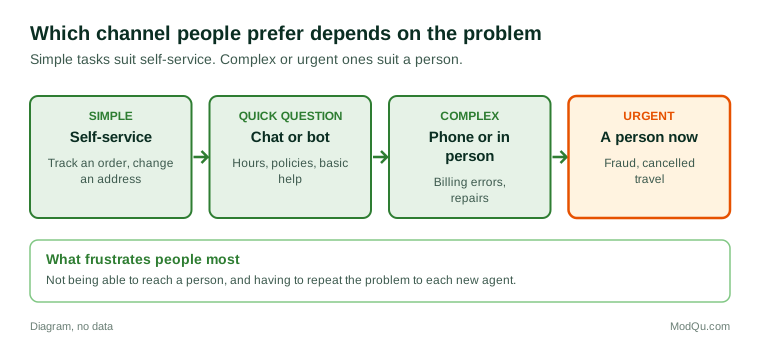
People's preferred channel depends on the problem. Many like self-service or chat for simple tasks, such as tracking an order or changing an address, and prefer to talk to a person for complicated, urgent or emotional problems such as a billing error, a cancelled flight or a fraud alert.
Example
A customer notices a double charge on their phone bill. They first try the company's chatbot, which offers links to help articles but cannot reverse the charge. They then wait 25 minutes on the phone for an agent, who fixes it in four minutes. Asked later, they say the agent was helpful but the wait spoiled the experience.
Chatbots and automation
Many companies now use chatbots and automated systems to answer common questions, sort requests and reduce waiting. Newer chatbots can understand ordinary language and give fuller answers, while older ones follow fixed menus. People's views are mixed:
- What people like: help at any hour, no waiting, quick answers to simple questions.
- What people dislike: going in circles, not being understood, and not being able to reach a person.
Common practice advice in the service industry is that automated systems should make it easy to reach a human, pass along what the customer has already said, and be clear that the customer is talking to a bot. Rules on disclosure and on automated decisions are under discussion in several countries.
What makes service good or bad
When people describe their best and worst service experiences, the same factors come up:
- Speed: short waits and quick resolution.
- Getting it fixed the first time, without being passed around.
- Not repeating information to each new agent.
- Knowledgeable staff with the power to solve the problem.
- Courtesy and empathy: being treated with respect.
- Clear communication about what will happen and when.
- Follow-through: a promised refund or callback actually happening.
- Honesty, including admitting a mistake.
Effort matters a great deal. A process that makes the customer work hard, with long menus, transfers and repeated forms, tends to leave a bad impression even when the problem is solved.
Example
A customer's new washing machine leaks on the first use. They phone the store, and the agent books a technician, emails a confirmation within minutes, and calls the day before the visit. The technician replaces a faulty hose on the first visit. The customer later recommends the store to a neighbour, mentioning the call the day before as the reason.
Waiting, queues and hours
Waiting is one of the most common complaints. Companies manage queues with estimated wait times, callbacks, appointment booking, and shifting simple requests to self-service. Some customers are willing to wait longer for a person they trust; others will abandon a call after a few minutes. Hours also matter, since many people can only call during breaks or after work.
Example
A small business owner needs to change an internet plan but can only call at lunch. Each time, the wait is over 30 minutes. They try the company's website at night and find the change can be made in the online account in five minutes. They say they would have done that first if the option had been easier to find.
Example (hypothetical figures)
A contact centre receives 600 calls in an hour. It offers callbacks when the wait is over 10 minutes, and 180 callers accept, which is 30%. Of the remaining 420 callers, 63 hang up before reaching an agent, an abandonment rate of 15% among those who waited. The manager compares this with the previous month, when 22% hung up and no callback was offered.
Complaints and escalation
When a problem is not solved, customers may ask for a supervisor, file a formal complaint, post a review, contact the company on social media, dispute a charge with their card issuer, or go to an outside body. In Canada, some sectors have independent complaint bodies, such as the Commission for Complaints for Telecom-television Services for phone, internet and TV, and banking ombudsman services for banks. Provincial consumer protection offices handle many other complaints.
How a business handles a complaint can change a customer's view. Research on service recovery has found that customers whose problems are fixed well sometimes end up more loyal than those who never had a problem, though this effect is not consistent.
How businesses measure service
Businesses track measures such as wait time, average handling time, first-contact resolution, customer satisfaction scores (CSAT), Net Promoter Score (NPS) and Customer Effort Score (CES). Many send short surveys after a call or chat. Critics point out that agents can be pushed to end calls quickly to meet targets, and that short surveys may not capture what customers really felt. Questions businesses want answered include how people prefer to make contact, how they feel about chatbots, what drives satisfaction and why customers leave.
Trends and debates
Trends include more messaging and chat, more automation, service from home-based agents, and companies using customer data to anticipate problems. People debate whether automation improves or worsens service, whether companies hide their phone numbers to cut costs, how agents' working conditions affect service, and whether businesses should be required to offer a human contact.
Key terms
- Customer experienceEverything a customer goes through with a business, from first contact to leaving.
- First-contact resolutionSolving a problem in the first call, chat or visit.
- ChatbotSoftware that answers customers in a chat window.
- EscalationPassing a problem to a supervisor or higher level.
- Self-serviceHelp customers find and use on their own, such as FAQs and account portals.
- Abandonment rateThe share of callers who hang up before reaching an agent.
- Service recoveryHow a business responds to and fixes a service failure.
- Customer Effort ScoreA measure of how easy it was for a customer to get help.
Full glossary: customer experience platforms terms on EditingTests.com.
Customer service experience vocabulary test
How well do you know the language of this topic? Try 8 quick questions. Your score is shown straight away and is not saved.
What the customer service experience survey asks
This survey is part of ModQu's Business and Professional Services survey. The customer service experience part takes about five minutes and covers:
- How you prefer to contact a company, and whether it depends on the problem.
- How you feel about chatbots and automated help.
- How long you are willing to wait, and when you give up.
- Your best recent service experience, and what made it good.
- Your worst recent service experience, and how it ended.
- Whether a service experience has made you stop using a company.
After that you can choose to continue with other short parts of the Business and Professional Services survey, such as small business owners or accounting and bookkeeping, or stop.
Ready to take part?
Your answers help show what people really think and do. Results are only ever reported as totals; no one can see your individual answers.
Start the surveyQuestions about this survey
Who can take part?
Adults.
Do I have to give my name?
No. You may be asked for your age group, region and similar details so results can be broken down, but not your name. ModQu never asks for passwords, card numbers or account numbers.
How are the results used?
Answers are combined into totals and percentages and published in ModQu reports. Individual answers are never shown.
Is the vocabulary test part of the survey?
No. It is optional and separate, and your score is not stored.