
Share how your business markets itself
Tell us which marketing channels you use, how your budget has changed and how you measure results. Your answers are combined with other people's and reported only as totals.
Start the marketing and advertising surveyAbout 5 minutes. No account needed. You can stop at any time.
What marketing and advertising cover
Marketing is the work of understanding customers, deciding what to offer them, at what price and through which channels, and telling them about it. Advertising is one part of marketing: paying to place a message in front of people, whether on a billboard, a website, a podcast or a social media feed.
Marketing in a business usually includes:
- research into customers and competitors;
- branding: the name, logo, look and voice of the business;
- pricing and offers;
- advertising and promotion;
- content such as articles, videos and newsletters;
- public relations and media coverage;
- events, sponsorships and trade shows;
- managing reviews and reputation.
This survey is for people who make marketing decisions, from owners of small shops to marketing managers in larger firms.
The main channels
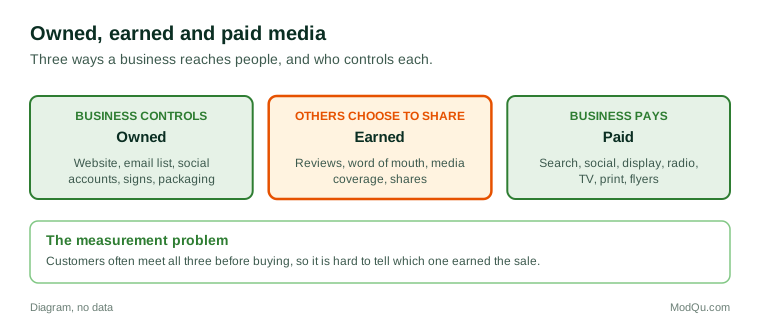
Businesses reach customers through many channels, which are often grouped as owned, earned and paid:
- Owned media: the business's own website, email list, social media accounts, blog, app, store signs and packaging.
- Earned media: coverage, reviews, word of mouth and shares that the business does not pay for directly.
- Paid media: advertising the business pays for.
Paid channels include:
- Search advertising, where ads appear alongside search results for chosen keywords.
- Social media advertising, targeted by interests, location and other traits.
- Display advertising on websites and apps.
- Video and streaming ads.
- Traditional media: radio, television, print, outdoor billboards and transit ads.
- Direct mail and flyers.
- Influencer and creator partnerships.
- Affiliate programs, which pay partners a share of sales they refer.
Local businesses often rely on a few channels: a website, an online business profile, reviews, social media, a newsletter and local community sponsorships. Business-to-business firms put more weight on trade shows, professional networks, direct sales and industry publications.
Example
A family-run garden centre used to spend most of its marketing money on a spring flyer delivered to nearby homes. Over three years it moves part of that budget to social media posts and a weekly email with plant tips. The flyer stays, but is sent to fewer streets, mainly those with older residents who mention it at the till.
Setting a marketing budget
Businesses set marketing budgets in different ways:
- A percentage of sales, past or expected.
- Matching competitors, where that can be estimated.
- Objective and task: deciding what the business wants to achieve and costing the work needed.
- What is left over after other costs, common in small businesses.
Budgets are often among the first costs to be cut when sales fall, even though some owners argue that this is when marketing matters most. Businesses also decide how to split the budget between building long-term awareness of the brand and campaigns that aim for immediate sales.
Example (hypothetical figures)
A business spends $2,000 on search ads in a month. The ads bring 1,000 visits to its website, so each visit costs $2. Of those visitors, 40 become customers, a conversion rate of 4%, so each new customer costs $2,000 ÷ 40, or $50 to acquire. Each customer spends an average of $180 on a first order, which the owner compares with the $50 cost when deciding whether to raise the budget.
In-house, agencies and freelancers
Who does the marketing depends on the business's size and budget:
- The owner, often in spare time.
- An in-house team, from one coordinator to a full department.
- Freelancers for specific tasks such as design, writing, photography or ad management.
- Agencies: full-service, digital, creative, media-buying, public relations or social media agencies.
Many businesses combine these, for example an in-house manager working with a freelancer for design and an agency for paid ads. Owners choosing an agency often look at its experience in their industry, examples of past work, how it reports results, contract length and fees.
Example
A dental clinic hires a digital agency on a 12-month contract to run search ads and social media. After six months the monthly reports show more website visits but the front desk sees no rise in new patient bookings. The clinic asks the agency to track booked appointments rather than visits, and agrees to review the contract at the end of the year.
Measuring results
Measuring whether marketing works is one of the hardest parts of the job. Common measures include:
- reach and impressions: how many people saw a message;
- clicks, visits and engagement;
- leads, sign-ups or enquiries;
- sales and conversion rates;
- cost per lead or per customer acquired;
- return on ad spend;
- customer lifetime value;
- brand awareness and consideration, often measured by surveys.
Attribution is the problem of deciding which channel deserves credit for a sale when a customer saw several. A customer might hear about a business from a friend, see an ad, search for it, read reviews and then buy in store. Different attribution methods give different answers, and businesses often argue about them.
Example
A furniture store runs ads on social media, radio and search during a sale. Online tools show many clicks from social media, but most buyers say at the till that they heard the radio ad. The manager starts asking every customer "How did you hear about us?" and uses a different discount code in each channel to compare.
Privacy, rules and trust
Marketing is subject to rules on advertising and on personal data. In Canada, the Competition Act prohibits false or misleading advertising, Canada's Anti-Spam Legislation (CASL) sets consent rules for commercial electronic messages such as marketing emails and texts, and federal and provincial privacy laws govern how businesses collect and use personal information. The Competition Bureau and the Office of the Privacy Commissioner of Canada enforce parts of these rules. Changes in browsers and phones that limit tracking have also made it harder to target and measure online ads.
Consumers' trust in advertising varies. Many people use ad blockers, skip ads or say they distrust influencer posts that are not clearly labelled.
Trends and debates
Trends include more spending on online channels, short-form video, creator marketing, retail media (ads on store websites and apps), automation of ad buying, and greater use of first-party data that customers share directly. Marketers debate how much to rely on large advertising platforms, how to measure brand-building, how to balance personalization with privacy, and whether automated content will make marketing more alike. Questions businesses want answered include which channels others use, how budgets are changing, whether agencies are used and how results are measured.
Key terms
- Conversion rateThe share of people who take a desired action, such as buying.
- Cost per acquisitionThe marketing cost of gaining one new customer.
- ImpressionsThe number of times an ad or post is shown.
- AttributionDeciding which marketing contact gets credit for a sale.
- Search advertisingPaid ads shown alongside search results for chosen keywords.
- Earned mediaCoverage, reviews and shares a business does not pay for directly.
- Return on ad spendRevenue earned for each dollar spent on advertising.
- CASLCanada's Anti-Spam Legislation, which sets consent rules for commercial electronic messages.
Full glossary: digital marketing terms on EditingTests.com.
Marketing and advertising vocabulary test
How well do you know the language of this topic? Try 8 quick questions. Your score is shown straight away and is not saved.
What the marketing and advertising survey asks
This survey is part of ModQu's Business and Professional Services survey. The marketing and advertising part takes about five minutes and covers:
- Which marketing channels your business uses, and which work best.
- How your marketing budget has changed this year, and why.
- Who does your marketing: you, staff, freelancers or an agency.
- How you measure whether marketing is working.
- What you find hardest about marketing.
- Which channels you plan to use more, or less, next year.
After that you can choose to continue with other short parts of the Business and Professional Services survey, such as small business owners or accounting and bookkeeping, or stop.
Ready to take part?
Your answers help show what people really think and do. Results are only ever reported as totals; no one can see your individual answers.
Start the surveyQuestions about this survey
Who can take part?
People who make marketing decisions in a business.
Do I have to give my name?
No. You may be asked for your age group, region and similar details so results can be broken down, but not your name. ModQu never asks for passwords, card numbers or account numbers.
How are the results used?
Answers are combined into totals and percentages and published in ModQu reports. Individual answers are never shown.
Is the vocabulary test part of the survey?
No. It is optional and separate, and your score is not stored.