
Share how your business buys from suppliers
Tell us how you find new suppliers, what payment terms you get and whether you have had supply delays this year. Your answers are combined with other people's and reported only as totals.
Start the suppliers and wholesale buying surveyAbout 5 minutes. No account needed. You can stop at any time.
What wholesale buying means
Wholesale buying means buying goods in larger quantities, usually at lower unit prices, to resell or use in a business. Suppliers include:
- manufacturers that sell directly to businesses;
- wholesalers and distributors that buy from many manufacturers and sell to businesses;
- cash-and-carry warehouses, where business customers collect goods themselves;
- importers and agents that source goods from abroad;
- online business-to-business (B2B) marketplaces;
- local producers, such as farms, bakeries and craft makers;
- service suppliers, such as cleaning, maintenance and IT providers.
Many businesses use a mix of large and small suppliers.
Finding suppliers
Common ways businesses find suppliers include:
- recommendations from other business owners and industry contacts;
- trade shows and fairs, where suppliers display products;
- online searches and B2B marketplaces;
- trade associations and directories;
- sales representatives who visit or call;
- looking at product labels and packaging to identify manufacturers;
- sourcing agents in other countries.
Example
A new gift shop owner visits a regional trade fair and meets 20 suppliers in one day. They place small first orders with five, test which products sell, and reorder from three. They say meeting suppliers in person helped them judge quality and reliability better than browsing online.
Choosing a supplier
Businesses usually weigh several factors:
- price per unit and discounts for volume;
- minimum order quantity (MOQ), which can be a barrier for small buyers;
- quality and consistency;
- reliability and delivery times;
- payment terms and credit;
- delivery costs and how often deliveries come;
- customer service and how problems are handled;
- ethical and environmental standards, such as fair labour and sustainable materials;
- location, since local suppliers may be faster and more flexible.
Many businesses keep a backup supplier for important items.
Payment terms
Payment terms set when and how a business pays its supplier. Common terms include:
- payment in advance or on order, common for new customers and small orders;
- cash on delivery;
- trade credit, such as payment within 30 or 60 days of the invoice, often called net 30 or net 60;
- early payment discounts, such as a small discount for paying within 10 days;
- deposits with the balance on delivery, common for large or custom orders.
Trade credit helps cash flow because a business can sell goods before paying for them. New businesses often have to pay up front until they build a track record.
Example (hypothetical figures)
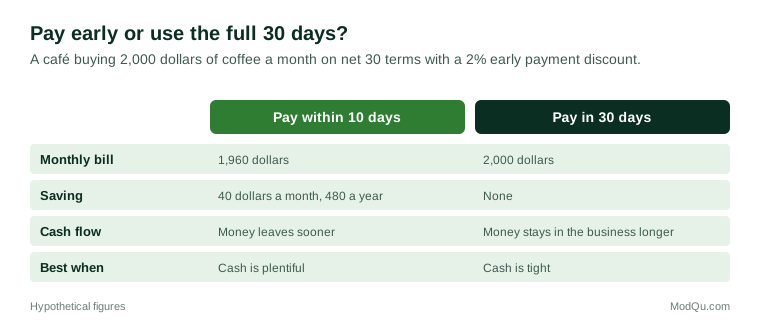
A café buys 2,000 dollars of coffee a month on net 30 terms. The supplier offers a 2 percent discount for paying within 10 days. Paying early saves 40 dollars a month, or 480 dollars a year. The café's owner decides to pay early in months when cash allows and use the full 30 days in quieter months.
Negotiating with suppliers
Small businesses often feel they have less bargaining power than large buyers. Common ways they negotiate include:
- committing to regular orders;
- combining orders with other businesses through buying groups or co-operatives;
- asking for better terms after a period of reliable payment;
- comparing quotes from several suppliers;
- paying promptly to build trust;
- agreeing longer contracts for stable prices.
Supply problems
Supply problems became more visible during the COVID-19 pandemic and later disruptions to shipping and energy. Problems businesses report include:
- delays in delivery;
- shortages of particular products or materials;
- price rises, sometimes at short notice;
- wrong or damaged deliveries;
- minimum orders rising;
- suppliers going out of business.
Businesses respond by keeping more stock, using several suppliers, buying locally, changing products, and building stronger relationships with key suppliers.
Example
A bakery's flour supplier raises prices twice in six months and misses two deliveries. The owner finds a second supplier, a regional mill, and splits orders between them. The mill costs slightly more but delivers twice a week, which lets the bakery keep less flour in storage.
Managing stock
Buying decisions are closely linked to how much stock a business keeps. Holding too much ties up cash and storage space, and goods may spoil or go out of fashion. Holding too little risks running out. Common approaches include:
- reordering when stock falls to a set level;
- regular fixed orders with a supplier;
- buying more ahead of busy seasons;
- just-in-time ordering, where goods arrive shortly before they are needed;
- inventory software that tracks sales and suggests orders.
Example
A hardware shop uses a simple spreadsheet to track its 300 best-selling items. When stock of any item falls below two weeks of typical sales, it reorders. After a year the owner says the shop runs out of popular items less often and has less money tied up in slow-moving stock.
Ethics and standards
Many businesses are paying more attention to how their suppliers operate. Concerns include working conditions, child and forced labour, environmental damage and product safety. Some countries now require larger companies to check their supply chains for human rights and environmental risks, and these rules can pass down to smaller suppliers. Certifications and audits are common ways to show standards.
Buying groups and co-operatives
Some small businesses join buying groups or co-operatives, which combine members' orders to get better prices and terms. These are common among independent pharmacies, hardware shops, grocers and farmers in many countries. Members may pay a fee or buy a share, and in return gain access to discounts, shared marketing and advice.
What people disagree about
Supplier relationships raise some debates:
- whether large buyers pay small suppliers too slowly, and whether payment times should be regulated;
- whether to buy locally even at higher cost;
- how far businesses can check conditions deep in their supply chains;
- whether keeping more stock is worth the cost.
Questions B2B suppliers, banks, software firms and accountants want answered include how small businesses find suppliers, what terms they get, which problems they face and how they plan to change their buying.
Key terms
- WholesalerA business that buys goods in bulk and sells them to other businesses.
- Minimum order quantityThe smallest amount a supplier will sell in one order.
- Trade creditTime allowed by a supplier to pay after receiving goods.
- Net 30Payment due within 30 days of the invoice.
- Early payment discountA price reduction for paying before the due date.
- Cash-and-carryA wholesale warehouse where business customers collect goods themselves.
- Lead timeThe time between placing an order and receiving it.
- Supply chainThe firms and steps involved in making and delivering a product.
Full glossary: apparel sourcing terms on EditingTests.com.
Suppliers and wholesale buying vocabulary test
How well do you know the language of this topic? Try 8 quick questions. Your score is shown straight away and is not saved.
What the suppliers and wholesale buying survey asks
This survey is part of ModQu's Business and Professional Services survey. The suppliers and wholesale buying part takes about five minutes and covers:
- How you find new suppliers.
- What matters most when you choose a supplier.
- What payment terms you usually get.
- Whether you have had supply delays, shortages or price rises this year.
- How you have changed your buying in response.
- Whether you check suppliers' ethical or environmental standards.
After that you can choose to continue with other short parts of the Business and Professional Services survey, such as small business owners or accounting and bookkeeping, or stop.
Ready to take part?
Your answers help show what people really think and do. Results are only ever reported as totals; no one can see your individual answers.
Start the surveyQuestions about this survey
Who can take part?
Business owners and buyers.
Do I have to give my name?
No. You may be asked for your age group, region and similar details so results can be broken down, but not your name. ModQu never asks for passwords, card numbers or account numbers.
How are the results used?
Answers are combined into totals and percentages and published in ModQu reports. Individual answers are never shown.
Is the vocabulary test part of the survey?
No. It is optional and separate, and your score is not stored.
Can service businesses take part?
Yes. The survey covers suppliers of services as well as goods.
Does the survey ask for supplier names?
No. It asks about kinds of supplier and your experience.