
Share your experience of selling online
Tell us where you sell online, what your biggest cost is and how you handle shipping. Your answers are combined with other people's and reported only as totals.
Start the online selling and e-commerce businesses surveyAbout 5 minutes. No account needed. You can stop at any time.
Who sells online
Online sellers range from people selling handmade crafts or second-hand clothes in their spare time to small companies with warehouses and staff. Common types include:
- makers selling handmade goods, art and crafts;
- resellers who buy stock and sell it online;
- brands that design products and have them made by suppliers;
- second-hand and vintage sellers;
- digital sellers offering downloads, courses, templates and software;
- dropshippers, who sell products shipped directly from a supplier without holding stock;
- shops with a physical store that also sell online.
Many start as a side income and some grow into full-time businesses.
Where people sell
Sellers choose between several channels, and many use more than one:
- online marketplaces, large websites where many sellers list products; they bring customers but charge fees and set rules;
- specialist marketplaces for handmade goods, vintage items or particular categories;
- their own website, built with an online store builder, giving more control and customer data but requiring them to attract visitors;
- social media shops and selling through posts, live streams and messaging apps;
- local selling apps and groups;
- wholesale to other shops.
Social commerce, selling through social media and messaging, is especially common in parts of Asia, Africa and Latin America, where many small sellers take orders through chat apps and accept mobile payments.
Example
A ceramics maker starts selling mugs on a handmade marketplace. After a year, about a third of their buyers come back for more. They open their own website to keep in touch with these customers and pay lower fees, but keep the marketplace listings because most new customers still find them there.
The costs of selling online
Online sellers face several kinds of cost:
- marketplace fees: listing fees, a share of each sale, and sometimes subscription fees;
- payment processing fees;
- website and app subscriptions;
- advertising, on marketplaces, search engines and social media;
- product costs and packaging;
- shipping and returns;
- taxes, including sales tax or VAT, which may apply to cross-border sales;
- photography, software and storage.
Many sellers say advertising and fees take a larger share of each sale than they expected.
Example (hypothetical figures)
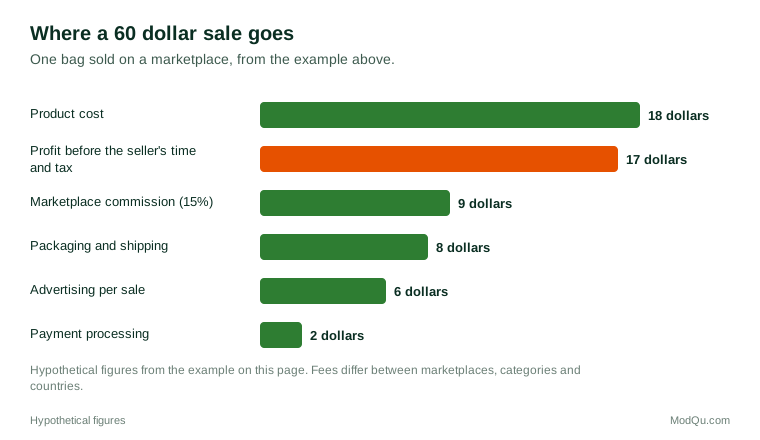
A seller sells a bag for 60 dollars on a marketplace. The marketplace takes 15 percent, 9 dollars, and payment processing costs 2 dollars. Advertising costs average 6 dollars per sale. The bag costs 18 dollars to make, and packaging and shipping cost 8 dollars. That leaves 17 dollars of profit before the seller's own time and tax, about 28 percent of the price.
Shipping and fulfilment
Getting products to customers is one of the biggest tasks. Options include:
- packing and posting orders themselves;
- using courier and postal services, often through shipping software that compares rates;
- fulfilment services, where a warehouse stores stock and ships orders;
- marketplace fulfilment programmes;
- local delivery or collection.
Customers often expect free or cheap shipping and fast delivery, which squeezes small sellers' margins. Many offer free shipping above a minimum order value.
Returns and customer service
Returns are a cost and a workload, especially in clothing. Consumer laws in many countries give online shoppers the right to return items within a set period. Sellers also handle questions, complaints, damaged parcels, and in some cases fraud such as false claims that items did not arrive.
Example
A small clothing seller finds that one in five dresses is returned, usually because of fit. They add detailed measurements and photos of the dresses on people of different sizes. Returns fall, and customers leave reviews saying the size guide helped.
Growing an online business
Owners describe several ways they grow:
- better product photos and descriptions;
- reviews and repeat customers;
- email lists and social media followings;
- paid advertising;
- new products and channels;
- selling to other countries.
Common obstacles include rising advertising costs, competition from very cheap sellers, changes to marketplace rules or search ranking, and the time needed to do everything alone.
Starting an online shop
People starting to sell online often follow similar steps: choosing products, checking demand, setting up a marketplace account or store, photographing products, writing descriptions, setting prices that cover all costs, arranging shipping and registering with tax authorities where required. Many start small, test what sells and add products gradually. Common early mistakes include underestimating fees and shipping costs, poor photos, and not planning for returns.
Example
A parent starts selling hand-knitted baby clothes on a handmade marketplace to fit around childcare. In the first three months they make few sales. They take new photos in daylight, add sizes and care instructions, and lower their shipping price by switching to a lighter mailer. Sales rise steadily, and after a year the shop covers the family's grocery bill each month.
Reviews, trust and fake listings
Reviews strongly affect online sales, and new sellers with no reviews often struggle to get their first orders. Sellers ask happy customers to leave reviews, respond politely to negative ones and include clear photos and policies. Fake reviews, copied listings and counterfeit products are a problem on some marketplaces, and regulators in several regions have introduced rules against fake reviews.
Rules and responsibilities
Online sellers must follow rules that vary by country, including consumer protection, product safety, labelling, data protection and tax registration. Some marketplaces now report sellers' income to tax authorities under rules in several regions. Selling across borders can bring customs duties and different tax rules.
What people disagree about
Online selling raises several debates:
- whether large marketplaces have too much power over small sellers;
- whether marketplace fees and advertising costs are fair;
- how to compete with very low-priced imported goods;
- whether free shipping and returns are sustainable;
- how much marketplaces should be responsible for unsafe or fake products.
Questions software firms, payment providers, couriers and banks want answered include where small businesses sell, what they pay in fees, how they ship, and what is holding back growth.
Key terms
- MarketplaceA website where many sellers list products for buyers.
- CommissionA share of each sale taken by a marketplace.
- DropshippingSelling products shipped directly from a supplier to the buyer.
- FulfilmentStoring, packing and shipping orders.
- Social commerceSelling through social media and messaging apps.
- Conversion rateThe share of visitors who make a purchase.
- MarginThe share of the price left as profit after costs.
- Customs dutyA tax on goods imported into a country.
Full glossary: e commerce terms on EditingTests.com.
Online selling and e-commerce businesses vocabulary test
How well do you know the language of this topic? Try 8 quick questions. Your score is shown straight away and is not saved.
What the online selling and e-commerce businesses survey asks
This survey is part of ModQu's Business and Professional Services survey. The online selling and e-commerce businesses part takes about five minutes and covers:
- Where you sell online: marketplaces, your own website, social media or others.
- What you sell and how long you have sold online.
- What your biggest cost is.
- How you handle shipping and returns.
- How your sales have changed in the last year.
- What is holding back your growth.
After that you can choose to continue with other short parts of the Business and Professional Services survey, such as small business owners or accounting and bookkeeping, or stop.
Ready to take part?
Your answers help show what people really think and do. Results are only ever reported as totals; no one can see your individual answers.
Start the surveyQuestions about this survey
Who can take part?
Owners of online shops.
Do I have to give my name?
No. You may be asked for your age group, region and similar details so results can be broken down, but not your name. ModQu never asks for passwords, card numbers or account numbers.
How are the results used?
Answers are combined into totals and percentages and published in ModQu reports. Individual answers are never shown.
Is the vocabulary test part of the survey?
No. It is optional and separate, and your score is not stored.
Can I take part if I sell as a hobby?
Yes. The survey includes people who sell part-time or as a side income.
Does the survey ask for my sales figures?
It asks for broad ranges, and you can skip any question.