
Share where you work
Tell us whether your business rents office space, whether you have used a coworking space and how much you pay each month. Your answers are combined with other people's and reported only as totals.
Start the office space and coworking surveyAbout 5 minutes. No account needed. You can stop at any time.
The main options
Businesses and independent workers choose from several kinds of workspace:
- working from home, at a kitchen table or in a home office;
- a traditional leased office, usually on a lease of several years;
- serviced offices, private offices rented on shorter terms with furniture, reception, internet and cleaning included;
- coworking spaces, shared workspaces where members rent a desk or use any free seat;
- hot desks, using any available desk, as opposed to a dedicated desk kept for one person;
- meeting room and day passes, rented by the hour or day;
- cafés, libraries and public spaces, used informally;
- shared space with another business, such as renting a spare room in a friend's office.
Many businesses now use a hybrid model, with staff working some days at home and some in a shared space.
Why people choose each option
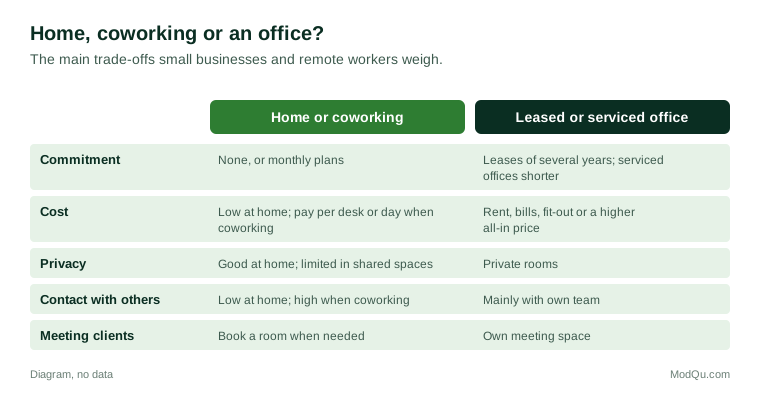
Each option involves trade-offs:
- Home is cheap and saves commuting, but can be isolating and hard to separate from family life.
- Leased offices give control and a fixed base but involve long commitments, fit-out costs and bills.
- Serviced offices are flexible and ready to use but cost more per square metre.
- Coworking offers flexibility, community and facilities, with less privacy and sometimes noise.
People also weigh location, commuting time, client meetings, the need for privacy or quiet, internet reliability, image and the chance to meet others.
Example
A two-person web agency works from home for three years. When they hire a third person, they find it hard to train them remotely. They take a three-desk plan at a coworking space near a train station on a monthly contract, keep working from home two days a week, and book meeting rooms for client visits.
What coworking spaces offer
Coworking spaces differ widely, from large chains to small independent spaces and community hubs. Typical features include:
- desks, chairs and fast internet;
- meeting rooms and phone booths;
- kitchens, coffee and lounge areas;
- printing and post handling;
- a business address, sometimes used for registration;
- events, workshops and networking;
- 24-hour access in some spaces;
- specialist spaces for particular groups, such as creative studios, labs or spaces with childcare.
Membership plans range from a few days a month to full-time private offices.
Costs
Workspace costs depend heavily on city and location. Common costs include:
- rent or membership fees;
- service charges, utilities and cleaning;
- business rates or property taxes, in some countries;
- internet and phone;
- furniture and equipment;
- insurance;
- for leased offices, deposits, legal fees and fit-out.
Example (hypothetical figures)
A freelancer compares options. Working from home adds about 40 dollars a month to their energy bill. A coworking space charges 180 dollars a month for 10 days, or 350 dollars a month for a full-time hot desk. A small private serviced office costs 900 dollars a month. They choose the 10-day plan, paying 180 dollars a month, or 2,160 dollars a year, and work from home the rest of the time.
What people want from a workspace
People who use shared and flexible spaces often mention:
- reliable internet and power;
- quiet areas and places for calls;
- comfortable, adjustable furniture and good light;
- short commuting time;
- flexibility to change plans as the business changes;
- a professional place to meet clients;
- contact with other people;
- clear pricing without hidden extras.
Example
A remote employee of a company based abroad works from home but feels isolated. They join a local coworking space two days a week, attend its monthly lunch, and meet a designer who later becomes a client of their side business. They say the social contact mattered more than the desk.
Choosing a coworking space
People choosing a coworking space often visit several, take a free trial day and ask about:
- the price of each plan and what is included;
- opening hours and access at weekends;
- how busy the space is at peak times;
- noise levels and quiet areas;
- the number of meeting rooms and phone booths, and how easy they are to book;
- parking, bicycle storage and public transport;
- the kind of members, since some spaces attract particular industries;
- notice periods for cancelling.
Many say the community and atmosphere decided their choice as much as the facilities.
Contracts and leases for small firms
Small businesses often find traditional office leases hard to take on. Leases may require personal guarantees, several months' rent as a deposit, and responsibility for repairs. Some landlords now offer shorter leases, rent-free periods or fitted-out "plug and play" offices to attract small tenants. Owners usually seek advice before signing, since lease terms on break dates, rent reviews and repairs vary a great deal.
Changes in office demand
Since the COVID-19 pandemic, many organizations in many countries have reduced office space or moved to hybrid work. Flexible offices and coworking spaces have grown in some cities, while some older offices stand empty or are being converted to other uses. Small towns and suburbs have seen new coworking spaces serving people who no longer commute daily to city centres.
Working from home: the hidden costs
Working from home is often seen as free, but it has costs: extra heating, cooling and electricity, a desk and chair, internet upgrades, and less separation between work and home. Some countries allow tax relief for home working costs, and some employers pay an allowance. Health and safety bodies also note the importance of a suitable chair, screen height and breaks.
What people disagree about
Workspaces raise several debates:
- whether staff should be required to return to offices;
- whether hybrid work helps or harms teamwork, training and careers;
- whether coworking spaces are good value compared with home;
- what should happen to empty offices;
- who should pay the costs of working from home.
Questions property firms, coworking operators, furniture makers and software firms want answered include where small businesses and remote workers work, what they pay and what would make them change.
Key terms
- LeaseA contract to rent property for a set period.
- Serviced officeA furnished private office rented on flexible terms with services included.
- Coworking spaceA shared workspace where members rent desks or use free seats.
- Hot deskA desk used by whoever is there, not kept for one person.
- Dedicated deskA desk reserved for one member in a shared space.
- Hybrid workSplitting working time between home and a workplace.
- Fit-outPreparing an empty office with furniture, wiring and fittings.
- Business addressAn address used for mail or company registration.
Full glossary: commercial real estate terms on EditingTests.com.
Office space and coworking vocabulary test
How well do you know the language of this topic? Try 8 quick questions. Your score is shown straight away and is not saved.
What the office space and coworking survey asks
This survey is part of ModQu's Business and Professional Services survey. The office space and coworking part takes about five minutes and covers:
- Where you or your business mainly works.
- Whether your business rents office space, and on what terms.
- Whether you have used a coworking space, and how often.
- How much you pay for workspace each month.
- What matters most to you in a workspace.
- How your use of office space has changed recently.
After that you can choose to continue with other short parts of the Business and Professional Services survey, such as small business owners or accounting and bookkeeping, or stop.
Ready to take part?
Your answers help show what people really think and do. Results are only ever reported as totals; no one can see your individual answers.
Start the surveyQuestions about this survey
Who can take part?
Business owners and remote workers.
Do I have to give my name?
No. You may be asked for your age group, region and similar details so results can be broken down, but not your name. ModQu never asks for passwords, card numbers or account numbers.
How are the results used?
Answers are combined into totals and percentages and published in ModQu reports. Individual answers are never shown.
Is the vocabulary test part of the survey?
No. It is optional and separate, and your score is not stored.
Can employees of larger companies take part?
Yes, if they work remotely or use flexible space. The survey also covers business owners.
Does the survey ask for my business address?
No. It asks only for your region and type of area, such as city or town.