
Share how your business takes payments
Tell us which payment methods you accept, how much you pay in fees and whether you have changed provider recently. Your answers are combined with other people's and reported only as totals.
Start the payments and point-of-sale systems surveyAbout 5 minutes. No account needed. You can stop at any time.
How businesses take payments
Businesses accept payment in many ways, and the mix differs greatly between countries and sectors:
- cash, still important in many countries and for many small traders;
- debit and credit cards, by chip and PIN, contactless tap or online;
- mobile wallets on phones and watches, which work through card networks;
- QR code payments, very common in parts of Asia and spreading elsewhere;
- mobile money, used widely in parts of Africa, where payments are made from a phone-based account;
- instant bank transfers through national real-time payment systems;
- buy now, pay later services online and in some shops;
- invoices and bank transfers for business customers;
- cheques, now rare in most countries.
The balance between cash and digital payments has shifted quickly in many countries, but some customers still rely on cash, and some places require shops to accept it.
Card terminals and point-of-sale systems
A card terminal reads cards and phones. A point-of-sale (POS) system does more: it records sales, tracks stock, prints or emails receipts, manages staff and links to accounting software. Options include:
- standalone terminals from banks or payment providers;
- mobile card readers that connect to a phone or tablet, popular with market traders and mobile businesses;
- tablet-based POS systems, common in cafés, shops and salons;
- full POS systems with tills, scanners and kitchen printers for larger shops and restaurants;
- soft POS, where a phone itself accepts contactless payments without a separate reader.
Example
A market trader who sells cheese at weekend markets took only cash until customers kept walking away. They buy a small card reader that connects to their phone. Sales rise, but they find that at busy markets the mobile signal is weak, so they choose a reader that can store payments offline and process them later.
Online payments
Businesses that sell online use a payment gateway or payment service provider to take card, wallet and bank payments on their website. Many online store builders include payments. Businesses weigh the range of payment methods offered, fees, how quickly money arrives, fraud protection and how smooth the checkout is for customers.
What payments cost
Payment fees are a regular cost and many owners are unsure exactly what they pay. Pricing models include:
- flat-rate pricing: one percentage, sometimes plus a fixed fee, for each payment;
- interchange-plus pricing: the card networks' fees plus a provider margin, often cheaper for larger businesses but harder to understand;
- monthly fees for terminals, software or the account;
- terminal purchase or rental;
- extra fees for chargebacks, refunds, international cards or instant payouts.
Cash is not free either: it involves counting, storage, security, bank deposit fees and the risk of theft.
Example (hypothetical figures)
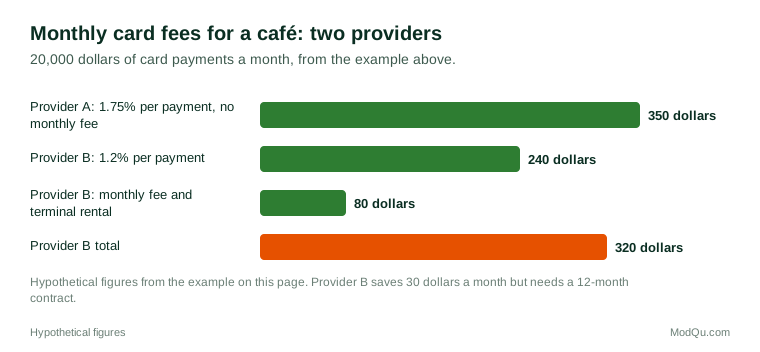
A café takes 20,000 dollars a month in card payments. Provider A charges 1.75 percent per payment with no monthly fee, 350 dollars a month. Provider B charges 1.2 percent plus a 50 dollar monthly fee and a 30 dollar terminal rental, 240 plus 80, or 320 dollars a month. Switching to Provider B would save 30 dollars a month, 360 dollars a year, but locks the café into a 12-month contract.
Choosing and switching providers
Owners compare providers on:
- fees and how clear they are;
- contract length and exit fees;
- how fast money reaches their bank account;
- reliability, including offline mode and support when something goes wrong;
- hardware cost and quality;
- links with accounting, booking or stock software;
- which payment methods customers want.
Switching is often put off because of contracts, the effort of setting up new hardware and software, and fear of disruption. Many owners only compare providers when a contract ends or fees rise.
Fraud, chargebacks and security
Businesses face several risks:
- card fraud, especially online, where a stolen card is used;
- chargebacks, when a customer disputes a payment and the bank reverses it;
- fake payment confirmations and scams aimed at small sellers;
- counterfeit cash.
Card security standards, such as the payment card industry rules, set requirements for businesses that handle card data. Most small businesses rely on their provider to meet these standards.
Example
An online shop receives three large orders in a day from different names but the same delivery address. The payment provider flags them as high risk. The owner cancels the orders and later learns the cards were stolen, avoiding chargebacks that would have cost them the goods and fees.
Payments and small traders
For very small businesses, such as market stalls, street vendors, tradespeople and home businesses, the choice of payment method has a large effect. A cheap card reader or a QR code linked to a bank or mobile money account can let a trader accept digital payments for the first time. Many small traders still prefer cash because it is free to accept and money is available immediately, while others say going cashless has made them safer and saved trips to the bank.
Receipts, records and accounting
Payment systems also affect record-keeping. Many POS systems send daily sales to accounting software, issue digital receipts and record tips and refunds. Some countries require businesses to use certified tills or to report sales electronically to the tax authority. Owners say systems that link payments, stock and accounts save time at the end of each month.
Trends
Payment habits keep changing. Trends in many countries include contactless and phone payments replacing cash, growth of instant account-to-account payments, QR codes, tipping prompts on terminals, and businesses adding surcharges for card payments where rules allow. Some regions limit surcharges by law.
What people disagree about
Payments raise several debates:
- whether businesses should be required to accept cash;
- whether card fees are too high and should be capped further;
- whether businesses should pass card fees to customers through surcharges;
- whether tipping prompts on terminals are fair;
- how quickly economies should move away from cash.
Questions payment providers, banks and software firms want answered include which payment methods businesses accept, what they pay, how they choose providers and why they switch.
Key terms
- Point-of-sale systemHardware and software that records sales and takes payments.
- Card terminalA device that reads cards and phones for payment.
- Payment gatewayA service that processes online payments for a website.
- Interchange feeA fee paid between banks on card transactions.
- ChargebackA reversal of a card payment after a customer disputes it.
- Contactless paymentPaying by tapping a card or phone near a terminal.
- Mobile moneyA phone-based account used to send and receive payments.
- SurchargeAn extra charge added for paying by a particular method.
Full glossary: card payment processing terms on EditingTests.com.
Payments and point-of-sale systems vocabulary test
How well do you know the language of this topic? Try 8 quick questions. Your score is shown straight away and is not saved.
What the payments and point-of-sale systems survey asks
This survey is part of ModQu's Business and Professional Services survey. The payments and point-of-sale systems part takes about five minutes and covers:
- Which payment methods your business accepts.
- Which terminals, POS systems or online payment services you use.
- How much you pay in payment fees, as a share or a range.
- Whether you have changed provider recently, and why.
- Problems you have had with payments, fraud or chargebacks.
- Whether customers still pay in cash, and how that is changing.
After that you can choose to continue with other short parts of the Business and Professional Services survey, such as small business owners or accounting and bookkeeping, or stop.
Ready to take part?
Your answers help show what people really think and do. Results are only ever reported as totals; no one can see your individual answers.
Start the surveyQuestions about this survey
Who can take part?
Business owners who take payments.
Do I have to give my name?
No. You may be asked for your age group, region and similar details so results can be broken down, but not your name. ModQu never asks for passwords, card numbers or account numbers.
How are the results used?
Answers are combined into totals and percentages and published in ModQu reports. Individual answers are never shown.
Is the vocabulary test part of the survey?
No. It is optional and separate, and your score is not stored.
Do I need to know my exact fees?
No. You can give an estimate or say you are not sure.
Can sole traders take part?
Yes. Any business that takes payments can answer.