
Research · Market and business research
Return on Investment of Market Research
How to judge whether market research is worth its cost: the value-of-information approach from decision theory, a worked example, evidence on when research is used, and practical ways to estimate return on investment.
Organisations spend large sums on market research. ESOMAR (2025) estimated the global insights industry at more than US$150 billion in 2024, of which about US$56 billion was traditional market research. Yet research budgets are often set by habit, and its return is rarely measured. This article explains how to estimate the return on research before commissioning it, and what evidence shows about when research pays off.
Research has value only through decisions
Research produces information, and information has economic value only if it can change a decision. If a company will launch a product whatever a study finds, the study's value to that decision is zero, however interesting its findings. This principle comes from decision theory, developed for business by Raiffa and Schlaifer (1961) and formalised as information value theory by Howard (1966).
The approach needs four inputs: the decision options, the uncertain outcomes, the payoffs of each option under each outcome, and the probability of each outcome. From these, two quantities can be calculated:
- The expected value of perfect information (EVPI) is the most any study could be worth: the gain from knowing the outcome for certain before deciding.
- The expected value of sample information (EVSI) is the value of a real study, which reduces uncertainty without removing it. EVSI is always less than EVPI.
A study is worth commissioning if its EVSI exceeds its cost. Its return on investment is (EVSI − cost) ÷ cost.
A worked example
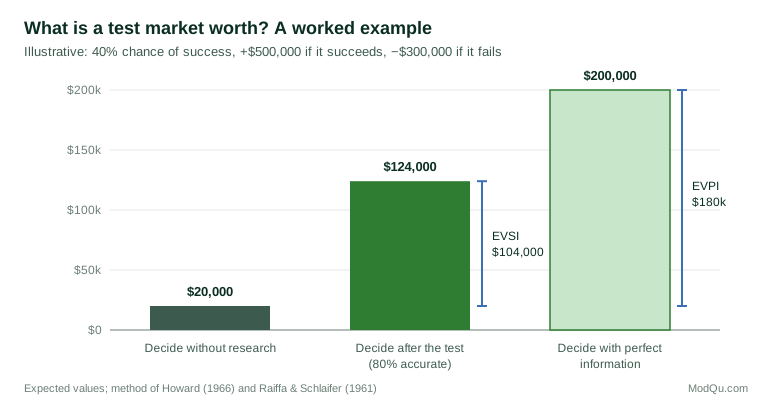
A company is deciding whether to launch a new product. Management believes there is a 40% chance it will succeed. Success would earn $500,000; failure would lose $300,000. The figures are illustrative.
Without research, launching has an expected value of 0.4 × $500,000 − 0.6 × $300,000 = $20,000. Not launching is worth $0, so the company would launch.
With perfect information, the company would launch only if the product would succeed, earning 0.4 × $500,000 = $200,000. The EVPI is $200,000 − $20,000 = $180,000. No study of this decision is worth more.
With a real test market, suppose the test correctly gives a positive result for 80% of products that would succeed and a negative result for 80% of those that would fail. A positive result then occurs 44% of the time, and after a positive result the chance of success rises to about 73%. The company launches only after a positive result, giving an expected value of $124,000. The EVSI is $124,000 − $20,000 = $104,000.
If the test costs $40,000, its expected net gain is $64,000 and its expected return is 160%. If it costs $120,000, it is not worth running, even though its findings would be useful. A test that is less accurate would have a lower EVSI.
The example shows the main factors that determine the value of research: the size of the stakes, how uncertain the decision-maker is, how close the options are, and how accurate the research is. Research is worth most when stakes are high, uncertainty is real and the decision could plausibly go either way. It is worth little when the answer is already clear or the cost of being wrong is small.
Research must be used
A study creates value only if its results are acted on. Deshpandé and Zaltman (1982) found that managers' use of research depended on factors including the technical quality of the research, whether it was actionable, whether its findings were surprising, and how much researchers and managers interacted. Menon and Varadarajan (1992) distinguished between using research to make a specific decision and using it to improve general understanding of a market. Moorman (1995) found that firms differed in how they acquired, shared and used market information, and that this was linked to the performance of their new products.
At the level of the firm, market orientation, which includes generating and acting on market intelligence, has been linked to performance. Jaworski and Kohli (1993) found an association between market orientation and overall business performance, and a meta-analysis by Kirca et al. (2005) confirmed a positive relationship across many studies. These are correlations, not proof that research causes better results, but they are consistent with the view that research pays when organisations act on it.
Practical ways to estimate return
Name the decision first. Before commissioning research, write down the decision it will inform, the options and what result would change the choice. If no result would change the choice, do not run the study.
Estimate the stakes and the uncertainty. Even rough figures help. Hubbard (2014) argues that most business uncertainties can be expressed as ranges and probabilities, and that the first small amount of measurement usually reduces uncertainty the most.
Match spending to value. EVPI sets a ceiling on what research is worth. Where stakes are small, cheap methods such as desk research, small surveys or quick tests are often enough.
Track decisions after the event. Record what each study recommended, what was decided and what happened. Over time this record shows which kinds of research change decisions and which do not.
Remember the cost of being wrong. Online experiments show how unreliable intuition can be: Kohavi et al. (2009) reported that only about a third of ideas tested at Microsoft improved the metrics they were designed to improve. Without testing, a company acts on the other two-thirds as well.
Summary
The return on market research depends on the decision it informs. Decision theory gives a practical way to estimate it: research is worth up to the value of perfect information, and a particular study is worth its expected improvement to the decision. Its value is highest when stakes are large, uncertainty is real and the findings will be used. Naming the decision before commissioning research is the single most useful step towards a good return.
References
Deshpandé, R., & Zaltman, G. (1982). Factors affecting the use of market research information: A path analysis. Journal of Marketing Research, 19(1), 14–31. https://doi.org/10.2307/3151527
ESOMAR. (2025). Global market research 2025. ESOMAR.
Howard, R. A. (1966). Information value theory. IEEE Transactions on Systems Science and Cybernetics, 2(1), 22–26. https://doi.org/10.1109/TSSC.1966.300074
Hubbard, D. W. (2014). How to measure anything: Finding the value of intangibles in business (3rd ed.). Wiley.
Jaworski, B. J., & Kohli, A. K. (1993). Market orientation: Antecedents and consequences. Journal of Marketing, 57(3), 53–70.
Kirca, A. H., Jayachandran, S., & Bearden, W. O. (2005). Market orientation: A meta-analytic review and assessment of its antecedents and impact on performance. Journal of Marketing, 69(2), 24–41.
Kohavi, R., Crook, T., & Longbotham, R. (2009). Online experimentation at Microsoft [Paper presentation]. Third Workshop on Data Mining Case Studies and Practice Prize.
Menon, A., & Varadarajan, P. R. (1992). A model of marketing knowledge use within firms. Journal of Marketing, 56(4), 53–71.
Moorman, C. (1995). Organizational market information processes: Cultural antecedents and new product outcomes. Journal of Marketing Research, 32(3), 318–335.
Raiffa, H., & Schlaifer, R. (1961). Applied statistical decision theory. Division of Research, Graduate School of Business Administration, Harvard University.