
Share your experience of returns
Tell us how often you return items, why, and how easy retailers make it. Your answers are combined with other people's and reported only as totals.
Start the returns and refunds surveyAbout 5 minutes. No account needed. You can stop at any time.
Why people return items
The most common reasons people give for returns include:
- Wrong size or fit, especially for clothing and shoes.
- Not as described or pictured, such as a different colour or material.
- Faulty or damaged on arrival or soon after.
- Changed mind or no longer needed.
- Duplicate or unwanted gifts.
- Late delivery, when the item arrives after it was needed.
Clothing and footwear have some of the highest return rates, because fit and look are hard to judge online.
How returns work
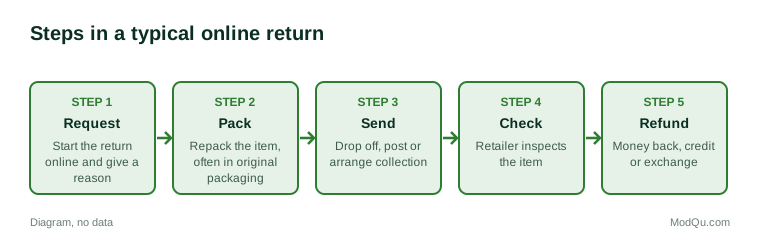
Returns usually follow one of a few routes:
- In store: taking the item back to a shop, sometimes including items bought online.
- By post or courier: printing a label or showing a code at a drop-off point.
- Collection: a courier picks up the item from home.
- Returnless refund: the retailer refunds without asking for the item back, often for low-value goods.
The refund may go back to the original payment method, or be given as store credit or an exchange.
The figure below shows the typical steps of an online return.
Legal rights and store policies
It helps to separate two things:
- Legal rights: many countries give buyers the right to a repair, replacement or refund when goods are faulty, not as described or not fit for purpose. Many also give a cooling-off period for online and distance purchases, during which buyers can cancel for any reason, with some exceptions such as personalized or perishable goods.
- Store policies: many retailers offer more than the law requires, such as longer return periods or refunds for change of mind in store. These policies are voluntary and can change.
Rules differ widely between countries, so what applies in one place may not apply in another.
Example
A customer buys a kettle in a shop and finds it leaks after two weeks. Under local consumer law, she is entitled to a remedy because it is faulty. The shop also has a 30-day change-of-mind policy, but she does not need it, because a fault is covered by law.
Return fees and free returns
Free returns became common in online shopping, especially for fashion. Some retailers have since introduced fees for returns by post, while keeping free returns in store, to cover rising costs. Shoppers often say free returns influence where they buy, and some check the returns policy before ordering.
Example (hypothetical figures)
An online clothing retailer charges 3 for postal returns. A shopper orders three sizes of the same jeans for 150 total, keeps one pair at 50, and returns two. They pay 3 for the return, so their total cost is 53. Before the fee was introduced, they would have paid 50.
Bracketing and serial returning
Some shoppers order several sizes or colours intending to return most of them, which is called bracketing. Some buy items to use once, for an event, and return them. Retailers see these patterns as costly. Some track customers' return rates and may limit or refuse returns from frequent returners.
The cost of returns
Returns cost retailers money in shipping, handling, inspection, repackaging and lost value. Some returned items cannot be resold as new and are sold at a discount, sent to outlet stores, donated, recycled or, in some cases, destroyed. Returns also add to transport emissions and packaging waste. Some countries have proposed or introduced rules against destroying unsold or returned goods.
Example
A retailer finds that a quarter of the dresses it sells online are returned. Many come back in good condition but miss the season and have to be sold at half price. The retailer adds more photos, model measurements and a fit guide, and returns fall.
Returns fraud
Retailers also face fraud, such as returning stolen goods, returning used or different items, or claiming items never arrived. Some retailers use data to spot unusual patterns. Honest customers can be affected by tighter rules introduced in response.
Reducing returns
Retailers try to reduce returns by improving product information, offering size guides and fit tools, showing customer photos, using virtual try-on technology, and improving packaging to reduce damage. Some reward customers for keeping items or charge for returns.
Shopper experience
Shoppers rate returns on how simple the process is, how quickly they get their money back, whether they have to pay, how far the drop-off point is, and how they are treated. A smooth return can increase loyalty; a difficult one can lose a customer.
Returns for gifts and seasonal shopping
Returns rise sharply after major holidays and gift-giving seasons. Gift receipts let recipients exchange or return items without showing the price, usually for store credit. Many retailers extend return periods for items bought in the weeks before holidays. Shoppers often say they keep unwanted gifts rather than face the effort of returning them, and some resell or donate them instead.
What people disagree about
Some argue that free, easy returns are essential to fair online shopping, because buyers cannot see or try items before buying. Others say free returns encourage over-ordering, waste and higher prices for everyone. There is debate about whether customers should pay return costs and whether retailers should be allowed to refuse returns from frequent returners.
Questions that businesses want answered include how many items people return, why, how they return them, how much they would pay for returns, how returns policies affect where they shop, and what would reduce their need to return.
Key terms
- ReturnSending or taking back an item for a refund, exchange or credit.
- RefundMoney paid back to the customer.
- Store creditValue that can be spent only with the same retailer.
- Cooling-off periodA time after a distance purchase when the buyer can cancel for any reason.
- FaultyNot working properly or not of the expected quality.
- BracketingOrdering several sizes or colours to return most of them.
- Returnless refundA refund given without the item being sent back.
- Returns policyA retailer's own rules for returns, which may exceed legal rights.
Full glossary: e commerce terms on EditingTests.com.
Returns and refunds vocabulary test
How well do you know the language of this topic? Try 8 quick questions. Your score is shown straight away and is not saved.
What the returns and refunds survey asks
This survey is part of ModQu's Shopping and Retail survey. The returns and refunds part takes about five minutes and covers:
- How many items you returned in the last year, and for what reasons.
- How you usually return items: in store, by post or by collection.
- How easy and quick your last return was.
- Whether you have paid a return fee and how much you would accept.
- Whether returns policies affect where you shop.
- Whether you order several sizes or colours intending to return some.
After that you can choose to continue with other short parts of the Shopping and Retail survey, such as online shopping or groceries and food shopping, or stop.
Ready to take part?
Your answers help show what people really think and do. Results are only ever reported as totals; no one can see your individual answers.
Start the surveyQuestions about this survey
Who can take part?
Adults who shop.
Do I have to give my name?
No. You may be asked for your age group, region and similar details so results can be broken down, but not your name. ModQu never asks for passwords, card numbers or account numbers.
How are the results used?
Answers are combined into totals and percentages and published in ModQu reports. Individual answers are never shown.
Is the vocabulary test part of the survey?
No. It is optional and separate, and your score is not stored.
Can a shop refuse to refund me if I change my mind?
In a physical shop, often yes, unless its policy allows it. For online purchases, many countries give a cooling-off period. Rules vary.
Do I have to accept store credit instead of a refund?
For faulty goods, many laws give a right to a refund or other remedy. For change of mind, it depends on the store's policy.