
Share how you use markets
Tell us how often you buy from markets or street vendors, what you buy and how you pay. Your answers are combined with other people's and reported only as totals.
Start the markets and street vendors surveyAbout 5 minutes. No account needed. You can stop at any time.
Types of markets
Markets take many forms around the world:
- Daily or weekly food markets, selling fresh fruit, vegetables, meat, fish and staples.
- Bazaars and souks, with many stalls selling clothing, spices, household goods and crafts.
- Street vendors, selling food, drinks, phone credit, snacks and small items from carts, stalls or on foot.
- Farmers' markets, where producers sell directly to customers.
- Night markets, combining food stalls, shopping and entertainment.
- Flea markets and car boot sales, selling second-hand goods.
- Wholesale markets, supplying shops, restaurants and traders.
In many countries, informal street trade is a major source of jobs and income.
Why people shop at markets
Reasons people give include:
- Price: lower prices for fresh food and everyday goods in many places.
- Freshness: produce sold soon after harvest.
- Convenience: markets close to home, work or transport hubs.
- Relationships: knowing the seller, getting advice and credit.
- Local and traditional products not found in supermarkets.
- Experience: atmosphere, food and social contact.
- Supporting local producers and small traders.
Example
A mother of three in a large city buys vegetables, rice and fish from the same market stalls three times a week. She has known the sellers for years. When money is short at the end of the month, one stall owner lets her pay part of her bill the following week.
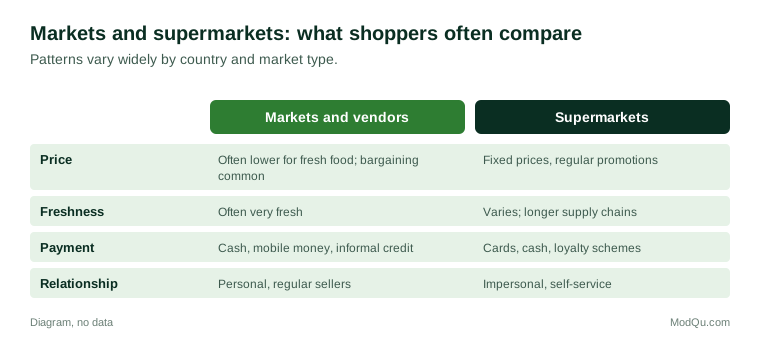
The figure below compares markets with supermarkets on factors shoppers often mention.
Prices and bargaining
In many markets, prices are not fixed. Buyers and sellers negotiate, and regular customers may get better prices or extra items. In others, especially farmers' markets in some countries, prices are fixed and can be higher than supermarkets, reflecting small-scale production and quality.
Example (hypothetical figures)
At a market, a vendor asks 6 for a kilogram of tomatoes. A regular customer offers 4 and they agree on 5. A supermarket nearby sells the same quantity for 5.50 in plastic packaging. The customer saves a little and avoids the packaging.
How people pay
Cash has traditionally dominated market trade. In many countries, mobile money, QR code payments and card readers have spread among market traders, allowing cashless payments. Some vendors still accept only cash. Informal credit, where regular customers pay later, is common in some markets.
Food safety and hygiene
Food safety is a concern for some shoppers, especially for street food and fresh meat and fish. Issues include access to clean water, refrigeration, waste disposal and protection from heat and dust. Many local authorities license and inspect markets and vendors, and some run training in food hygiene. Shoppers often judge safety by how busy a stall is, how clean it looks, and whether food is cooked fresh.
Livelihoods and regulation
For many vendors, market trade is their main income. Many work informally, without licences, social protection or secure places to trade. Issues they face include eviction from public spaces, fees and fines, competition from supermarkets and online retailers, and weather. Some cities have built new market halls or designated vending zones; others have cleared vendors from streets. Vendor associations represent traders in negotiations with authorities.
Example
A city plans to remove street vendors from a busy road to reduce congestion. The vendors' association negotiates a new covered market nearby with water and storage. Some vendors move and do well; others say they lose passing trade and return to the street.
Markets and the environment
Markets can reduce packaging waste, since many goods are sold loose, and can shorten supply chains when producers sell directly. They also produce organic waste and may use single-use plastic bags. Some markets have introduced composting and reusable bag schemes.
Farmers' markets and local food
In many higher-income countries, farmers' markets have become popular with shoppers who want local, seasonal and sometimes organic food. Shoppers value meeting producers and knowing where food comes from. Prices can be higher than supermarkets, and access depends on market days and locations.
Markets as social and tourist spaces
Markets are social places where people meet, chat and share news. Many are also tourist attractions, known for food, crafts and atmosphere. Tourism can bring income but also raise prices and change what is sold.
Markets and online competition
Online grocery delivery and quick-commerce apps compete with markets for some shoppers, especially younger people in cities. Some market traders have responded by taking orders through messaging apps, joining delivery platforms, or offering home delivery themselves. Others rely on loyal customers and the advantages of freshness and personal service. Markets that combine shopping with food and events often attract visitors who would not come only to buy groceries.
Example
A fruit seller at a city market starts taking orders by message from office workers nearby, delivering at lunchtime by bicycle. Within a few months, these orders make up a fifth of her sales, and she hires her nephew to help.
What people disagree about
Some see markets and street vendors as essential to affordable food, jobs and city life. Others focus on congestion, hygiene, tax and competition with formal shops. There is debate about how cities should regulate street trade and how markets can adapt to cashless payments and online shopping.
Questions that businesses want answered include how often people buy from markets and vendors, what they buy, how they pay, how they compare markets with shops, whether they trust food safety, and what would make them use markets more.
Key terms
- Open-air marketA market held outdoors with many stalls.
- Street vendorA person who sells goods or food in public spaces.
- BazaarA market with many stalls, common in parts of Asia, the Middle East and Africa.
- Farmers' marketA market where producers sell directly to customers.
- BargainingNegotiating the price between buyer and seller.
- Informal tradeSelling without official registration or licences.
- Mobile moneyA service for storing and sending money by mobile phone.
- Vendor associationA group representing market and street traders.
Full glossary: retail operations terms on EditingTests.com.
Markets and street vendors vocabulary test
How well do you know the language of this topic? Try 8 quick questions. Your score is shown straight away and is not saved.
What the markets and street vendors survey asks
This survey is part of ModQu's Shopping and Retail survey. The markets and street vendors part takes about five minutes and covers:
- How often you buy from markets or street vendors.
- What you usually buy there.
- How you pay: cash, card, mobile money or credit from the seller.
- Whether you bargain over prices.
- How you compare markets with supermarkets on price, freshness and safety.
- What would make you use markets more or less.
After that you can choose to continue with other short parts of the Shopping and Retail survey, such as online shopping or groceries and food shopping, or stop.
Ready to take part?
Your answers help show what people really think and do. Results are only ever reported as totals; no one can see your individual answers.
Start the surveyQuestions about this survey
Who can take part?
Adults.
Do I have to give my name?
No. You may be asked for your age group, region and similar details so results can be broken down, but not your name. ModQu never asks for passwords, card numbers or account numbers.
How are the results used?
Answers are combined into totals and percentages and published in ModQu reports. Individual answers are never shown.
Is the vocabulary test part of the survey?
No. It is optional and separate, and your score is not stored.
Are market prices always cheaper?
Not always. Daily markets are often cheaper for fresh food; some farmers' markets can be dearer than supermarkets.
Is street food safe?
Standards vary. Busy stalls, fresh cooking and visible hygiene are signs many shoppers use.