
Share your experience of home inspections
Tell us whether you had an inspection before buying, what it found and whether the results changed the price. Your answers are combined with other people's and reported only as totals.
Start the home inspections and surveys surveyAbout 5 minutes. No account needed. You can stop at any time.
What this topic covers
A home inspection, called a building survey or property survey in some countries, is a check of a home's condition by a trained professional before or during a purchase. Its aim is to find defects, safety problems and repairs that will be needed, so the buyer can decide whether to go ahead, negotiate the price or plan for costs.
This topic covers:
- whether buyers have an inspection and why or why not;
- the different kinds of inspection and survey;
- what inspectors check and commonly find;
- what inspections cost;
- how buyers use the results;
- the problems and disagreements that arise.
An inspection is different from a valuation or appraisal, which estimates what a property is worth, usually for a lender. Many buyers confuse the two.
How it works in different countries
Practice varies a great deal:
- In Canada and the United States, buyers commonly hire a home inspector after an offer is accepted, often with an inspection condition that lets them withdraw or renegotiate if serious problems are found. Some buyers in competitive markets waive the inspection to make their offer stronger.
- In the United Kingdom, buyers can choose between levels of survey from chartered surveyors, ranging from a basic condition report to a full building survey for older or unusual homes. The lender's valuation is separate.
- In Australia, building and pest inspections are common before buying, with pest checks looking especially for termites.
- In some European countries, sellers must provide certain reports, such as energy performance certificates or checks for asbestos, lead or termites, before a sale.
- In many other places, formal inspections are less common, and buyers rely on their own checks, a trusted builder, or the developer's warranty for new homes.
Buyers are usually advised to check local practice and rules with professionals where they live.
What inspectors check
A general inspection usually looks at the visible and accessible parts of a home:
- Structure: foundations, walls, floors and signs of movement or cracking.
- Roof: coverings, flashing, gutters and signs of leaks.
- Damp and water: rising damp, leaks, condensation, mould and drainage.
- Electrical system: the panel or fuse box, wiring type and safety.
- Plumbing: pipes, water pressure, leaks and water heaters.
- Heating and cooling: boilers, furnaces, air conditioning and ventilation.
- Windows, doors and insulation.
- Attic and basement or crawl space.
- Safety: smoke and carbon monoxide alarms, stairs and railings.
Specialist inspections may be added for pests, wood rot, radon, asbestos, sewer lines, septic systems, wells, pools and chimneys. Inspectors usually cannot see inside walls or move furniture, so reports note what could not be checked.
What inspections commonly find
Most inspections find something. Common findings include:
- roofs near the end of their life;
- signs of past or current water leaks;
- damp and mould in basements and bathrooms;
- old or unsafe electrical wiring;
- ageing water heaters, boilers or furnaces;
- poor drainage around the home;
- missing safety features;
- unapproved alterations or extensions.
Example
A first-time buyer's inspection on an older house finds that the roof has about three years of life left and that one bathroom fan vents into the attic, causing damp. Neither problem stops the purchase, but the buyer now knows to budget for a new roof and asks the seller to fix the fan before closing.
Costs of an inspection
The cost depends on the size, age and location of the home and the type of inspection. Specialist inspections cost extra. Many buyers say the fee is small compared with the price of the home and the cost of problems that might be missed.
Example (hypothetical figures)
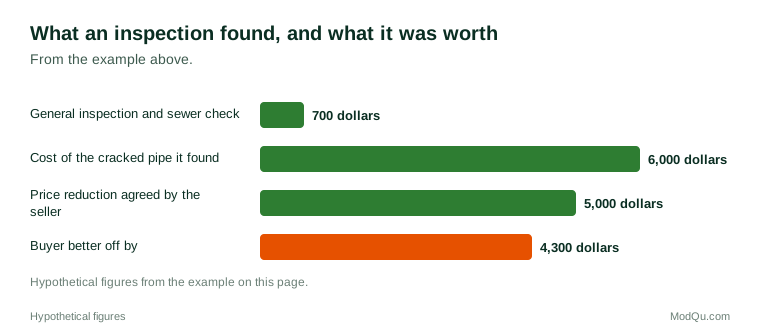
A buyer pays 500 dollars for a general inspection and 200 dollars for a sewer camera check on a 450,000-dollar home. The sewer check finds a cracked pipe that will cost 6,000 dollars to replace. The seller agrees to reduce the price by 5,000 dollars. After paying 700 dollars for inspections, the buyer is 4,300 dollars better off than if they had not inspected.
Figure 1 shows the money in that example.
How buyers use the results
After an inspection, buyers usually do one of several things:
- Go ahead as agreed, using the report to plan future repairs and maintenance;
- Negotiate a lower price or a credit towards repairs;
- Ask the seller to fix particular problems before the sale completes;
- Get quotes from contractors to understand the real cost of repairs;
- Withdraw from the purchase if the problems are serious and the contract allows it.
Example
A couple buying a 1960s flat learn from their survey that the building's shared roof needs replacing and that each owner will share the cost. They ask the building's management for the latest repair plans and financial statements, confirm the expected charge and decide to go ahead with a lower offer that reflects their share.
Common problems and disagreements
Inspections can lead to disappointment or disputes:
- problems found after moving in that the inspection missed, often because they were hidden;
- reports full of minor issues that make it hard to see what matters;
- sellers refusing to negotiate;
- buyers in competitive markets skipping inspections and later finding expensive defects;
- concern that an inspector recommended by an agent may not be fully independent;
- limited liability in inspection contracts.
Licensing of inspectors varies. Some countries, provinces or states require inspectors to be licensed or certified; others do not.
Trends and debates
Trends include pre-listing inspections paid for by sellers, inspections using drones and thermal cameras, and more attention to energy efficiency and climate risks such as flooding. Debates include whether inspections should be required, whether buyers should be able to waive them, and how to make reports easier to understand.
Questions that businesses want answered here include how many buyers have an inspection, what problems are found, what buyers pay, and whether the results change the price or the decision to buy.
Key terms
- Home inspectionA check of a home's condition by a professional before or during a purchase.
- Building surveyA detailed condition report on a property, the term used in some countries.
- ValuationAn estimate of a property's market value, often for a lender.
- Inspection conditionA clause that lets a buyer withdraw or renegotiate based on inspection results.
- DefectA fault or problem in a building that needs repair.
- Rising dampMoisture moving up through walls from the ground.
- RadonA natural radioactive gas that can build up in homes and is tested for in some regions.
- Pre-listing inspectionAn inspection paid for by the seller before putting a home on the market.
Full glossary: real estate appraisal terms on EditingTests.com.
Home inspections and surveys vocabulary test
How well do you know the language of this topic? Try 8 quick questions. Your score is shown straight away and is not saved.
What the home inspections and surveys survey asks
This survey is part of ModQu's Home and Property survey. The home inspections and surveys part takes about five minutes and covers:
- Whether you had an inspection or survey before buying your home, and what type.
- Why you did or did not have one.
- What problems the inspection found.
- What the inspection cost.
- Whether the results changed the price, the terms or your decision to buy.
- Whether problems appeared after you moved in that the inspection did not find.
After that you can choose to continue with other short parts of the Home and Property survey, such as buying a home or renting, or stop.
Ready to take part?
Your answers help show what people really think and do. Results are only ever reported as totals; no one can see your individual answers.
Start the surveyQuestions about this survey
Who can take part?
Adults who bought or plan to buy a home.
Do I have to give my name?
No. You may be asked for your age group, region and similar details so results can be broken down, but not your name. ModQu never asks for passwords, card numbers or account numbers.
How are the results used?
Answers are combined into totals and percentages and published in ModQu reports. Individual answers are never shown.
Is the vocabulary test part of the survey?
No. It is optional and separate, and your score is not stored.
Is a home inspection the same as a valuation?
No. A valuation or appraisal estimates what the property is worth, usually for a lender. An inspection or survey checks the property's condition and the repairs it needs.
Should new homes be inspected?
Many buyers of new homes also have an inspection, because new buildings can have defects too. Some countries have warranty schemes for new homes, with their own inspection and claim rules.