
Share your experience of repairing household items
Tell us whether you have had furniture or an appliance repaired, whether it was cheaper than replacing it and how easy it was to find a repairer. Your answers are combined with other people's and reported only as totals.
Start the furniture and appliance repair surveyAbout 5 minutes. No account needed. You can stop at any time.
What this topic covers
This topic covers the repair of household items that people expect to last for years:
- Large appliances: washing machines, dryers, refrigerators, freezers, dishwashers, ovens and cookers.
- Small appliances: vacuum cleaners, kettles, coffee machines, microwaves and food processors.
- Furniture: sofas, chairs, tables, beds, wardrobes and cabinets, including upholstery and wood repair.
- Other household items such as lamps, sewing machines and some electronics.
It looks at how often things break, whether people repair or replace them, what repairs cost, how people find repairers, and the barriers to repair.
Repair or replace: how people decide
When something breaks, people weigh several factors:
- Cost of repair compared with a new item: many people use an informal rule, such as not repairing if the repair costs more than half the price of a new one.
- Age of the item: older items are more often replaced, partly because people expect other parts to fail soon.
- Warranty: whether the item is still covered.
- Availability of parts and repairers.
- Time: how long the repair will take, and how long the household can manage without the item.
- Attachment: furniture with sentimental value or good quality is more often repaired.
- Environmental concern: avoiding waste.
- Efficiency: a new appliance may use less energy or water.
Example
A household's eight-year-old washing machine stops spinning. A repairer says a worn part needs replacing and quotes a price about a quarter of the cost of a new machine. The family repair it, reasoning that the machine has otherwise worked well and that a new one would take a week to arrive.
What repairs cost
Repair costs usually include a call-out or diagnosis fee, labour and parts. For large appliances, the call-out fee alone can be significant. Furniture repairs such as re-upholstering a sofa can cost a large share of the price of a new one, but may be worth it for well-made furniture.
Example (hypothetical figures)
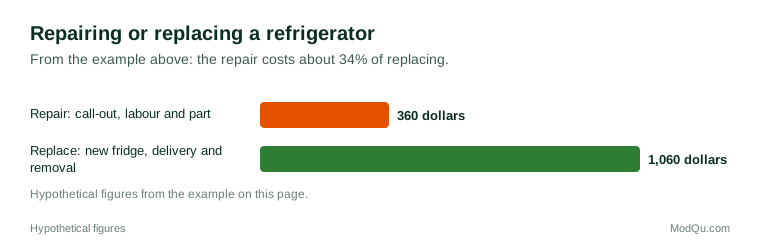
A refrigerator that cost 900 dollars five years ago stops cooling. The repair costs 90 dollars for the call-out, 120 dollars for labour and 150 dollars for a part: 360 dollars in total. A similar new refrigerator costs 1,000 dollars plus 60 dollars for delivery and removal of the old one, 1,060 dollars in total. The repair costs about 34% of replacing it.
Figure 1 compares the two costs in the example. Whether repair is the better choice also depends on how long the repaired fridge will last and how much more efficient a new one would be.
Finding a repairer
Many people say finding a repairer is the hardest part. Options include:
- The manufacturer's service network, especially during the warranty period;
- Independent repair shops and technicians;
- The retailer where the item was bought;
- Upholsterers, carpenters and furniture restorers;
- Repair cafés: free community events where volunteers help people repair items;
- Doing it yourself, with online videos, guides and spare parts.
In some places, especially smaller towns and rural areas, repairers for certain items are hard to find. In many cities in Africa, Asia and Latin America, repair is a large and visible part of the economy, with markets and street-side workshops repairing appliances, electronics and furniture.
What makes repair difficult
Common barriers to repair include:
- Spare parts that are expensive, hard to find or no longer made;
- Designs that are glued or sealed, making them hard to open;
- Repair information and diagnostic tools available only to authorized repairers;
- Software locks that stop replacement parts working;
- High labour costs compared with cheap new items;
- Long waiting times for repairers or parts;
- Uncertainty about whether the repair will last.
Example
A family's oven door glass cracks. The manufacturer no longer makes the part for that model, and an independent repairer cannot find a compatible one. The rest of the oven works perfectly, but they have to replace the whole oven. They say they were frustrated to throw away a working appliance because of one part.
Furniture repair and restoration
Furniture is often easier to repair than appliances, and many problems can be fixed with basic tools: loose joints, wobbly legs, broken drawer runners and worn finishes. Larger jobs include re-upholstering, replacing springs and cushions, and restoring wood. Some people repair or restore second-hand furniture to save money or for its quality and character.
Flat-pack furniture is often harder to repair well, because particle board can crumble and parts may not be sold separately, although some makers do sell spare parts.
Right to repair
"Right to repair" refers to laws and campaigns that aim to make products easier and cheaper to repair. Measures introduced or proposed in different places include:
- requiring manufacturers to supply spare parts for a set number of years;
- giving independent repairers and owners access to repair manuals and tools;
- designing products so they can be taken apart;
- repairability scores shown at the point of sale, as introduced in France;
- rules requiring sellers to offer repair under warranty in some cases.
The European Union, the United Kingdom, several US states and other jurisdictions have introduced rules covering some appliances and electronics. Supporters say these rules reduce waste and costs; some manufacturers raise concerns about safety, quality and intellectual property.
Trends and debates
Trends include the spread of repair cafés and community workshops, online spare parts and repair guides, extended warranties and service plans, and growing interest in second-hand and refurbished appliances. Debates include whether products are designed to last, whether repair should be made cheaper through tax reductions, as some countries have done, and how to train more repair technicians.
Questions that businesses want answered here include how often people repair rather than replace, what repairs cost, how easy it is to find repairers and what would make people repair more.
Key terms
- RepairFixing a broken item so it works again.
- Call-out feeA charge for a repairer to visit and diagnose a problem.
- Spare partA replacement component for a product.
- Right to repairLaws and campaigns to make products easier and cheaper to repair.
- Repair caféA free community event where volunteers help people repair items.
- Repairability scoreA rating showing how easy a product is to repair.
- UpholsteryThe padding, springs and fabric covering of furniture.
- Planned obsolescenceDesigning products to last a limited time, a practice critics say some makers follow.
Full glossary: appliance manufacturing terms on EditingTests.com.
Furniture and appliance repair vocabulary test
How well do you know the language of this topic? Try 8 quick questions. Your score is shown straight away and is not saved.
What the furniture and appliance repair survey asks
This survey is part of ModQu's Home and Property survey. The furniture and appliance repair part takes about five minutes and covers:
- Whether you have had furniture or an appliance repaired in the last year, and what it was.
- Whether you repaired it, replaced it, or tried to repair it yourself.
- What the repair cost, and whether it was cheaper than replacing.
- How easy it was to find a repairer or spare parts.
- What stopped you repairing items you replaced.
- Whether you have used a repair café or would like right-to-repair rules.
After that you can choose to continue with other short parts of the Home and Property survey, such as buying a home or renting, or stop.
Ready to take part?
Your answers help show what people really think and do. Results are only ever reported as totals; no one can see your individual answers.
Start the surveyQuestions about this survey
Who can take part?
Adults.
Do I have to give my name?
No. You may be asked for your age group, region and similar details so results can be broken down, but not your name. ModQu never asks for passwords, card numbers or account numbers.
How are the results used?
Answers are combined into totals and percentages and published in ModQu reports. Individual answers are never shown.
Is the vocabulary test part of the survey?
No. It is optional and separate, and your score is not stored.
Is it safe to repair appliances myself?
Simple tasks such as cleaning filters or replacing a door seal are often manageable. Work involving gas, mains electricity or refrigerant gas is usually advised, and in many places required, to be done by trained professionals.
How can I tell if a repairer is reliable?
People commonly check reviews, ask for a written quote before work starts, ask whether parts and labour come with a guarantee, and use repairers approved by the manufacturer for items under warranty.