
Share how you learned about money
Tell us how confident you feel about money and where you learned what you know. Your answers are combined with other people's and reported only as totals.
Start the financial literacy surveyAbout 5 minutes. No account needed. You can stop at any time.
What financial literacy means
Financial literacy is usually described as having the knowledge, skills and confidence to make good decisions about money. It goes beyond knowing facts. It includes being able to plan a budget, compare products, understand risk and resist pressure from sellers. Some organizations prefer the term financial capability or financial wellbeing, to stress behaviour and outcomes as well as knowledge.
International organizations and many governments run national strategies to improve financial literacy, and some include it in school curricula.
The basic ideas
Most definitions cover a set of core ideas:
- Budgeting: knowing what comes in and goes out, and planning for both.
- Interest: how interest is earned on savings and charged on debt.
- Compound interest: earning or paying interest on previous interest, which makes small differences grow over time.
- Inflation: rising prices reduce what money can buy.
- Risk and diversification: spreading money across different investments lowers the risk of losing a lot at once.
- Borrowing costs: understanding interest rates, fees and the total cost of credit.
- Protection: insurance, emergency savings and avoiding scams.
Example (hypothetical figures)
Two friends each save 100 a month. One starts at 25, the other at 35. Both stop at 65 and earn the same 5% a year. Because of compound interest, the friend who started ten years earlier ends with far more, even though they paid in only 12,000 more in total.
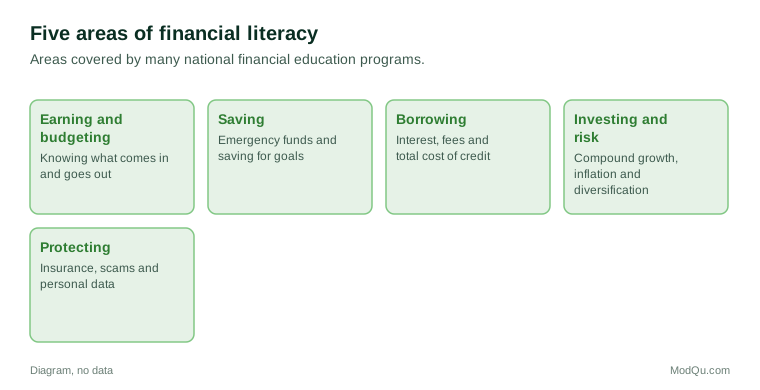
The figure below shows the five areas many financial literacy programs cover.
How it is measured
Researchers often measure financial literacy with a short set of questions about interest, inflation and risk. A widely used approach asks three or more multiple-choice questions, such as whether money in a savings account at 2% interest will buy more or less after a year if inflation is 3%. Studies in many countries using questions like these have found that a large share of adults cannot answer all of them correctly.
Surveys also ask people to rate their own knowledge. A common finding is that confidence and knowledge do not always match: some people rate themselves highly but answer questions wrongly, while others, often women and older adults in some studies, underrate their knowledge.
Where people learn about money
People learn about money from many sources:
- parents and family, often the earliest and most lasting influence;
- school, where financial education is taught in some places;
- employers, through pension and benefits information;
- banks and financial firms;
- websites, social media and video creators;
- friends and colleagues;
- trial and error, including mistakes.
Example
A young adult grew up in a household where money was never discussed. They take out a phone contract, a store card and an overdraft in their first year of work without reading the terms. After falling behind, a free debt advice service explains interest and minimum payments. They say it was the first time anyone had walked them through it.
Social media has become a major source, especially for younger people. It can make money topics more approachable, but advice is not always accurate or independent, and some content promotes risky products.
Why it matters
People with stronger financial literacy are, on average, more likely to save for emergencies and retirement, compare financial products, avoid high-cost debt and spot scams. The direction of cause and effect is debated, because income, education and life experience also play a part.
Low financial literacy is linked with paying more in fees and interest, holding too little in savings, and being more vulnerable to fraud. It can affect anyone, but the effects are often hardest for people with low incomes, who have less room for mistakes.
Financial literacy across life
Money skills matter at different points in life:
- Children and teenagers: pocket money, saving, the idea of earning.
- Young adults: first jobs, first accounts, student loans, renting, credit.
- Families: budgeting for children, housing, insurance.
- Mid-life: pensions, investments, caring for parents.
- Later life: drawing down savings, inheritance, avoiding scams.
Example
A couple in their sixties are offered a scheme by a caller promising guaranteed high returns. Their grandchild, who learned about investment scams in a school lesson, tells them that guaranteed high returns are a warning sign. They hang up and report the call.
Digital financial literacy
As banking, payments and investing move online, a newer idea is digital financial literacy: knowing how to use apps and online services safely, protect passwords and personal data, recognize fake websites and messages, and understand new products such as digital wallets and crypto-assets. People who are confident with traditional money matters may still struggle with these.
Money and mental health
Money and wellbeing are closely connected. Worry about bills or debt is a common source of stress, and stress can make it harder to plan, open letters or contact lenders, which can make money problems worse. People with mental health conditions may also find some financial tasks harder at certain times. Some banks and advice services now offer support for customers in vulnerable circumstances, such as extra time, a named contact, or the option to block certain kinds of spending. Surveys about financial literacy increasingly ask about money worries and wellbeing as well as knowledge.
What people disagree about
Some argue that financial education is the best way to improve money outcomes and should be taught to everyone. Others say education alone has limited effects and that simpler products, clearer rules and default options, such as automatic pension enrolment, help more. Many experts support both.
Questions that businesses want answered include how confident people feel, how they score on basic questions, where they learn about money, which topics they want to understand better, and whether they trust online sources.
Key terms
- Financial literacyThe knowledge and skills to make informed decisions about money.
- Financial capabilityThe ability to act on financial knowledge in daily life.
- Compound interestInterest earned or charged on previous interest as well as the original amount.
- InflationA general rise in prices that reduces what money can buy.
- DiversificationSpreading money across different investments to lower risk.
- Emergency fundSavings set aside for unexpected costs.
- BudgetA plan for income and spending over a period.
- Financial wellbeingFeeling secure and in control of one's finances now and in future.
Full glossary: consumer finance terms on EditingTests.com.
Financial literacy vocabulary test
How well do you know the language of this topic? Try 8 quick questions. Your score is shown straight away and is not saved.
What the financial literacy survey asks
This survey is part of ModQu's Money and Banking survey. The financial literacy part takes about five minutes and covers:
- How confident you feel about managing money and making financial decisions.
- A few short questions about interest, inflation and risk.
- Where you learned most of what you know about money.
- Which sources you trust for money information today.
- Which money topics you would like to understand better.
- Whether you have had financial education at school or work.
After that you can choose to continue with other short parts of the Money and Banking survey, such as everyday banking or digital payments and wallets, or stop.
Ready to take part?
Your answers help show what people really think and do. Results are only ever reported as totals; no one can see your individual answers.
Start the surveyQuestions about this survey
Who can take part?
Adults.
Do I have to give my name?
No. You may be asked for your age group, region and similar details so results can be broken down, but not your name. ModQu never asks for passwords, card numbers or account numbers.
How are the results used?
Answers are combined into totals and percentages and published in ModQu reports. Individual answers are never shown.
Is the vocabulary test part of the survey?
No. It is optional and separate, and your score is not stored.
Is financial literacy taught in schools?
In some countries and regions it is part of the curriculum; in others it is optional or not taught. Coverage and quality vary widely.
How can I test my own financial literacy?
Many governments and consumer bodies publish short free quizzes on interest, inflation and risk, similar to the vocabulary test on this page.