
Tell us what you think about crypto
Tell us whether you own cryptocurrency, how you bought it and how risky you think it is. Your answers are combined with other people's and reported only as totals.
Start the cryptocurrency surveyAbout 5 minutes. No account needed. You can stop at any time.
What cryptocurrency is
A cryptocurrency is a digital asset that is recorded on a blockchain, a shared ledger maintained by a network of computers rather than by a single bank or government. Ownership is controlled by private keys: long secret codes that prove who can move the coins. Bitcoin, launched in 2009, was the first widely used cryptocurrency. Thousands of others now exist.
Cryptocurrencies are used, or promoted, for several purposes:
- as an investment that people hope will rise in value;
- as a means of payment, especially across borders;
- as a store of value that is not controlled by a central bank;
- as the base for other applications, such as decentralized finance and digital collectibles.
Stablecoins are a special type of cryptocurrency designed to keep a steady value, usually tied to a currency such as the US dollar.
How people buy cryptocurrency
Most people buy through a cryptocurrency exchange or trading platform, an online service that converts regular money into cryptocurrency. Others buy through:
- investment funds and exchange-traded funds that hold cryptocurrency, bought through a regular brokerage account;
- payment apps that offer crypto purchases alongside other services;
- crypto ATMs, which accept cash or cards;
- directly from other people, which carries more risk.
In Canada, trading platforms that offer crypto to the public are expected to register with securities regulators, and investment funds holding crypto are regulated like other funds. Buyers are encouraged to check whether a platform is registered before using it.
Example
A 34-year-old buys a small amount of cryptocurrency through a crypto fund in their existing online brokerage account. They chose a fund rather than an exchange because they did not want to manage private keys and wanted their holdings in the same place as their other investments.
Wallets and keeping crypto safe
Cryptocurrency can be held in different ways:
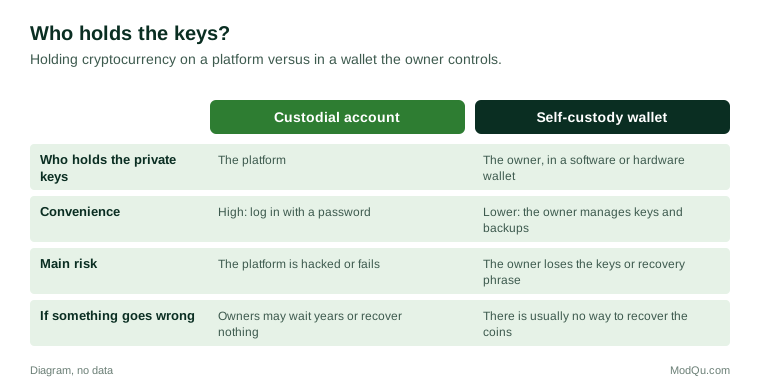
- Custodial accounts: the platform holds the private keys for the customer. This is convenient, but the customer depends on the platform staying secure and solvent.
- Software wallets: apps on a phone or computer where the user controls the keys.
- Hardware wallets: small devices that store keys offline.
Self-custody gives more control but more responsibility. If a person loses their keys or recovery phrase, there is usually no way to recover the coins. Several platforms have failed over the years, and customers of some failed platforms waited a long time to recover part of their money, or recovered nothing.
Why people buy
People give many reasons for owning cryptocurrency:
- hope of high returns;
- curiosity, or not wanting to miss out;
- belief in the technology;
- distrust of banks and governments;
- a wish to diversify investments;
- sending money abroad.
Most owners hold small amounts relative to their other savings, but some put in large sums. Age, gender, income and trust in institutions are often linked with ownership in research on the subject.
Example (hypothetical figures)
A student puts $500 into a cryptocurrency after seeing friends talk about gains. Within three months it is worth $900. They do not sell, and six months later it is worth $300. They decide to keep it as a lesson but not to add more money.
Why people stay away
Many people choose not to buy. Common reasons include:
- prices that rise and fall sharply;
- not understanding how it works;
- fear of scams and hacks;
- a view that it has no real value;
- concern about the energy used by some networks;
- uncertainty about regulation and tax.
Some people who once owned cryptocurrency stopped after losses or after a platform failure.
Scams and fraud
Cryptocurrency is often involved in scams, partly because payments are hard to reverse. Common patterns include:
- investment scams promising guaranteed high returns;
- romance scams, where a contact met online persuades the victim to invest;
- impersonation scams, where people are told to pay a fake bill or "fine" in cryptocurrency or through a crypto ATM;
- fake platforms and apps that show false profits and block withdrawals.
Police and consumer protection agencies regularly warn that no legitimate government agency asks for payment in cryptocurrency.
Example
An older adult receives a call from someone claiming to be from their bank's fraud team. The caller says their account is compromised and asks them to move savings into a crypto ATM "for safekeeping". A cashier at the store notices the large cash withdrawal and the nervous customer, and asks a few questions that stop the transfer.
Paying with cryptocurrency
Although cryptocurrency was first described as electronic cash, few people use it to buy everyday things. Prices that change from hour to hour make it awkward to spend: a coffee bought with crypto could cost much more or less in dollars a week later. Transaction fees and waiting times on some networks add to the problem. Some merchants accept cryptocurrency, often through a payment processor that converts it to regular currency straight away, and some cards let holders spend crypto balances at ordinary stores.
Where cryptocurrency is used for payments, it is most often for cross-border transfers, online services, and payments between people who already hold it. Stablecoins are used more than other coins for payments because their value is meant to stay steady.
Example
A freelance translator is paid by an overseas client in a stablecoin because it arrives faster than a bank wire. They convert it to Canadian dollars on a registered platform the same day, so they are not exposed to price changes.
Taxes and record keeping
In Canada, the CRA treats cryptocurrency as a commodity for tax purposes. Selling, trading or spending it can lead to a capital gain or loss, or to business income for people who trade frequently. Many owners do not keep good records of what they paid and when, which makes calculating gains difficult. Some platforms provide transaction reports, and specialist software can help.
What businesses and policy makers want to know
Banks, investment firms, payment companies and regulators all study public attitudes to cryptocurrency. Questions they want answered include how many people own it, how much they hold, where they bought it, whether they understand the risks, and whether they would use it to pay for everyday things.
Key terms
- CryptocurrencyA digital asset recorded on a blockchain rather than by a bank.
- BlockchainA shared digital ledger kept by a network of computers.
- Private keyA secret code that proves ownership and allows coins to be moved.
- WalletSoftware or a device that stores private keys.
- ExchangeAn online platform for buying and selling cryptocurrency.
- StablecoinA cryptocurrency designed to keep a steady value, often tied to a currency.
- Custodial accountAn account where a platform holds the private keys for the customer.
- Recovery phraseA list of words used to restore access to a wallet.
Full glossary: cryptocurrency exchanges terms on EditingTests.com.
Cryptocurrency vocabulary test
How well do you know the language of this topic? Try 8 quick questions. Your score is shown straight away and is not saved.
What the cryptocurrency survey asks
This survey is part of ModQu's Money and Banking survey. The cryptocurrency part takes about five minutes and covers:
- Whether you own, have owned or have considered buying cryptocurrency.
- Where you bought it, and how you hold it.
- Why you bought it, or why you have not.
- How risky you think cryptocurrency is compared with other investments.
- Whether you have seen or experienced a crypto-related scam.
- Whether you would use cryptocurrency to pay for everyday things.
After that you can choose to continue with other short parts of the Money and Banking survey, such as everyday banking or digital payments and wallets, or stop.
Ready to take part?
Your answers help show what people really think and do. Results are only ever reported as totals; no one can see your individual answers.
Start the surveyQuestions about this survey
Who can take part?
Adults.
Do I have to give my name?
No. You may be asked for your age group, region and similar details so results can be broken down, but not your name. ModQu never asks for passwords, card numbers or account numbers.
How are the results used?
Answers are combined into totals and percentages and published in ModQu reports. Individual answers are never shown.
Is the vocabulary test part of the survey?
No. It is optional and separate, and your score is not stored.