
Tell us how you manage money
Tell us how you budget, what you owe and how you feel about your finances. Your answers are combined with other people's and reported only as totals.
Start the budgeting and household debt surveyAbout 5 minutes. No account needed. You can stop at any time.
What budgeting means in practice
A budget is a plan for how money coming in will be used. For some households that means a detailed spreadsheet updated every week. For others it means a rough idea of what the bills are and a habit of checking the bank balance before spending. Both are forms of budgeting.
Most budgets sort spending into a few groups:
- Fixed costs that are the same each month, such as rent, mortgage payments, insurance and phone plans.
- Variable essentials such as groceries, fuel, utilities and medicine.
- Debt payments on credit cards, loans and lines of credit.
- Savings for emergencies and goals.
- Discretionary spending such as eating out, entertainment and gifts.
The aim is not to remove every treat. It is to make sure essentials and debt payments are covered, and that spending matches what the household values most.
Common budgeting methods
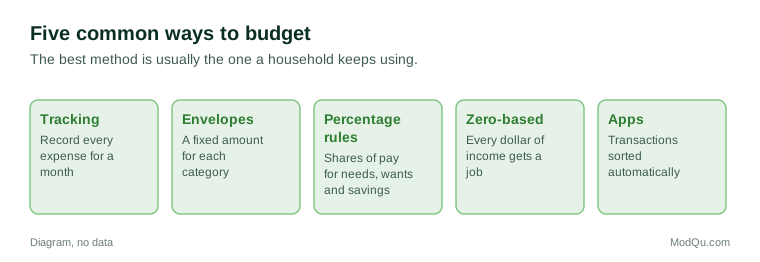
People use many methods, and the best one is usually the one they keep using:
- Tracking: recording every expense for a month to see where money goes.
- The envelope method: setting a fixed amount for each category, sometimes in cash envelopes, sometimes in separate accounts.
- Percentage rules: dividing take-home pay into shares for needs, wants and savings.
- Zero-based budgeting: giving every dollar of income a job, so income minus planned spending equals zero.
- Apps: banking apps and budgeting apps that sort transactions automatically.
Example
A couple who argued about money each month try tracking every purchase for 30 days. They discover they spend more on takeout and delivery fees than on their car payment. Instead of cutting takeout entirely, they agree on a fixed weekly amount and use the difference to pay down a credit card.
Why household debt builds up
Debt builds up for many reasons, and few of them are simply about spending too much:
- Income shocks: job loss, reduced hours, illness or separation.
- Large unexpected costs: car repairs, dental work, a family emergency.
- Rising essential costs: rent, groceries and energy increasing faster than income.
- Irregular income: gig work, commission and seasonal jobs make planning hard.
- Easy access to credit: card offers, store financing and instalment plans that make small purchases add up.
Once a balance carries interest, it can grow even without new spending, especially if only minimum payments are made.
Example (hypothetical figures)
A household spends $200 a month more than it earns for a year, covering the gap with a credit card at 20% interest. After 12 months the balance is about $2,400 plus interest. If the family then pays $100 a month, interest takes about $40 of each payment at first, and repayment takes more than two and a half years.
Money stress and how it affects people
Money worries are one of the most common sources of stress. People describe losing sleep, avoiding opening bills, arguing with partners and feeling ashamed to ask for help. Stress can make good decisions harder: some people avoid looking at accounts altogether, which can lead to missed payments and fees.
Surveys of household finances often ask about feelings as well as numbers, because two households with the same debt can feel very differently about it and act differently as a result.
Strategies people use to pay down debt
Common approaches include:
- The avalanche method: paying extra on the debt with the highest interest rate first, which saves the most money.
- The snowball method: paying off the smallest balance first, which gives quick wins and motivation.
- Consolidation: moving several debts to one lower-rate loan or line of credit.
- Balance transfers: moving a card balance to a card with a low promotional rate, usually with a fee.
- Negotiation: asking a lender for a lower rate or a payment plan.
Example
A single parent with four debts uses the snowball method. They pay off a $400 store card first, then a $900 line of credit. Seeing two accounts closed keeps them motivated to tackle the larger credit card balance, even though the avalanche method would have saved a little more interest.
Where people turn for help
When debts become hard to manage, people turn to different sources:
- family and friends;
- their bank or lender;
- non-profit credit counselling agencies, which can set up debt management plans;
- online information and community forums;
- in Canada, Licensed Insolvency Trustees, who can arrange consumer proposals or bankruptcy when debts cannot be repaid.
Many people wait a long time before asking for help, often because they feel embarrassed or do not know what options exist. Others are drawn to costly options, such as high-interest short-term loans, because they are quick and easy to get.
Emergency savings
An emergency fund is money set aside for unexpected costs. Even a small fund can stop a car repair from turning into credit card debt. Many households have little or no emergency savings, and building one competes with paying off existing debt. Some people split extra money between the two, so they make progress on debt while building a cushion.
Teaching children about money
Many parents want their children to grow up comfortable with money but are unsure how to teach it. Common approaches include giving an allowance, opening a youth savings account, letting children make small spending choices and talking openly about family decisions such as saving for a holiday. Schools in several provinces include financial literacy in the curriculum. Questions that banks, educators and policy makers ask include how people learned about money and what they wish they had been taught.
Key terms
- BudgetA plan for how income will be spent and saved.
- Fixed costsExpenses that stay the same each month, such as rent.
- Discretionary spendingSpending on wants rather than needs.
- Emergency fundSavings set aside for unexpected costs.
- Avalanche methodPaying off the highest-interest debt first.
- Snowball methodPaying off the smallest debt first.
- Debt management planAn arrangement through a credit counsellor to repay debts in one monthly payment.
- Consumer proposalA legal agreement in Canada to repay part of what is owed, arranged by a Licensed Insolvency Trustee.
Full glossary: debt management terms on EditingTests.com.
Budgeting and household debt vocabulary test
How well do you know the language of this topic? Try 8 quick questions. Your score is shown straight away and is not saved.
What the budgeting and household debt survey asks
This survey is part of ModQu's Money and Banking survey. The budgeting and household debt part takes about five minutes and covers:
- Whether your household follows a budget, and how you keep track of spending.
- Which kinds of debt your household has, if any.
- How stressed you feel about money and debt.
- What you have done to reduce debt or spending in the last year.
- Whether you have emergency savings.
- Where you would turn for help with debt, and whether you have done so.
After that you can choose to continue with other short parts of the Money and Banking survey, such as everyday banking or digital payments and wallets, or stop.
Ready to take part?
Your answers help show what people really think and do. Results are only ever reported as totals; no one can see your individual answers.
Start the surveyQuestions about this survey
Who can take part?
Adults who manage household money.
Do I have to give my name?
No. You may be asked for your age group, region and similar details so results can be broken down, but not your name. ModQu never asks for passwords, card numbers or account numbers.
How are the results used?
Answers are combined into totals and percentages and published in ModQu reports. Individual answers are never shown.
Is the vocabulary test part of the survey?
No. It is optional and separate, and your score is not stored.
Will you ask how much I owe exactly?
Some questions ask for ranges, such as "under $5,000". You can skip any question you prefer not to answer.
I am struggling with debt right now. Where can I get help?
In Canada, non-profit credit counselling agencies and Licensed Insolvency Trustees offer free first consultations. Your bank can also discuss payment options. ModQu does not give financial advice.