
Tell us how you send money abroad
Tell us how often you send or receive money from other countries, which service you use and what matters most. Your answers are combined with other people's and reported only as totals.
Start the sending money abroad surveyAbout 5 minutes. No account needed. You can stop at any time.
Who sends money abroad and why
International money transfers are a regular part of life for many households. The most common reasons are:
- supporting family in another country with living costs, school fees or medical bills;
- paying tuition and rent for a student studying abroad;
- buying or maintaining property in another country;
- paying for services from overseas freelancers or suppliers;
- gifts for weddings, births and holidays;
- moving savings when emigrating or returning home.
Money sent home by migrants to family is often called a remittance. For many families and some whole countries, remittances are an important source of income.
The main ways to send money
People can choose from several types of service:
- Banks, usually by international wire transfer. Banks are trusted and familiar, but fees and exchange rate margins can be higher.
- Money transfer operators, companies that specialize in sending money abroad. Many have agent locations where cash can be sent and collected.
- Online transfer services and apps, which often show the fee and exchange rate upfront and send money to bank accounts or mobile wallets.
- Mobile money, used widely in some countries where recipients may not have a bank account.
- Informal channels, such as asking a traveller to carry cash, which can be cheap but riskier.
Example
A nurse who moved to Canada sends money to her parents every month. She used her bank's wire service for the first year. A colleague shows her an online service that delivers money to her parents' mobile wallet within minutes for a lower total cost. She switches but keeps the bank option for large transfers.
Understanding the real cost
The cost of a transfer has two parts:
- the transfer fee, which is usually shown clearly;
- the exchange rate margin, the difference between the rate the service uses and the mid-market rate, which is often less visible.
A service that advertises "no fee" may still earn money through a less favourable exchange rate. Comparing the amount the recipient actually receives is the most reliable way to compare services.
Example (hypothetical figures)
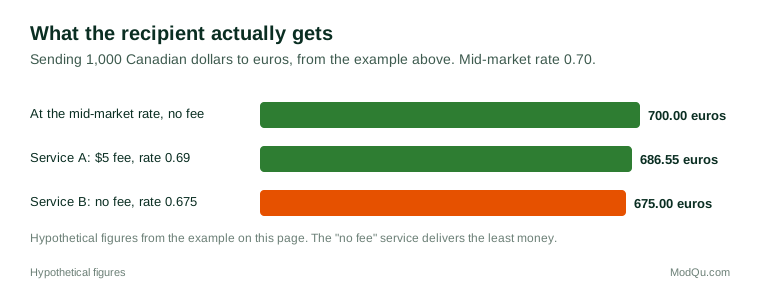
A sender wants to send 1,000 Canadian dollars. The mid-market rate is 1 CAD = 0.70 euros. Service A charges a $5 fee and uses a rate of 0.69, so the recipient gets (1,000 - 5) x 0.69 = 686.55 euros. Service B charges no fee but uses 0.675, so the recipient gets 675 euros. The "no fee" service costs more.
Speed, convenience and how money is received
People weigh speed and convenience alongside cost. Options for the person receiving the money include:
- deposit into a bank account;
- cash pickup at an agent location;
- deposit into a mobile wallet;
- home delivery in some countries.
The best option depends on where the recipient lives and what they can access. In rural areas, cash pickup or mobile money may be the only practical choices.
Trust and safety
Trust matters more than usual because transfers are hard to reverse once sent. People look for services that are well known, regulated and recommended by people they know. In Canada, money services businesses must register with FINTRAC, the federal agency that oversees anti-money laundering rules, and some provinces have additional rules.
Common risks include sending money to the wrong account details, fraud by people posing as relatives, and scams that ask for payment by transfer for goods that never arrive.
Example
A grandfather receives a message from someone claiming to be his grandson studying overseas, saying he needs money urgently for a hospital bill. He calls his grandson's usual number first and finds the message was a scam.
Identification and limits
Transfer services must check the identity of their customers, especially for larger amounts. People may be asked for photo ID, proof of address and sometimes the source of the funds or the purpose of the transfer. These checks can feel intrusive, but they are required by anti-money laundering rules. Daily and monthly limits also apply, and they vary between services.
How people choose and switch services
Many senders stay with one service for years because it is familiar and their family knows how to collect the money. Things that make people switch include:
- a better rate or lower fee;
- a recommendation from family or friends;
- a bad experience, such as a delayed or lost transfer;
- the recipient asking for a different method;
- a promotion for new customers.
Questions that banks and transfer companies want answered include how often people send money, how much, to which countries, how they compare costs and what would make them change provider.
Large transfers and timing
For large amounts, such as a home purchase, tuition for a full year or moving life savings, small differences in the exchange rate matter much more. A difference of one cent per dollar on $50,000 is $500. People making large transfers often:
- compare several providers and ask banks whether a better rate is available for large amounts;
- split the transfer into several parts over weeks or months to reduce the effect of rate changes;
- use a rate alert or a forward contract offered by some specialist providers, which fixes a rate for a future date;
- check transfer limits and documents needed well before the deadline.
Timing can also matter for regular senders. Some people send money when the rate looks favourable, while others send on the same day each month regardless.
Example (hypothetical figures)
A family must pay $40,000 of university fees overseas in August. Instead of sending it all at once, they send $10,000 a month from May to August. The average rate they receive is close to the four-month average, so they avoid the risk of sending everything on a day when the rate is poor.
Receiving money from abroad
The same choices apply in reverse for people who receive money from other countries, such as students supported by family, retirees with pensions from another country, and freelancers paid by overseas clients. Receivers care about the fees their own bank charges for incoming wires, how long funds take to arrive, and the exchange rate applied when foreign currency is converted to Canadian dollars.
Key terms
- RemittanceMoney sent by a migrant to family or friends in their home country.
- Exchange rateThe price of one currency in terms of another.
- Mid-market rateThe midpoint between buying and selling rates in currency markets.
- Exchange rate marginThe difference between the rate a service uses and the mid-market rate.
- Wire transferAn electronic transfer of money between banks.
- Cash pickupCollecting a transfer in cash at an agent location.
- Money services businessA business that transfers money or exchanges currency, subject to registration rules.
- Mobile moneyA service that stores and transfers money using a mobile phone account.
Full glossary: foreign exchange terms on EditingTests.com.
Sending money abroad vocabulary test
How well do you know the language of this topic? Try 8 quick questions. Your score is shown straight away and is not saved.
What the sending money abroad survey asks
This survey is part of ModQu's Money and Banking survey. The sending money abroad part takes about five minutes and covers:
- How often you send or receive money from another country, and to or from which regions.
- Which service you use and why you chose it.
- What matters most to you: fee, exchange rate, speed or convenience.
- How you compare costs between services.
- Any problems you have had, such as delays, errors or scams.
- What would make you switch to another service.
After that you can choose to continue with other short parts of the Money and Banking survey, such as everyday banking or digital payments and wallets, or stop.
Ready to take part?
Your answers help show what people really think and do. Results are only ever reported as totals; no one can see your individual answers.
Start the surveyQuestions about this survey
Who can take part?
Adults who send or receive money across borders.
Do I have to give my name?
No. You may be asked for your age group, region and similar details so results can be broken down, but not your name. ModQu never asks for passwords, card numbers or account numbers.
How are the results used?
Answers are combined into totals and percentages and published in ModQu reports. Individual answers are never shown.
Is the vocabulary test part of the survey?
No. It is optional and separate, and your score is not stored.