
Tell us about your plans
Tell us whether you have a will and powers of attorney, how you made them and what has held you back. Your answers are combined with other people's and reported only as totals.
Start the wills and estate planning surveyAbout 5 minutes. No account needed. You can stop at any time.
What estate planning covers
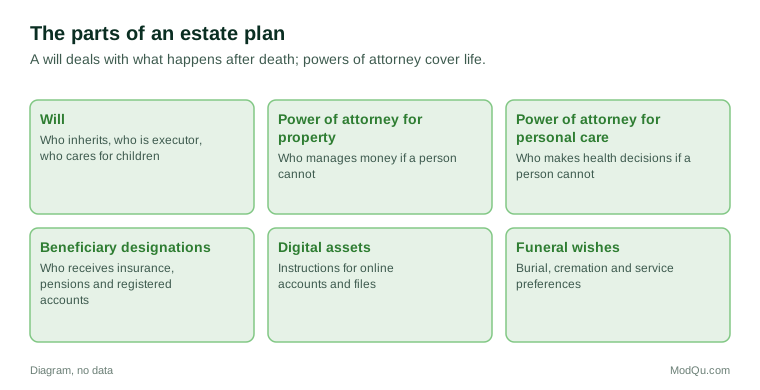
Estate planning means deciding what will happen to your money, property and responsibilities if you die or become unable to make decisions. It usually includes:
- a will, which says who receives your property and who will manage your estate;
- powers of attorney, which name someone to make decisions for you while you are alive but unable to act, for financial matters and for personal care or health;
- beneficiary designations on registered accounts, pensions and life insurance;
- guardianship wishes for children under 18;
- funeral wishes and, for some people, organ donation decisions.
The words used vary by province and country. In some provinces a health care document is called a representation agreement, a personal directive or a mandate.
What a will does
A will names:
- an executor (sometimes called an estate trustee or liquidator), who gathers the assets, pays debts and taxes, and distributes what is left;
- the beneficiaries, who receive property or money;
- guardians for minor children;
- any trusts, for example to hold money for children until they reach a certain age.
For a will to be valid it must meet the legal requirements of the province or state, such as being signed in front of witnesses. Some provinces also accept handwritten wills, called holograph wills, under certain conditions.
Example
A couple in their thirties with two young children make wills after their second child is born. Their main concern is not money but who would raise the children. Choosing guardians takes them several weeks of discussion; signing the wills takes one appointment.
What happens without a will
When someone dies without a valid will, they are said to have died intestate. Provincial or state law then decides who inherits, usually in a fixed order: spouse, children, parents, siblings and more distant relatives. The rules may not match what the person would have wanted. For example, in many places an unmarried partner may have fewer rights than a married spouse, and close friends or charities receive nothing.
A court must also appoint someone to administer the estate, which can take longer and cost more than when an executor is named in a will.
How people make a will
People make wills in several ways:
- with a lawyer, or a notary in Quebec and British Columbia, often for a fixed fee for simple wills;
- through online will services, which guide users through questions and produce documents to print and sign;
- with will kits bought in stores;
- by hand, where holograph wills are accepted.
Cost, complexity and trust all affect the choice. People with businesses, blended families, property in more than one country or family members with disabilities are more likely to need a lawyer's advice.
Example (hypothetical figures)
A retired widow compares options. An online service costs about $100 for a will and powers of attorney. A local lawyer quotes $600 for the same documents. Because she owns a cottage that she wants to leave to two children in a particular way, she chooses the lawyer, so she can ask questions about the cottage and taxes.
Why people put it off
Common reasons people give for not having a will include:
- "I do not have enough to need one";
- not wanting to think about death or illness;
- not knowing how to start or how much it costs;
- family disagreements they would rather avoid;
- thinking they are too young;
- simply never getting round to it.
Life events often prompt action: marriage, a new baby, buying a home, a diagnosis, a parent's death, or travel.
Keeping a will up to date
A will reflects life at the time it was written. Events that may make an update necessary include marriage or separation, the birth of children or grandchildren, the death of a beneficiary or executor, moving to another province or country, and major changes in property or savings. In some provinces, marriage can revoke an existing will, so a new one is needed.
Example
A man made a will at 30 naming his brother as executor. Twenty years later, he has remarried, has two stepchildren and his brother has moved overseas. Reviewing the will, he realizes it no longer reflects anyone he wants to provide for.
Powers of attorney and incapacity
Planning for illness or injury is as important as planning for death. Without a power of attorney, family members may have to apply to a court or a public guardian before they can manage a person's money or make health decisions. People who are caring for ageing parents often discover this when it is too late for the parent to sign documents.
Digital assets and online accounts
More of what people own and manage now lives online: bank and investment accounts with no paper statements, email, social media profiles, photo libraries, loyalty points, domain names and cryptocurrency. Executors may not know these accounts exist, and access can be difficult without passwords or the provider's cooperation.
Estate planning increasingly includes:
- a list of important online accounts, kept somewhere safe and updated from time to time;
- instructions about what should happen to social media profiles and photos;
- use of features some providers offer to name a legacy contact;
- a password manager with an emergency access option.
Example
After her father's death, a daughter knows he paid all his bills online but cannot find a list of accounts. It takes several months of reading bank statements to identify his subscriptions, utilities and a small online investment account.
Talking to family
Many estate disputes start because family members did not know what was planned or why. Some people hold a family meeting to explain their choices, introduce the executor and say where documents are kept. Others prefer to keep matters private. Lawyers often suggest at least telling the executor where the will is and how to reach the lawyer or service that prepared it.
Key terms
- WillA legal document saying who receives your property after you die.
- ExecutorThe person named in a will to manage and distribute the estate.
- BeneficiaryA person or organization that receives property from an estate.
- IntestateDying without a valid will.
- Power of attorneyA document naming someone to act for you if you cannot.
- ProbateThe court process that confirms a will and the executor's authority.
- Holograph willA will written entirely by hand by the person making it.
- EstateEverything a person owns at death, minus what they owe.
Full glossary: estate planning terms on EditingTests.com.
Wills and estate planning vocabulary test
How well do you know the language of this topic? Try 8 quick questions. Your score is shown straight away and is not saved.
What the wills and estate planning survey asks
This survey is part of ModQu's Money and Banking survey. The wills and estate planning part takes about five minutes and covers:
- Whether you have a will, and when it was last updated.
- Whether you have powers of attorney for finances and for health care.
- How you made your will: a lawyer or notary, an online service, a kit or by hand.
- What it cost, and whether you thought it was good value.
- If you have no will, what has held you back.
- Whether you have talked to family about your plans.
After that you can choose to continue with other short parts of the Money and Banking survey, such as everyday banking or digital payments and wallets, or stop.
Ready to take part?
Your answers help show what people really think and do. Results are only ever reported as totals; no one can see your individual answers.
Start the surveyQuestions about this survey
Who can take part?
Adults aged 30 and over.
Do I have to give my name?
No. You may be asked for your age group, region and similar details so results can be broken down, but not your name. ModQu never asks for passwords, card numbers or account numbers.
How are the results used?
Answers are combined into totals and percentages and published in ModQu reports. Individual answers are never shown.
Is the vocabulary test part of the survey?
No. It is optional and separate, and your score is not stored.
Will you ask what is in my will?
No. The survey asks whether you have documents and how you made them, not their contents.